

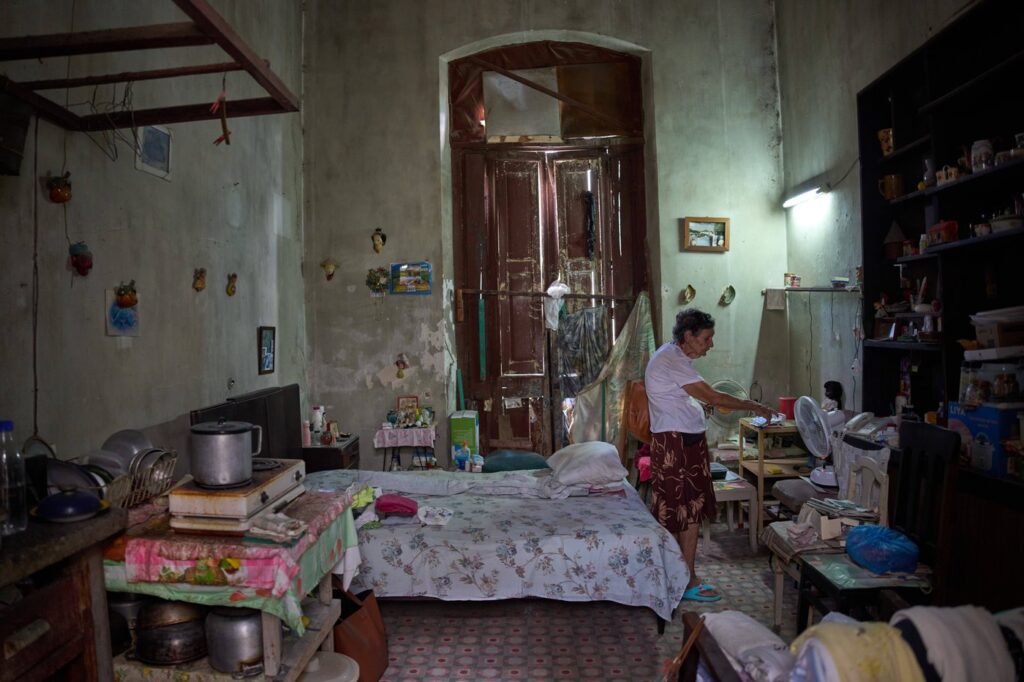
HAVANA (AP) – In Old Havana, a group of elderly residents recently gathered at the Church of the Holy Spirit for a modest but essential meal consisting of ground meat, rice, red beans, and crackers topped with mayonnaise, all accompanied by a strong cup of Cuban coffee. They began their lunch with a traditional prayer, seeking blessings for their meal, as part of a routine that takes place three times a week in the church’s dining hall.
Among the nearly 50 participants is 84-year-old Carmen Casado, a retired chemical engineer. Casado, who has a monthly pension of 2,000 Cuban pesos (approximately $4 at the informal exchange rate), lives alone without children and does not receive remittances from abroad. She emphasizes the importance of these church meals as a vital supplement to the minimal rations she receives from state-run stores, primarily bread, rice, and beans.
Casado describes the meals as a "lifeline" for retirees coping with small pensions, noting, "What we get from the bodegas alone is not enough." The elderly population in Cuba is among the hardest hit by the severe economic crisis exacerbated by an oil embargo imposed by former U.S. President Donald Trump at the beginning of the year. Most of these seniors are former government employees, including teachers, doctors, and lawyers, with pensions that typically fall below $10 a month. They face not only shrinking subsidies for essential goods but also the loneliness resulting from the ongoing migration of the younger population.
Carmen Casado and her peers have witnessed the island's major historical events, from the Bay of Pigs invasion to President Barack Obama’s diplomatic thaw with Raúl Castro in 2016. Now, their resilience is tested as they grapple with the latest crisis, resorting to selling cigarettes on the streets, waiting in line for basic food supplies, and relying on charitable meals offered by churches and state institutions.
Casado walks the four blocks back to her home after lunch, a second-floor apartment in a dilapidated 19th-century building. Born in 1942, she came of age during the Cuban Revolution led by Fidel Castro. Her life encompasses the island’s pivotal moments, including the 1962 Missile Crisis and the extensive subsidies provided by the Soviet Union during the 1970s and 80s. Despite the harsh economic reality, Casado expresses a deep-rooted commitment to her home, stating, "This is our life; we were born and raised here."
Even before the recent economic downturn and the exodus of nearly 1.5 million people over the last five years, which has reduced the island's population from 11.1 million to 9.7 million, Cuba had one of the oldest populations in Latin America. As high life expectancy and low birth rates contribute to this demographic shift, projections indicate that, by the end of 2024, nearly 26% of the Cuban population will be aged 60 or older—almost double the regional average of 14.2%.
The visible impact of the crisis and youth emigration is evident on the streets, where elderly individuals often navigate their daily lives in solitude. Many can be seen searching for food scraps or standing in line for the meager allocations guaranteed by the ration book, which includes only basic subsidized foods. In response to the increasing difficulties faced by elderly citizens, the Cuban government has recently permitted private entrepreneurs to provide elder care services—marking a noteworthy departure from the previous model of total state control.
Despite her circumstances, Casado feels fortunate. She manages her household chores independently and has only a minor blood pressure medication, which is still available at state pharmacies. Her mental acuity remains sharp, and she continues to maintain her faith in the government, attributing the nation’s struggles to external pressures, particularly from the United States. “We’re doing everything we can here to move the country forward,” she insists, identifying the U.S. as a significant adversary in their quest for progress.








