

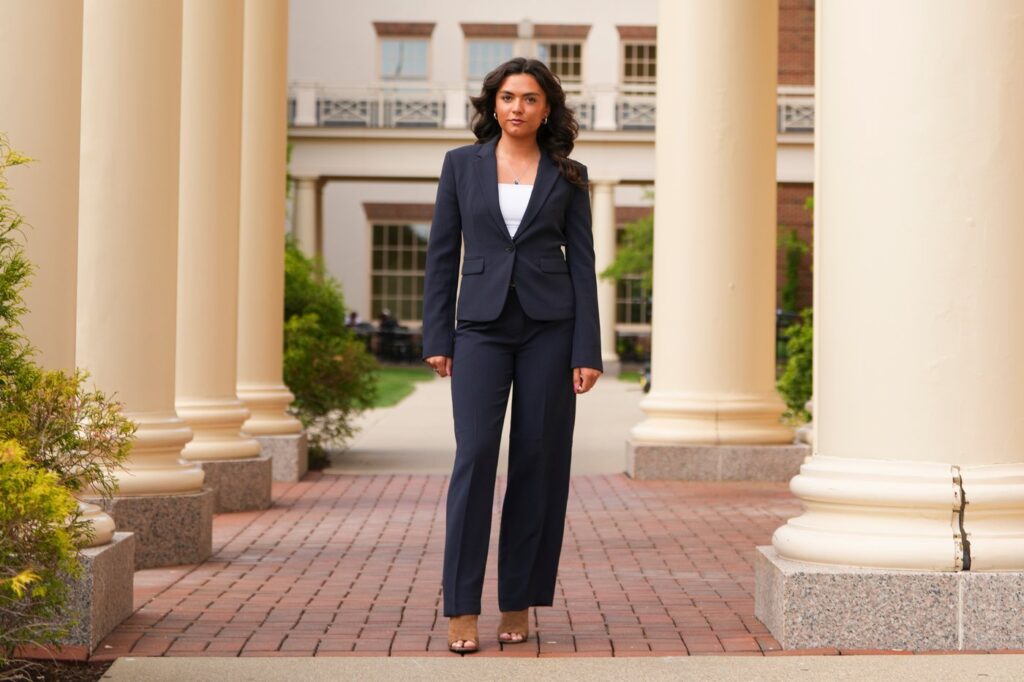
Two years ago, Josephine Timperman, a student at Miami University in Ohio, started her college journey with a plan to major in business analytics. Her goal was to acquire niche skills that would enhance her resume and increase her chances of securing a good job after graduation. However, the rapid rise of artificial intelligence (AI) has complicated these career considerations. Timperman expressed concerns that the fundamental skills she was learning in statistical analysis and coding could soon be automated, leading to fears among students about entry-level jobs being replaced by AI.
Recently, Timperman decided to switch her major to marketing, believing that focusing on critical thinking and interpersonal skills would better prepare her for the job market. She emphasized the importance of human qualities such as communication and relationship-building, which, in her view, cannot be replicated by AI. Despite her change in direction, Timperman plans to retain business analytics as a minor and pursue a one-year master’s degree in the subject.
The sentiment among college students today is one of uncertainty as they try to choose majors that they consider "AI-proof." A 2025 poll by the Institute of Politics at the Harvard Kennedy School revealed that approximately 70% of college students regard AI as a threat to their job prospects. Furthermore, a Gallup poll highlighted increasing concerns among U.S. workers about being displaced by technological advancements.
This apprehension appears to be especially pronounced among students pursuing technology and vocational degrees. Many feel the pressure to develop expertise in AI while simultaneously fearing that they may be replaced by these very technologies. A recent Quinnipiac poll indicated that a vast majority of Americans believe it is essential for college students to learn how to effectively use AI, particularly as it becomes more prevalent in technology-related fields.Conversely, students in healthcare and natural sciences might experience less impact from AI changes, according to the same Gallup research.
“We see students all the time change majors; that’s not new or different,” stated Courtney Brown, a vice president at Lumina, an education nonprofit. “But the fact that so many students say it’s because of AI is startling.” This reflects a significant shift in students' motivations, as they navigate an uncertain educational landscape shaped by the rapid advancement of AI technologies.
A Gallup poll targeting Generation Z individuals revealed a notable skepticism towards AI, despite half of them using the technology regularly. Many expressed concerns about its impact on cognitive abilities and job opportunities, with nearly 48% of Gen Z workers believing the risks of AI in the workforce outweigh the potential benefits.
Students find themselves adrift as many of their traditional advisors—professors, parents, and academic counselors—struggle to provide guidance on navigating this evolving landscape. Brown remarked, "Students are having to navigate this on their own, without a GPS.” The urgency of addressing educational priorities and job market readiness became evident during a panel discussion at Stanford University, where leaders from several prominent universities discussed the future of higher education amid the AI revolution.
Christina Paxson, President of Brown University, remarked on the need to consider what skills will be essential for success in the job market over the next several decades, asserting that communication and critical thinking might be more valuable than technical skills like coding at this moment. This highlights a broader trend wherein anxiety about job security extends even to computer science majors.
Ben Aybar, a recent computer science graduate from the University of Chicago, shared his challenges in the job market, having applied for numerous software engineering positions without securing an interview. He is now pursuing a master's degree in computer science and working part-time in AI consulting. Aybar believes that possessing AI skills will be crucial, emphasizing the value of effective communication and human interaction in this new landscape.
At the University of Virginia, data science major Ava Lawless expressed doubt about the future value of her degree, as she struggles to receive clear guidance on her career prospects. While some advisers insist that data scientists will remain integral in developing AI models, Lawless remains apprehensive about the potential obsolescence of her field by the time she graduates. As a result, she considers switching to her minor in studio art, contemplating that if job security eludes her, she might as well pursue a passion.








