

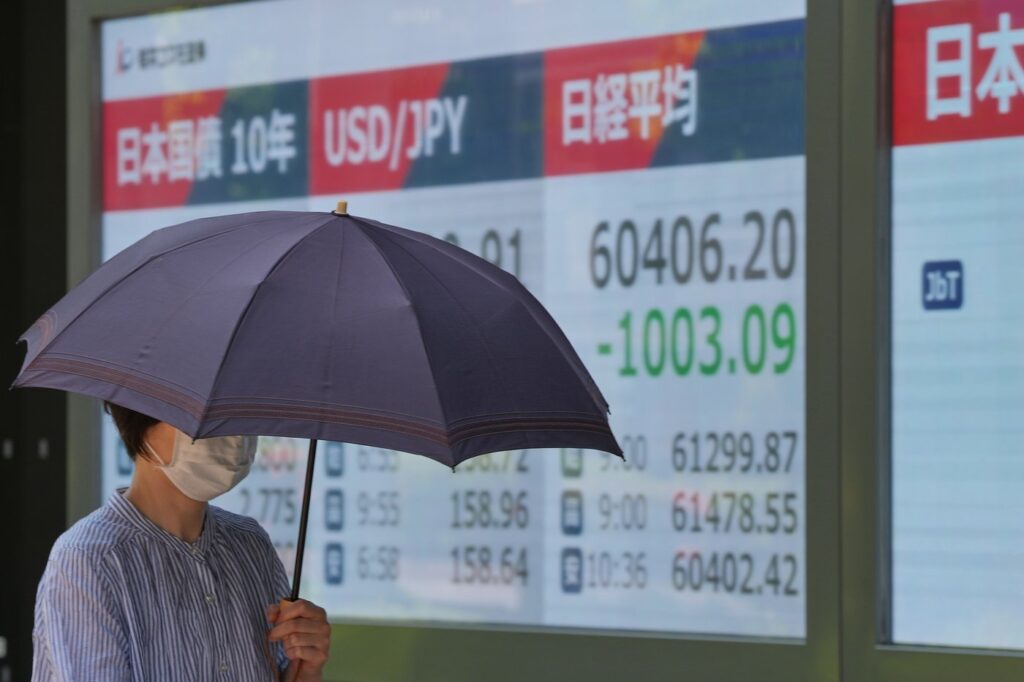
HONG KONG (AP) — Asian stocks saw a general retreat on Monday as oil prices experienced a significant increase following a stern warning from U.S. President Donald Trump to Tehran. The warning came amid stalled negotiations with Iran regarding a permanent cessation of hostilities. Trump's remarks — “the clock is ticking” — added to market anxiety, leading U.S. futures to drop more than 0.6%.
In Japan, investors pulled back with the Nikkei 225 index falling by 0.9% to 60,843.09, following a record high above 63,000 just a week ago. The decline was primarily driven by a slump in technology-related stocks, demonstrating the market's sensitivity to rapid price fluctuations. Alongside this, the yield on the 10-year Japanese government bond surged to 2.8%, marking the highest level since the late 1990s. This rise reflects a broader trend towards higher yields as the Bank of Japan adjusts interest rates, influenced by escalating energy costs and inflation expectations.
In South Korea, the Kospi index rose by 0.9% to 7,558.50 after earlier declines, buoyed partially by strong purchasing in technology shares linked to the burgeoning artificial intelligence sector. However, profit-taking led to a pullback after the index crossed the 8,000 mark just last Friday. Conversely, Hong Kong's Hang Seng index saw a notable drop of 1.6% to 25,543.32, while the Shanghai Composite index edged down by 0.1% to 4,132.24, spurred by disappointing retail data from China.
As for Australia, the S&P/ASX 200 index declined by 1.4% to 8,508.40. In Asia's broader markets, Taiwan's Taiex slipped 1.1%, and India's Sensex dropped by 0.6%, further reflecting bearish sentiment across the region.
In the oil market, prices surged following Trump's remarks about Iran, which underscored the escalating tensions in the region. Brent crude, the international oil benchmark, rose by 1.9% to $111.31 per barrel, a substantial jump from approximately $70 in late February before the onset of hostilities. Similarly, U.S. benchmark crude increased by 2.3% to $107.83 per barrel.
The potential for re-escalation in the Iran conflict has provoked concern among market analysts. ING commodities strategists, Warren Patterson and Ewa Manthey, highlighted that risks of renewed tensions are rising amid geopolitical complexities, reiterating that the situation around the Strait of Hormuz remains volatile. The strait has faced closures and is still significantly impacted by U.S. sea blockades on Iranian ports initiated last month.
Additionally, a recent drone strike targeting a nuclear power plant in the United Arab Emirates has fueled fears of further conflict escalation. Wall Street’s fluctuations have reflected these global tensions, with the S&P 500 index losing 1.2% on Friday, marking a decline from its prior record high. The Dow Jones Industrial Average fell by 1.1%, while the Nasdaq composite dropped by 1.5%.
Furthermore, the U.S. dollar strengthened against the Japanese yen, trading at 159.02 yen compared to 158.62 yen previously. The euro was up slightly, trading at $1.1626, an increase from $1.1622.
In summary, today's market movements underscore the significant impact of geopolitical tensions on financial markets, with investors remaining cautious as they navigate through the complexities posed by the ongoing U.S.-Iran relations and its broader implications on global energy supplies.








