

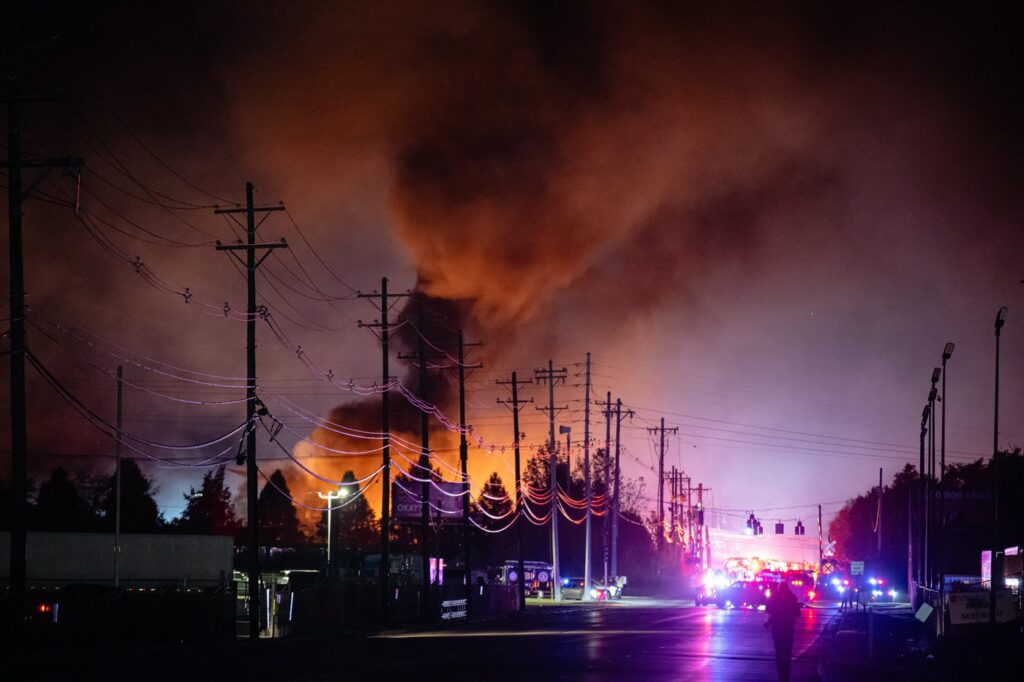
Federal safety investigators are set to conduct hearings this week to investigate the catastrophic crash of a UPS cargo plane last year that resulted in the deaths of 15 individuals. The crash, which occurred at Louisville's Muhammad Ali International Airport in November, was triggered by the engine detaching from the MD-11 aircraft as it accelerated down the runway. This incident claimed the lives of three pilots aboard the plane and 12 people on the ground.
The National Transportation Safety Board (NTSB) hearings, scheduled for Tuesday and Wednesday, aim to uncover the reasons behind the engine's separation and why Boeing did not adequately address the identified flaws prior to the crash. The NTSB's final report is anticipated to take over a year to complete, as they will investigate various factors that may have contributed to the tragic event.
On the day of the crash, the UPS aircraft was en route to Hawaii, carrying packages and fuel. It had barely taken flight and cleared the airport fence when it collided with several local businesses, resulting in a massive fireball. The NTSB released dramatic images showing the engine's detachment and the subsequent eruption of flames from the wing. The final photographs depict the flaming plane as it ascended, leaving behind trails of smoke.
This incident echoes a similar 1979 tragedy in Chicago involving a DC-10, the predecessor of the MD-11, which also experienced engine separation and resulted in the loss of 273 lives. That earlier crash led to the grounding of 274 DC-10 aircraft worldwide. The NTSB found that the DC-10 accident was linked to improper maintenance practices rather than a fatal design flaw, despite prior documented issues with the model.
In the aftermath of the Louisville crash, investigators found cracks in the components responsible for securing the engine to the wing, an issue that had gone undetected during routine maintenance. The last comprehensive examination of these crucial parts occurred in October 2021, and the aircraft was not scheduled for another detailed inspection for approximately 7,000 more takeoffs and landings. Concerns had previously been raised regarding the spherical bearing responsible for mounting the engines. Despite Boeing documenting four previous failures of this part on three different aircraft in 2011, they concluded that these issues did not constitute a safety concern at that time.
The service bulletin issued by Boeing did not mandate mandatory repairs like an FAA airworthiness directive would, nor did the FAA issue such a directive. Instead, Boeing only recommended replacing the bearings with an updated part that was less likely to fail. Following the NTSB's intervention, some MD-11s have resumed operations after the FAA approved Boeing's plan to replace the spherical bearings on each aircraft and enhance inspection protocols.
As of May 10, FedEx has reinstated the use of their MD-11 fleet for package deliveries, while UPS has announced intentions to retire their own MD-11s. Western Global also operates MD-11s but has not publicly disclosed its plans for these aircraft. Some industry experts speculated that the MD-11s might never be operational again if the necessary repairs turned out to be cost-prohibitive for these older planes. However, Boeing successfully implemented a solution to address the safety concerns by simply replacing the bearings and increasing the frequency of inspections.








