

In the lead-up to the midterm elections, Republicans are accelerating their efforts to redraw congressional districts in their favor, following a recent U.S. Supreme Court decision that undermined minority protections under the federal Voting Rights Act. This flurry of legislative activity comes as the party seeks to consolidate its narrow House majority amidst challenging political tides. Historical trends suggest that the party of a sitting president typically suffers losses in congressional seats during midterm elections, and with Donald Trump's approval ratings hovering in the negative, Republicans are optimistic that redistricting can offer them a strategic advantage.
As of now, new congressional districts have already been enacted in Tennessee and Alabama, while proposals have cleared at least one legislative chamber in Louisiana and South Carolina. However, several obstacles remain in both the courts and state legislatures before these new maps are operational for the November elections.
Republican leaders, including Trump, have encouraged GOP-controlled states to take immediate action on redistricting. They believe that by implementing aggressive redistricting plans, Republicans could potentially secure up to 15 additional seats in seven states, whereas Democrats are aiming to gain six seats through new maps in two states.
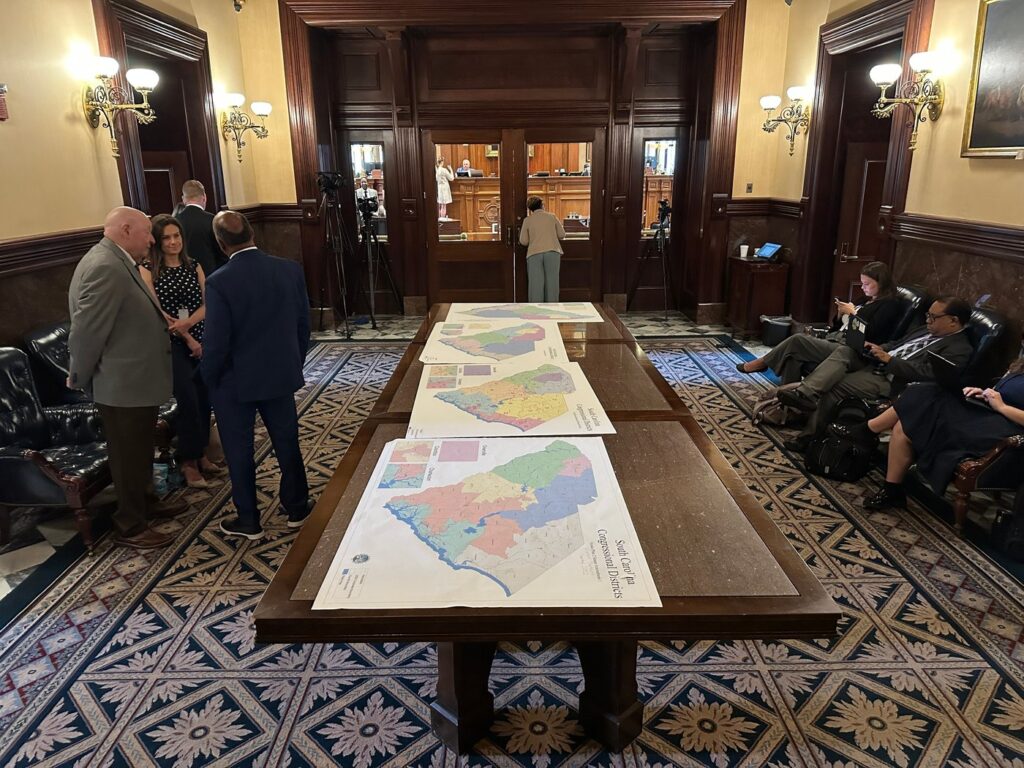
In South Carolina, tensions are evident within the Republican Party as the legislature grapples with redistricting proposals. Governor Henry McMaster has convened a special session for lawmakers to discuss congressional redistricting. The Republican-controlled House has already passed a plan aimed at enhancing the party’s chance of capturing the state’s only Democratic-held seat. However, the Senate remains divided over the proposal, with some Republicans expressing concern that efforts to unseat Democratic U.S. Rep. Jim Clyburn may inadvertently lead to the loss of existing Republican districts. State primaries are scheduled for June 9, with legislative changes potentially setting a new primary date in August.
In Louisiana, following a Supreme Court ruling that deemed the existing congressional map an illegal racial gerrymander, lawmakers are currently considering two proposals for new electoral maps that could significantly alter the political landscape. The state legislature, dominated by Republicans, has shown general agreement on the overall framework of a new map, but differing opinions have emerged over specific local divisions. If both the House and Senate pass distinct versions, a joint committee may negotiate a compromise before the legislative session concludes on June 1. Governor Jeff Landry has postponed the congressional primary, originally slated for May 16, to later in the summer to accommodate redistricting efforts.
In Alabama, a federal court is deliberating a case to block the state from using a newly drawn map that could help Republicans win additional seats. The state’s 2023 approved map includes one majority-Black district, a decision that has faced legal challenges. A separate ruling initially blocked this map, permitting a new map that enabled Democrats to win two majority-Black districts. After the recent Supreme Court directive to reexamine these matters in light of ruling in Louisiana, attorneys for the NAACP and ACLU are advocating for a preliminary injunction against the 2023 map. Alabama's primary elections took place on May 19, but new congressional primaries are set for August under the modified districts.
In Tennessee, similar legal challenges have arisen concerning new congressional maps that partition a Memphis-based majority-Black district represented by a Democrat. A lawsuit filed by the NAACP aims to invalidate this new redistricting, arguing that the General Assembly overstepped its authority by including extraneous provisions in the legislation that were not part of the governor’s original proclamation regarding the special session. The NAACP contends that the map cannot be utilized if the legislature exceeded its jurisdiction.








