

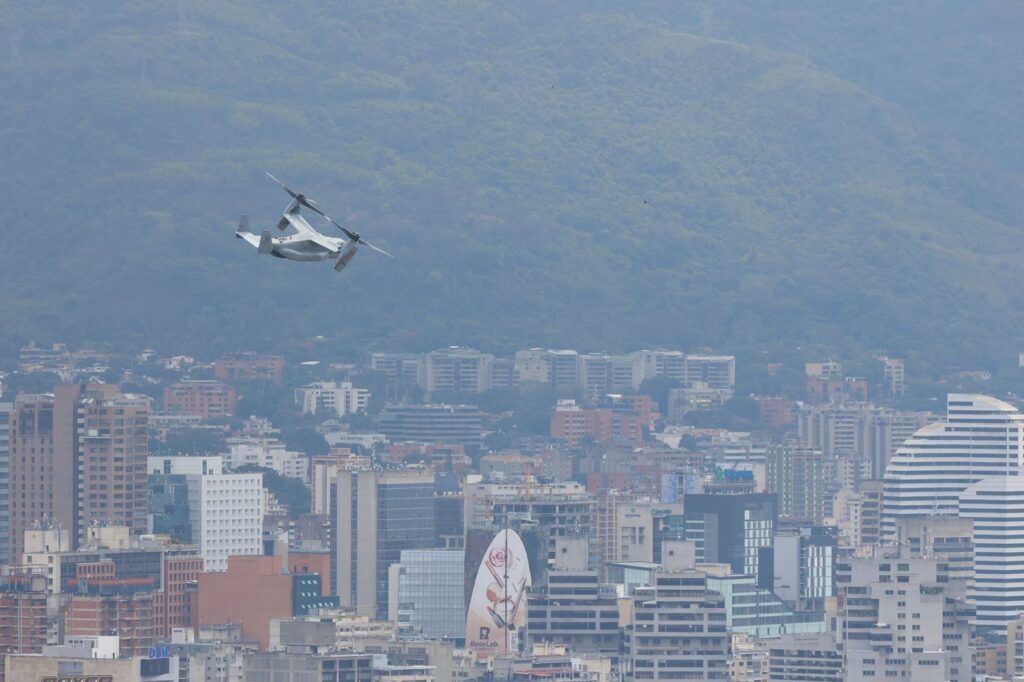
CARACAS, Venezuela (AP) — On Saturday, the U.S. military executed a rapid response drill in Venezuela's capital, over four months following the ouster of former President Nicolás Maduro. The exercise involved U.S. Marines and military aircraft, specifically two Marine Corps Osprey aircraft, known for their versatility as both helicopters and fixed-wing airplanes.
The Ospreys were observed flying over the recently reopened U.S. Embassy in Caracas before landing in the parking lot, creating strong downdrafts that disturbed nearby tree branches. As part of the drill, U.S. forces descended from the aircraft, emphasizing the military's commitment to maintaining a readiness to respond swiftly to various emergencies.
The U.S. Embassy communicated on Instagram that “ensuring the military's rapid response capability is a key component of mission readiness, both here in Venezuela and around the world.” The drill was planned in advance, with Venezuelan Foreign Minister Yván Gil confirming earlier in the week that the U.S. military would conduct the exercise to prepare for potential medical emergencies and catastrophic situations.
This military exercise comes nearly two months after the official reopening of the U.S. Embassy in Caracas, signaling a restoration of full diplomatic relations with Venezuela after Maduro's removal from power in early January. The drill not only serves military purposes but also carries political implications in the context of U.S.-Venezuelan relations.
Several residents of Caracas gathered near the U.S. Embassy to witness the aircraft operation, while some others protested against the exercise in different parts of the city. Demonstrators held a Venezuelan flag emblazoned with the message “No to the Yankee drill,” reflecting a segment of the community's opposition to the U.S. military presence.
Interestingly, U.S. military aircraft had been involved in a significant operation just prior to Maduro's ousting on January 3, when elite U.S. forces intervened, rappelling from helicopters to capture Maduro and his wife. The event led to the couple's extradition to New York, where they face drug trafficking charges, to which they have both pleaded not guilty.
Amidst ongoing tensions in the region, the drill underscores the complexities of U.S. involvement in Venezuela and highlights the dual nature of military operations, which are framed as emergency preparedness while also serving as a display of U.S. power and influence in Latin America.








