

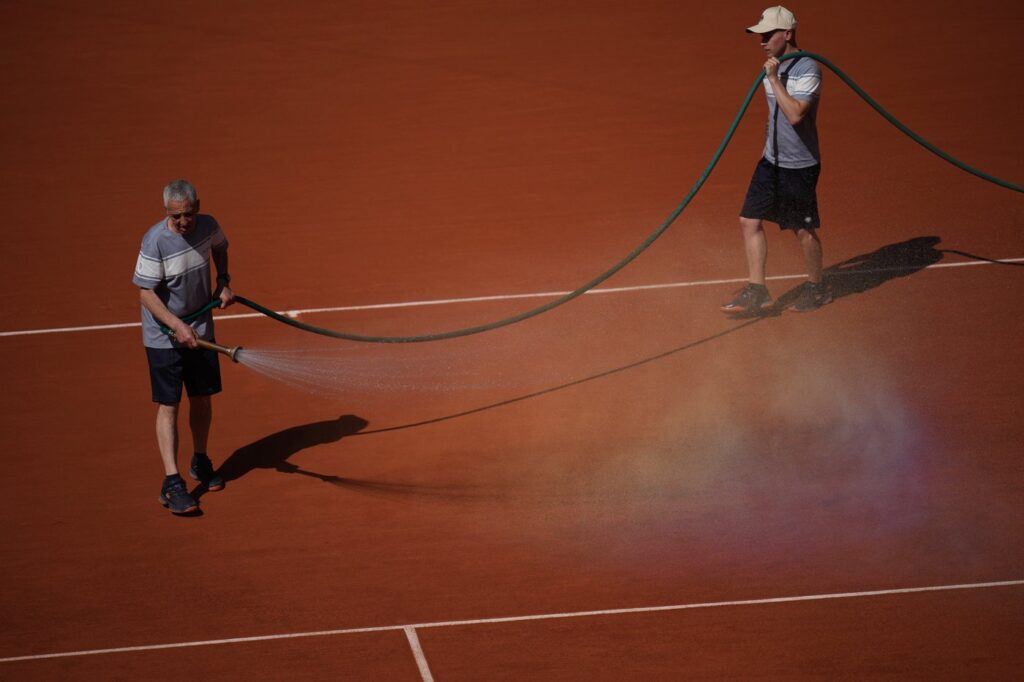
PARIS (AP) - The extreme heat wave gripping Paris during the French Open is not only challenging players but also threatening the integrity of the clay courts at Roland Garros. Throughout the tournament, temperatures have soared to at least 32 degrees Celsius (90 degrees Fahrenheit), significantly above the typical levels for late May in the French capital. As of Tuesday, the temperature reached a peak of 35 degrees Celsius (95 degrees Fahrenheit), with forecasts predicting continued heat through the week.
Philippe Vaillant, the head of court maintenance at the French Open, emphasized the unprecedented nature of this heat wave. He noted, "Even the weather services say it themselves: it's unprecedented to have temperatures this high for such a long period at this time of year." The intense heat poses a risk to the clay surface, which can change in consistency, impacting the bounce of the balls and overall player safety.
To combat these challenges, Vaillant and his team of 200 groundskeepers have had to implement various strategies to maintain the 18 competition courts and 15 additional practice courts. This includes extensive watering and carefully applying calcium chloride, which aids in moisture retention. In elevated temperatures, the clay courts dry out more rapidly, resulting in faster play on the traditionally slower surface. Top-ranked player Aryna Sabalenka noted the difference, saying, "Now it's, like, boiling hot and balls are flying, everything is much faster."
Vaillant’s primary objective is to preserve the clay-court conditions as effectively as possible. To achieve this, the grounds crew waters the courts more frequently, particularly in the evenings, soaking them to recharge the various layers beneath the top surface of crushed red brick. This watering technique ensures that moisture rises through the limestone base, which is crucial for maintaining the court's integrity.
Calcium chloride plays a vital role in this process. Vaillant describes it as “basically just salt,” applied in flake form that melts when it contacts water, thus helping to retain surface moisture. As the courts dry out due to player movement, the lighter watering between sets becomes essential to reactivate the calcium chloride within the crushed brick layer.
Earlier rain in May has also significantly mitigated the impact of the ongoing heat wave. According to Vaillant, "We were able to let the rain do its job. It recharged all our water-retaining layers, which means that today, after several days of heat-wave conditions, the courts are still in excellent condition." This prior rainfall allowed the courts to absorb sufficient water without succumbing to drought conditions.
A typical Roland Garros clay court consists of five layers totalling about 80 centimeters deep, including large stones, gravel, volcanic-rock residue, limestone, and the top layer of crushed brick. Vaillant pointed out that the limestone layer is the critical component: "This limestone layer must remain moist at all times. If we let it dry out too much, the courts could crack. We have to stay vigilant." Maintaining this moisture is essential, as it not only influences the playing conditions but also player safety. With players using ice bags around their necks during changeovers, the risk of heatstroke and slipping on dry courts is a real concern.
During matches, groundskeepers typically use slightly more than one cubic meter of water per court each day for maintenance. Although French regulations had previously prohibited the use of collected rainwater to irrigate the courts, a recent decree allows for such practices, enabling plans to better utilize natural resources in the future.
As the tournament progresses, the management at Roland Garros continues to monitor the courts closely, employing innovative measures to adapt to the unusual and extreme weather conditions.








