

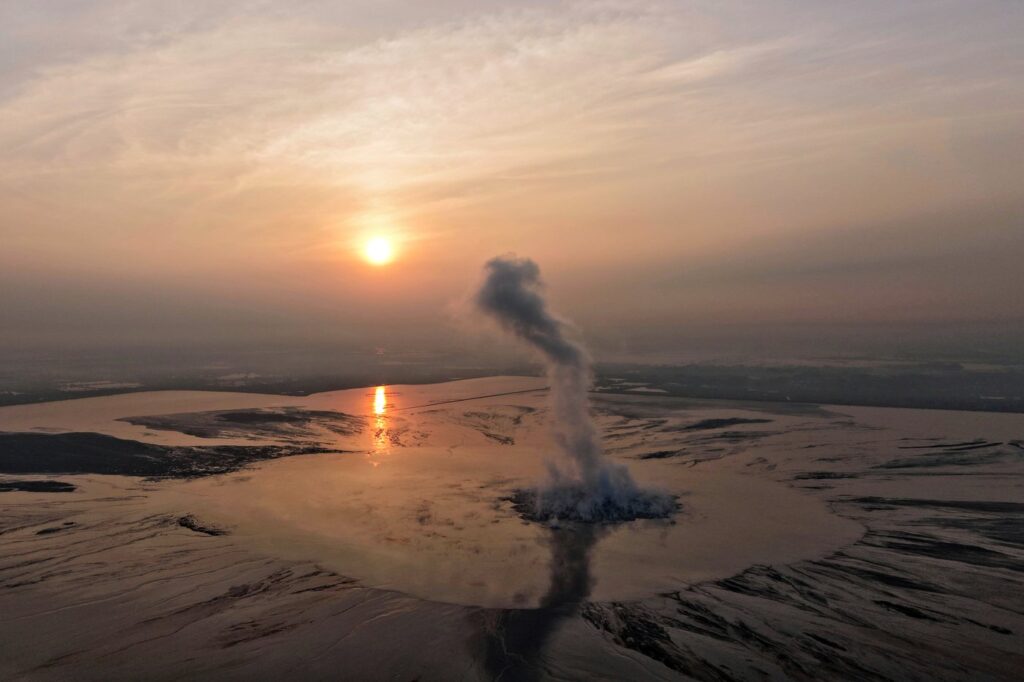
On May 29, 2026, residents in Sidoarjo, East Java, Indonesia, commemorated the 20th anniversary of the Lusi mud volcano eruption, a catastrophic event that submerged villages and claimed at least 14 lives. The disaster, which began in 2006, is believed to have been triggered by gas drilling by PT Lapindo Brantas, contradicting claims from the Indonesian government at that time that it was a natural calamity.
During the remembrance ceremony, locals scattered flowers and held prayers at the outskirts of the mud lake, reflecting on the homes and neighborhoods that were engulfed by the hot, flowing mud. The Porong subdistrict, in particular, was hit hard as boiling mud continued to flow, displacing tens of thousands of residents who not only lost their homes and jobs but also their ancestors’ graves.
Among those affected is 55-year-old Sastro, who lost his house and former job as a factory worker when the mud swallowed the factory he worked at along with many structures encompassing 572 hectares (over 1,400 acres). Now, Sastro has transitioned to becoming a motorcycle taxi driver, offering tours to the site that has ironically become a tourist attraction in East Java.
The Indonesian president at the time of the disaster, Susilo Bambang Yudhoyono, ordered Lapindo Brantas to pay $420 million in compensation to the victims. However, while the government provided some emergency financial aid, the compensation that Lapindo Brantas managed to supply was significantly lower than expected.
Two decades later, smoke still rises from the center of the mud lake, an indication that the volcano remains active. Excavators dredging the bottom of the mud pond have become commonplace, and aerial photographs reveal the vent as a small dot amidst the expansive mud lake, marking one of Indonesia's most prolonged and severe disasters.
The mudflow has resulted in the submergence of 19 villages across three subdistricts, affecting over 1,100 hectares (approximately 2,700 acres). Survivors continue to grapple with various challenges, including environmental contamination, health issues, and ongoing civil registration problems, as highlighted by Lucky Wahyu Wardana from the Indonesian Forum for Living Environment (WALHI) in East Java.
Wardana emphasized that the Lapindo tragedy should serve as a crucial lesson for the government regarding its reliance on extractive industries, arguing that the long-term costs significantly outweigh any benefits. The incident not only resulted in loss of life but also jeopardized the futures of children who lived in affected areas and led to an erosion of local history and identity for many families.








