

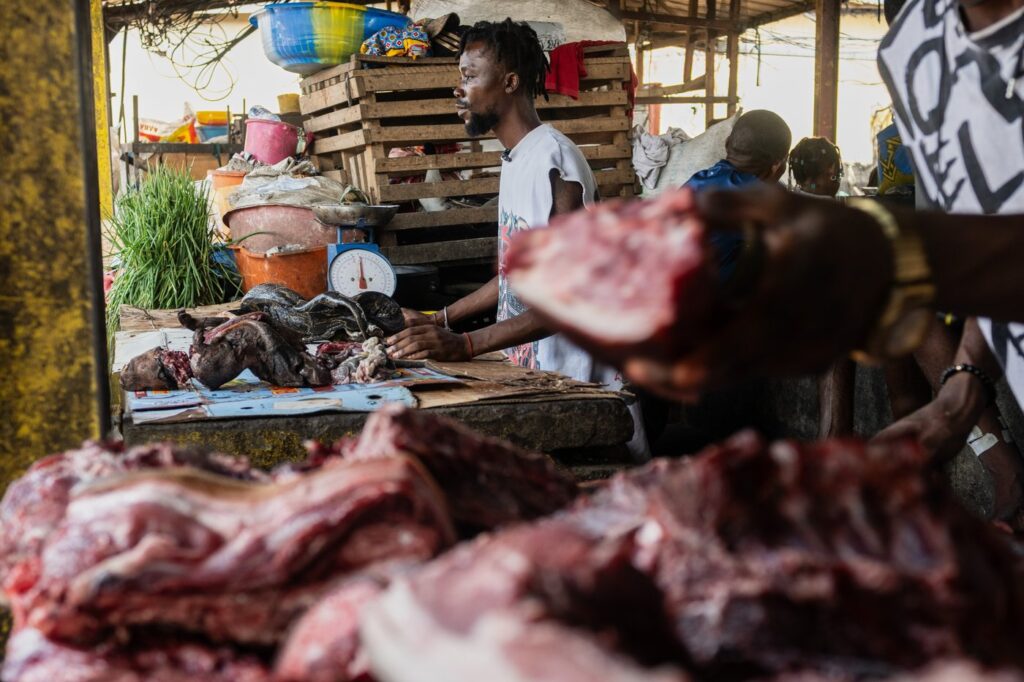
The vendors at the sprawling Masina Market in Kinshasa, the capital of the Democratic Republic of Congo, often keep their offerings of wild meat discreetly hidden. Shoppers are required to inquire about specific items, whether it’s a giant swamp rodent or various antelope parts. Meanwhile, some merchants openly display their goods, such as the women selling large baskets filled with squirming caterpillars.
In Congo and across Central and West Africa, wild meat, referred to as “viande de brousse” in French, is a staple and a cultural necessity for many. Despite threats like the ongoing Ebola outbreak in a remote region of eastern Congo, the demand for wild meat from the Congo Basin continues unabated. The Congo Basin is renowned for its diverse wildlife, including great apes and snakes, which are commonly hunted for their flesh. Consequently, locals face risks of zoonotic diseases like Ebola.
Although the U.S. Centers for Disease Control and Prevention (CDC) state that Ebola is generally not transmitted through food, it has been linked to activities like hunting and butchering infected animals. Dr. Tolbert Geewleh Nyenswah from the Africa Centres for Disease Control and Prevention emphasizes the importance of a one health approach when considering virus outbreaks as communities interact closely with wildlife, including bats and monkeys.
The Congolese government has verified more than 1,000 suspected Ebola cases, with at least 220 fatalities since the outbreak was declared on May 15. The virus likely remained unnoticed for weeks, and the World Health Organization suspects that the situation may be more serious than reported. Ebola, which takes its name from a Congo River tributary, was first identified in 1976 during outbreaks in Congo and South Sudan. Experts believe that cross-species infections typically occur when humans handle and consume wild meat.
However, due to the sporadic nature of Ebola outbreaks in communities that consume wild meat, some individuals disregard the potential health risks, while others remain unaware. Dr. Misaki Wayengera, a microbiologist advising Uganda’s Ministry of Health, notes that changing certain cultural practices related to wild meat consumption can be challenging.
The impact of Ebola outbreaks has been severe, instilling fear in entire villages and leading many to believe they are cursed. Since the virus's discovery, it has triggered 17 outbreaks in Congo and many more across the region. The most devastating outbreak took place in West Africa from 2014 to 2016, infecting approximately 28,000 people and resulting in over 11,300 deaths. According to the Food and Agriculture Organization, while animal-to-human spillovers of Ebola are uncommon, the resulting consequences can be catastrophic.
Once an individual contracts Ebola, the virus spreads through contact with the bodily fluids of sick or deceased patients. Health care workers are particularly vulnerable without adequate protective equipment. The current outbreak in eastern Congo is attributed to the Bundibugyo virus, a rare type of Ebola that currently lacks approved treatments or vaccines. Compounding the situation, armed violence from rebel groups in the area has displaced many residents.
While hunting endangered species, particularly great apes, is illegal in Congo, no comprehensive ban on wildlife trading exists, leading to continued illegal hunting of culturally significant animals like bonobos. For many residents in and around the Congo Basin, wild meat provides their primary source of animal protein. It is estimated that around 4.5 million tons of wild meat are extracted annually from the Congo Basin, according to the Center for International Forestry Research.
Wild meat consumption has become increasingly popular, even appearing on the menus of trendy restaurants. This rising demand places additional strain on the dwindling wildlife resources within the Congo Basin, a critical carbon sink that exceeds the Amazon in its ability to capture and store carbon.
Public health advocates stress the need for enhanced educational initiatives to inform communities about how Ebola is transmitted, particularly in areas that frequently experience outbreaks. Gladys Kalema-Zikusoka, founder of the Uganda-based Conservation Through Public Health group, highlights the necessity of educating people that consuming meat from unknown or deceased animals is hazardous. Some fruit bats, natural hosts of the viruses responsible for Ebola, are delicacies in several regions of Central and West Africa, putting consumers at risk.
At Kinshasa’s Masina Market, vendors offer a variety of wildlife, including antelope, rodents, and snakes, sourced from the Congo Basin. Many have opted to stop selling monkey meat, believed to be a potential reservoir for the Ebola virus. One vendor, Guyva Mputu, shares that he sells python meat, while another vendor, Charles Ntanga, sells giant rodents. NTanga emphasizes the importance of this trade for livelihoods, stating, “We sell wild meat. We make our lives through this business.”








