

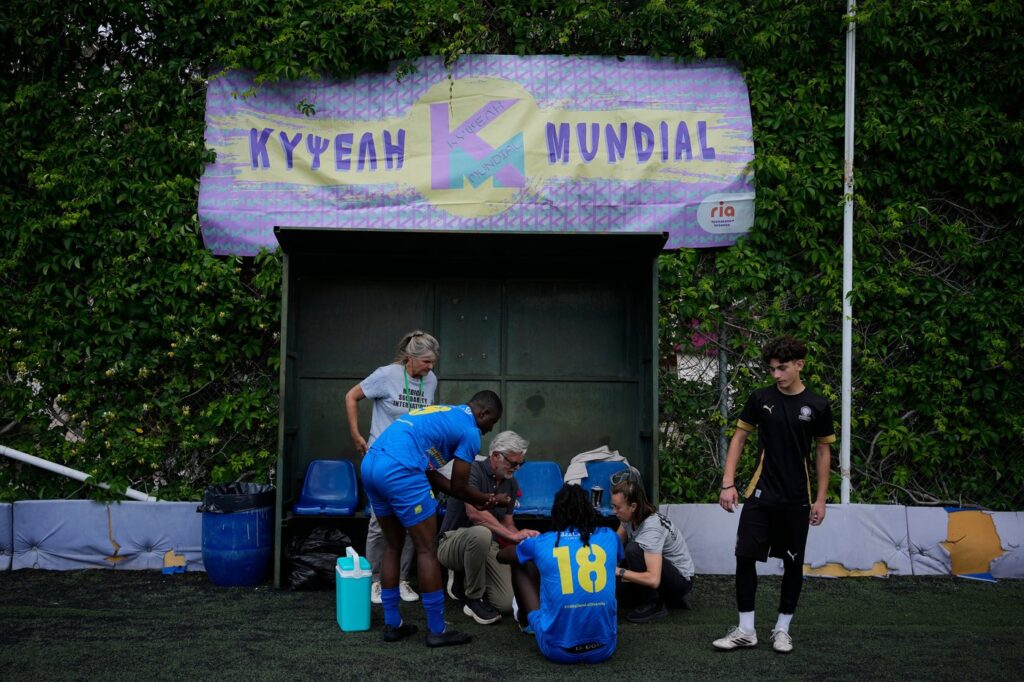
ATHENS, Greece (AP) – In the vibrant city of Athens, before the World Cup excitement makes its way to North America, a unique local tournament has brought together players from migrant and refugee communities. Unlike the grand stadiums that will soon host matches in Mexico, Canada, and the United States, this tournament took place on modest practice fields nestled within urban neighborhoods.
Amidst the rhythm of African pop music, players from countries such as Albania, Afghanistan, Cameroon, Guinea, Mali, Nigeria, and Sudan engaged in a spirited soccer competition. Although these nations did not qualify for the World Cup, the athletes with ties to these communities showcased their talent in Athens, drawing crowds that gathered near chain-link fences to watch the matches unfold.
The tournament is a joyful diversion for many migrant players, particularly with the looming changes to Europe’s migration and asylum policies expected to take effect in June. Despite the challenges they face and the stricter regulations on asylum seekers in Europe, this tournament was a celebration of football, community, and identity.
One of the tournament venues was located near Plato's Academy, a historic site where ancient Athenians discussed citizenship. The Acropolis served as a striking backdrop as matches were played in the densely populated district of Kypseli. Supporters waved flags from the Congo and Ivory Coast, while volunteers organized outdoor drumming lessons, enhancing the festive atmosphere.
The event, known as the Kypseli Mundial, was founded three years ago by Ivorian Moussa Sangare. His goal was to utilize football as a medium to address and mitigate the fear and mistrust often directed toward migrants in Greece. With Greece being a significant entry point for migrants into the European Union and a focal point during the 2015 refugee crisis, these dynamics make the tournament not just a sporting event but also a means for social change. Sangare expresses, “People are often afraid of migrants, but we wanted to change this narrative. Interacting with migrants and second-generation migrants can change minds through experience.”
The tournament coincides with a turbulent time in Greek migration policy, as new EU regulations are set to tighten border controls and enhance deportation processes. Despite this, the atmosphere during the tournament remained entirely festive; while matches were competitive, they were characterized by camaraderie rather than hostility. Coaches shouted instructions passionately while fans shared laughter from opposing sides of the fencing.
Mali's Amissi, a midfielder participating in the tournament for the first time, reflected proudly on the experience, stating, “I am very proud to be playing in this tournament.” Many players, who labor long hours in various sectors like restaurant kitchens and construction jobs across Athens, found in this tournament a temporary escape from their daily routines.
In the men's competition, the Nigerian team emerged victorious, while the women's title was claimed by Greek neighborhood club Fostiras. Head referee Chara Vogiatzidaki emphasized the tournament’s importance, stating, “There are so many countries and different cultures, and I think the main goal is to show respect for all communities." She noted that while technical skills varied across teams, the focus was on enjoyment, highlighting the spirit of the tournament as “really beautiful.”
Thus, the Kypseli Mundial stands as a miniature World Cup in its own right, illustrating not only the unifying power of sport but also the resilience and hope within migrant communities in Athens.








