

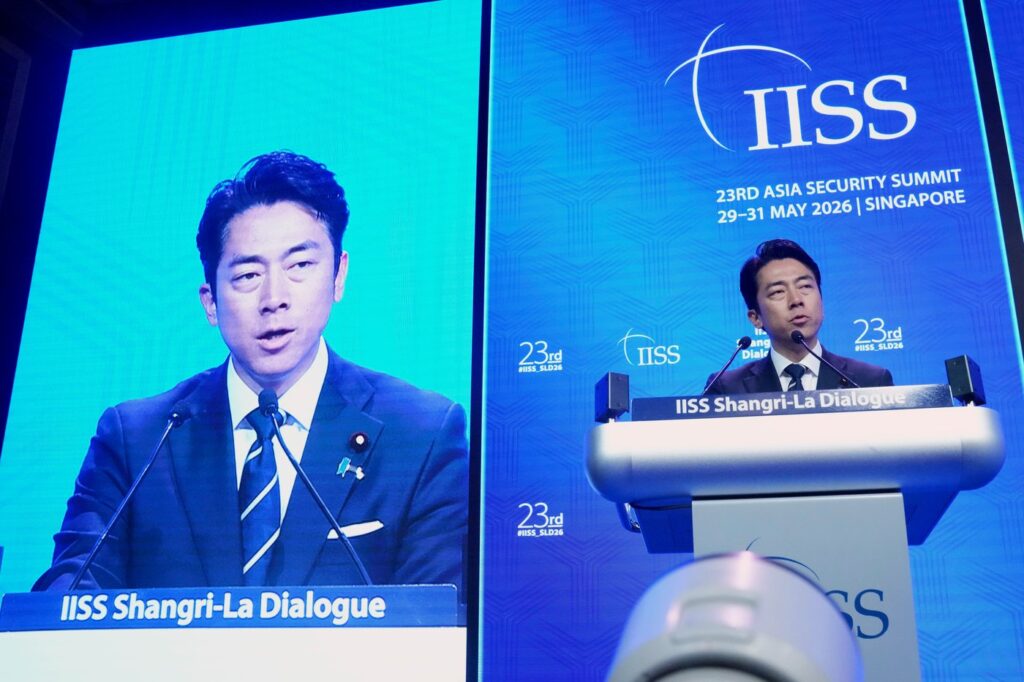
SINGAPORE (AP) – During a prominent defense conference in Singapore on Sunday, American allies emphasized the critical importance of unity amidst evolving global threats that transcend regional boundaries. The discussions took place against a backdrop of U.S. criticisms directed toward traditional allies, particularly within NATO, highlighting a shift in diplomatic tone from Washington.
U.S. Defense Secretary Pete Hegseth, speaking at the Shangri-La Dialogue, reiterated his criticisms of Western European allies for their insufficient defense expenditures. His comments were echoed by Japanese Defense Minister Shinjiro Koizumi, who commended Hegseth's focus on the Indo-Pacific while underscoring the necessity for robust global coalitions. Koizumi articulated a belief that "division weakens deterrence, unity strengthens deterrence," stressing the need for sustained cooperation among the U.S., Europe, and allied nations to deter external threats effectively.
Japan's defense policy is undergoing significant transformation as it adapts to China's rapid military expansion and modernization. Recently, Prime Minister Sanae Takaichi’s Cabinet announced the lifting of a ban on lethal weapons exports, a significant departure from Japan's postwar pacifist stance. This policy shift has drawn criticism from China, with Foreign Ministry spokesperson Guo Jiakun asserting that China would "resolutely resist Japan's reckless moves toward a new type of militarism." In response, Koizumi found the accusation ironic, pointing out that Japan does not possess nuclear weapons and has been unfairly labeled as militaristic.
Hegseth's remarks at the conference included a praise for various Asian nations that are increasing defense spending, while he continued to challenge European allies, who, according to him, have become sidetracked by "empty globalist rhetoric." He emphasized that without substantial military capabilities, international rules are rendered ineffective, stating, "You can have all the rules you want, but if you can't back them up with hard power, the rules are not worth the paper they are written on."
Australian Defense Minister Richard Marles supported Hegseth's perspective regarding the necessity of a power-backed rules-based order, expressing that solid regulations hold greater significance today than in the past. He highlighted that cooperation among allies is crucial, describing it as a "collective challenge" that requires a unified response, which aligns with the essence of the rules-based international order.
Further reinforcing this notion, Netherlands Defense Minister Dilan Yesilgöz-Zegerius noted that the relevance of current conflicts is globally extensive, necessitating a coordinated response. She stated that "a war in Europe involves drones from Iran, soldiers and ammunition from North Korea, and various types of support from China," illustrating the interconnectedness of regional security challenges. Yesilgöz-Zegerius warned that if middle powers fail to collaborate, they risk becoming passive observers and losing their voice in critical discussions about stability and security.
She concluded by emphasizing the importance of defending international laws, stating, "The fact that international rules are being violated does not mean we should abandon them. On the contrary, it means we must defend them more constantly and more courageously." She acknowledged the imperfections of international law but argued that history shows the consequences of abandoning such frameworks could be much worse.








