

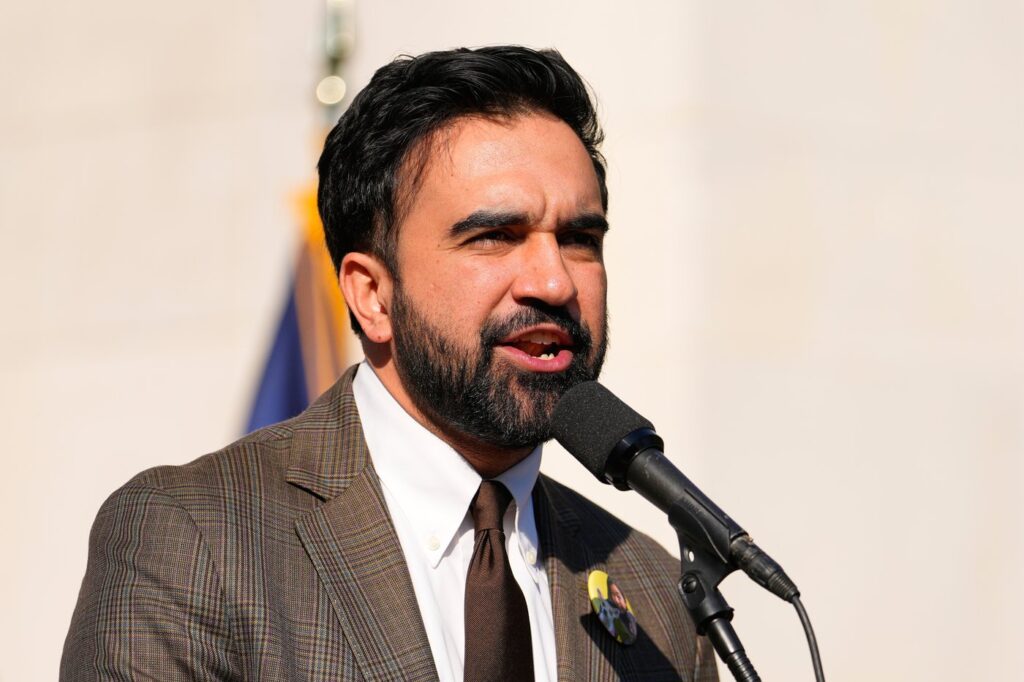
NEW YORK (AP) — New York City Mayor Zohran Mamdani has announced his decision not to attend the upcoming annual parade honoring Israel, deviating from a long-standing tradition where mayors and political leaders participate. This decision stems from Mamdani’s vocal support for Palestinian rights, reflecting a shift in political dynamics regarding the Israeli-Palestinian conflict.
The Israel Day parade, which has undergone various name changes over the years, traditionally attracts a large audience of supporters from both the Jewish community and the political sphere, eager to celebrate the establishment of Israel in 1948. However, Mamdani’s stance aligns with his campaign promises that included a commitment to advocate for Palestinian issues and to express his views on the Israeli government, which he has repeatedly emphasized.
Two weeks prior, Mamdani's office released a video commemorating the Nakba, an Arabic term meaning "catastrophe", which refers to the expulsion and displacement of approximately 700,000 Palestinians during the turbulent period surrounding Israel's creation in 1948. In light of these events, Mamdani reiterated his position at a news conference, asserting his commitment to Palestinian rights while ensuring that the parade would proceed safely, stating, “While I will not be attending, our administration has been preparing for weeks to ensure the parade is safe for all those who take part.”
New York City's Police Commissioner Jessica Tisch, who is Jewish, expressed her intention to attend the parade, making a clear distinction between her choices and the mayor's. “It is the mayor’s decision not to march, and it is my decision to march proudly,” Tisch stated. This divergence between the mayor and the police commissioner underscores the complex and sometimes contentious relationship between municipal leaders and the community they serve.
Mamdani's absence from the parade has sparked criticism and accusations from various opponents who view his criticisms of the Israeli government as antisemitic. Rabbi Marc Schneier, a prominent Jewish leader, condemned the mayor’s decision, calling it “a slap in the face to all Jewish New Yorkers.” He further stated, “Do us a favor, stay home; we don’t need you. We don’t want you,” echoing sentiments from other Jewish figures who apprehended Mamdani’s Nakba video as one-sided propaganda that disregards the complexities of the historical context, including the displacement of Jewish individuals from Arab countries during the same time period.
The video presented a personal narrative of Inea Bushnaq, a Palestinian woman who recounted her feelings of displacement and longing for her homeland. Critics argue that the narrative oversimplifies the historical context and fails to acknowledge the atrocities faced by Jewish populations, particularly the Holocaust's impact on the Jewish quest for a homeland.
Historically, New York City mayors have maintained a strong pro-Israel stance, often visiting the country and engaging with its community due to the city’s significant Jewish population. However, recent attitudes toward Israel appear to be changing, with public support for Israel in the U.S. witnessing significant erosion, particularly in light of recent military actions in Gaza.
Mamdani, as the city’s first Muslim mayor, continues to advocate for Palestinian rights while affirming the importance of protecting Jewish New Yorkers. He stresses that while he believes in Israel's right to exist, it should not do so as a state that privileges Jewish citizens over others. He has also emphasized the actions taken by his administration to combat antisemitism, indicating his commitment to fostering a diverse and inclusive city.








