

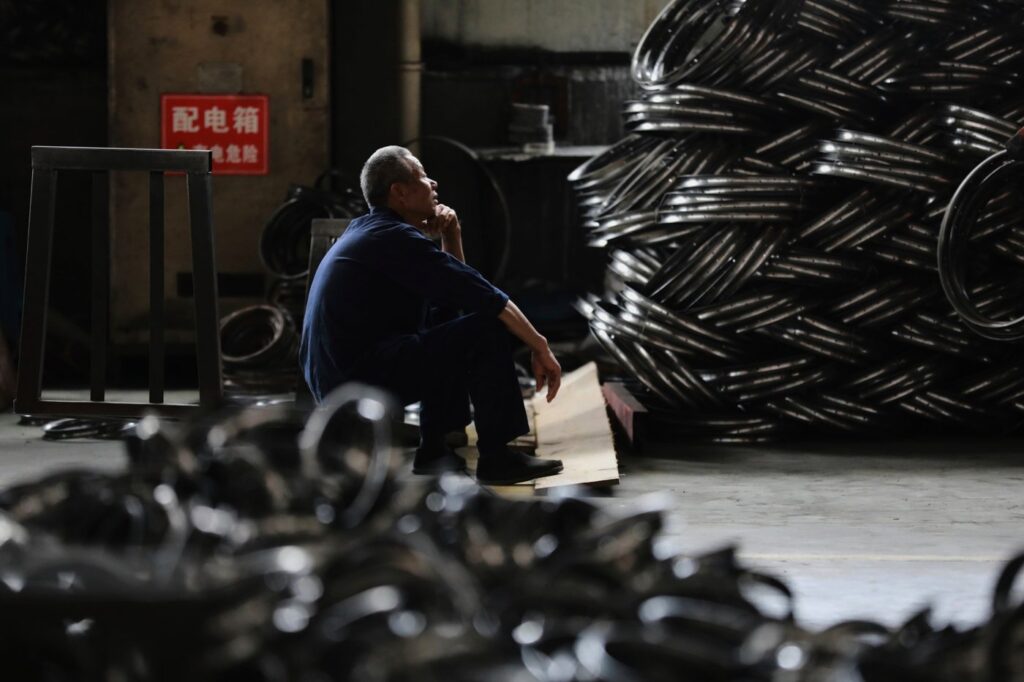
BEIJING (AP) – China's factory activity showed no significant growth in May, as indicated by an official survey released on Sunday, leading to concerns regarding the resilience of the country's economy amidst the ongoing Iran war and dropping demand pressures. The National Bureau of Statistics reported that the official manufacturing purchasing managers index (PMI) slightly declined to 50 from 50.3 in April. PMI readings above 50 indicate expansion, while below 50 signify contraction.
The new orders sub-index saw a decrease, falling to 49.9 from 50.6 in April. Additionally, the production sub-index also edged down to 51.2, compared to April's 51.5. The sub-index for raw material stockpiles dropped significantly to 48.6 from 49.3 in the previous month. These declines in sub-indices reflect ongoing concerns about domestic demand and production capabilities.
Despite global disruptions, particularly those caused by the energy shock from the Iran war, China has thus far remained relatively insulated compared to other nations. Many countries are experiencing inflationary pressures as oil prices have surged due to the closure of the Strait of Hormuz, a crucial passage for global oil shipping. Analysts attribute China's resilience to its significant oil reserves and diversified energy sources, which have enabled the country to navigate the geopolitical tensions without severe economic repercussions.
Frederic Neumann, Chief Asia Economist at HSBC, noted in a research report that while the energy crisis poses challenges for Asia, China's robust energy security provides a level of protection against these external threats. Additionally, exports continue to play a pivotal role in supporting China's broader economic landscape, with global exports remaining strong, particularly to Europe and Southeast Asia.
However, exports to the United States have generally declined year-on-year over the previous months. The anticipated recovery in U.S. exports has been bolstered by the summit between President Donald Trump and Chinese leader Xi Jinping in mid-May. The subsequent agreement to establish separate boards of trade and investment was viewed positively by many analysts.
Chinese exports in sectors like automobiles, technology, and artificial intelligence have helped bolster growth figures. Nonetheless, there's a prevalent concern regarding the overall economy, especially due to sluggish domestic demand resulting from a prolonged slump in the property sector, which has adversely affected consumer confidence and investment levels.
According to Robin Xing, Chief China Economist at Morgan Stanley, although domestic demand is currently lagging, high-end manufacturing and global exports are managing to sustain economic stability. In light of these circumstances, Chinese authorities have set a relatively modest annual economic growth target of between 4.5% and 5% for the year, marking the lowest target since 1991, though it is only slightly lower than the “around 5%” target set for 2025.
Morgan Stanley suggested that while China is likely to achieve its objectives for 2026, the trajectory of oil prices and a decrease in uncertainties surrounding global oil supplies will significantly influence the country's economic future. The interplay between these factors will be crucial as China navigates through ongoing domestic and international challenges.
In conclusion, although China's manufacturing sector exhibits signs of stagnation amid external pressures, a relatively robust export market and strategic energy policies provide a buffer against severe economic decline. As the country aims to stabilize its economy, key indicators from both domestic demand and global trade will be vital in shaping future growth.








