

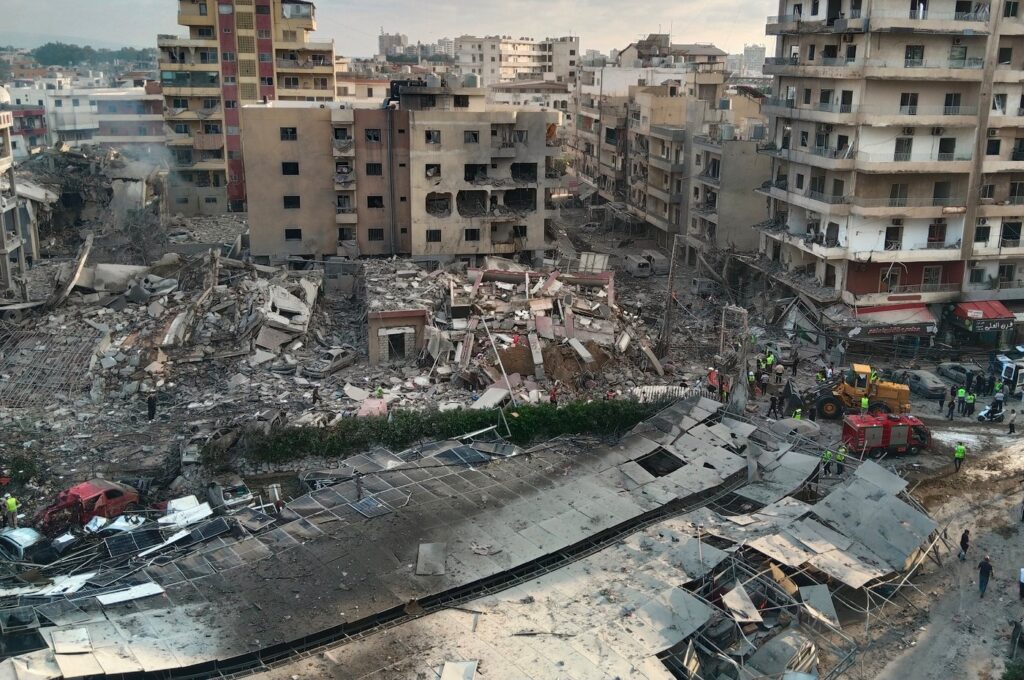
BEIRUT (AP) – Israeli drone strikes on southern Lebanon on Tuesday resulted in the deaths of eight individuals, including a father and his two children. This escalation occurred just a day after U.S. President Donald Trump indicated that Israel and Hezbollah had agreed to reduce hostilities. The violence has heightened fears in the region, especially given that Israeli forces have recently conducted their most significant incursion into Lebanon in 26 years.
On Monday, Israel issued threats to target Beirut’s southern suburbs, leading to widespread panic in the Lebanese capital as thousands sought refuge in safer areas. In retaliation, Hezbollah launched rockets into northern Israel, intensifying the conflict between the two sides. Although Beirut has largely avoided direct attacks over the past six weeks, there have been targeted strikes during this period.
In a significant development, Trump announced that following discussions with Israeli Prime Minister Benjamin Netanyahu and mediated communications with Hezbollah, "there will be no troops going to Beirut." This statement reflects the complex dynamics at play between military actions and diplomatic efforts to manage the conflict.
The Lebanese State-run National News Agency reported that one drone strike targeted a car on the road connecting the southern town of Marjayoun to Nabatiyeh, killing James Karam, a dentist from the nearby Christian town of Qlayaa, along with his daughter and son. Similarly, a separate drone strike injured two Lebanese soldiers on a road outside Nabatiyeh.
Furthermore, a drone strike in the village of Jibchit resulted in the deaths of two Syrians employed at a plant nursery, while another strike in the village of Toul killed two individuals. Another drone attack near the village of Harouf claimed one life. The agency also noted that an Israeli airstrike in the southern village of Marwaniyeh on Monday had previously resulted in six fatalities.
In response to ongoing military activities, Hezbollah reported that its forces had fired anti-tank missiles at Israeli troops advancing into the southern village of Hadatha, roughly 4 miles from the Israeli border. Alarmingly, sirens were activated in multiple areas of northern Israel as the military confirmed the identification of a "suspicious aerial target" in the vicinity where Israeli soldiers were operating in southern Lebanon. Fortunately, no injuries were reported from this encounter.
Despite a Washington-brokered ceasefire achieved in April, hostilities have persisted as Israel cited a need for self-defense in its operations against Hezbollah. The current exchanges of fire coincide with a second round of negotiations scheduled for Tuesday and Wednesday in Washington. These discussions, following the initial talks that began in April, aim to establish a comprehensive ceasefire to prevent future confrontations between the two nations, which have not maintained formal diplomatic relations for over three decades.
The ongoing conflict poses a significant challenge to potential agreements aimed at expanding the ceasefire regarding the broader Iranian conflict that escalated after U.S. and Israeli actions against the Islamic Kingdom on February 28. Iran has expressed a desire for any agreement to include a complete cessation of hostilities in Lebanon.
Hezbollah has maintained a position of rejecting direct negotiations, relying instead on Iranian support to exert pressure on the opposite side. The recent escalation in hostilities has resulted in a staggering death toll of 3,433 individuals in Lebanon and the displacement of over 1 million people since the conflict intensified. According to reports from Netanyahu's office, at least 27 Israeli soldiers and one defense contractor have lost their lives in the southern Lebanon conflict, alongside two civilian casualties recorded in northern Israel.
Moreover, the Israeli military revealed late Monday that one soldier was killed in southern Lebanon, with seven more sustaining injuries, three of which were classified as severe. Hezbollah's employment of advanced fiber-optic drones has brought additional challenges to the Israeli military, which is struggling to respond effectively to these threats.








