

OTTAWA – A recent study by the Canadian Climate Institute, released on Thursday, critiques Ottawa's energy deal with Alberta, stating that it is unlikely to significantly reduce Canada's emissions. The analysis emphasizes that the minimal benefits arising from the Alberta memorandum of understanding (MOU) are overshadowed by the potential increase in oil production facilitated by the agreement due to inefficiencies in Alberta's industrial carbon pricing system.
Dave Sawyer, the principal economist at the Canadian Climate Institute and author of the study, expressed concerns over the current design of the carbon pricing system, urging a closer examination of the rates at which emissions can be produced. These "tightening rates," or stringency rates, dictate the emissions limits for industries operating under Alberta's carbon pricing regime.
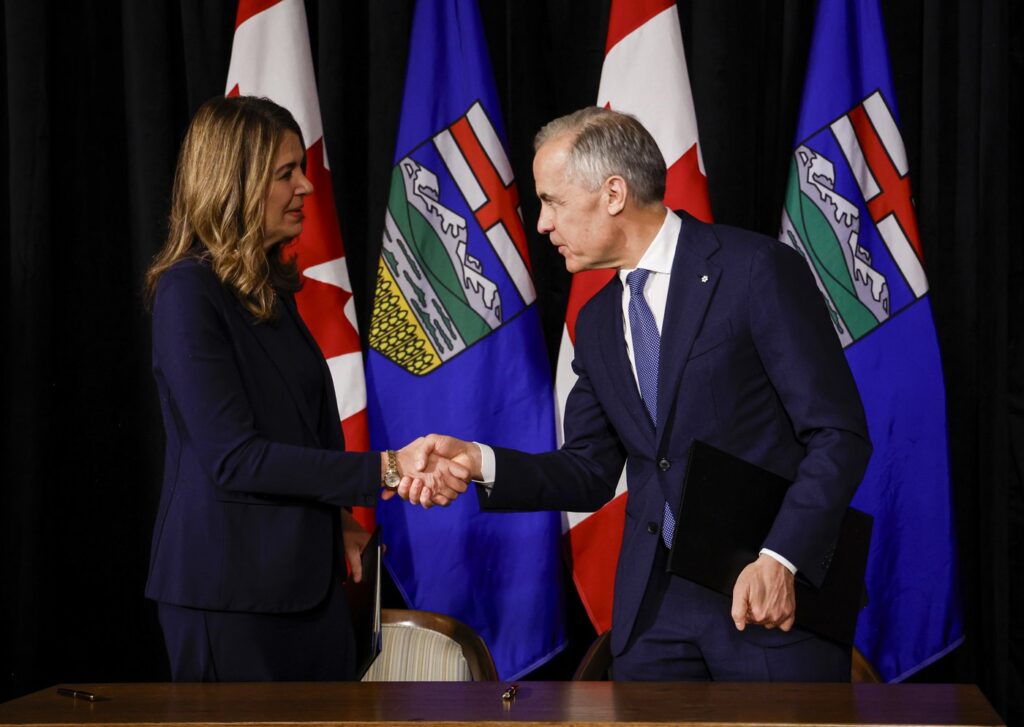
In May 2026, Prime Minister Mark Carney and Alberta Premier Danielle Smith signed an implementation agreement that aims to raise Alberta’s effective carbon price to $130 per tonne by 2040. The agreement outlines a phased approach where the headline carbon price is set to reach $100 per tonne by 2027 and then increase to $130 per tonne by 2035. However, discrepancies exist between the effective carbon price and the headline price because of the way companies earn credits to meet their emission limits.
The MOU has also relaxed stringency rates, which has provided industries with increased leeway concerning their emissions allowances. Although the framework for the new carbon pricing is being promoted as stronger than the previous federal carbon price backstop, the Canadian Climate Institute’s report argues that this is misleading. This is mainly due to the fact that Ottawa has decided not to impose the more stringent federal standard, and the new structure does not adequately incentivize reductions in emissions.
Sawyer's analysis warns that the changes in the carbon pricing model may result in an oversupply of lower-cost credits post-2030. This scenario is anticipated to arise because producers are expected to exceed their emissions benchmarks easily until that time, thus accumulating a surplus of credits under the more lenient stringency rates. The report articulates that "the floor maintains prices but the underlying signal to abate is lost," suggesting that the current system will result mainly in paperwork compliance rather than actual reductions in emissions.
How the excess credits in the system will be addressed remains uncertain. Prime Minister Carney has suggested the possibility of the government buying up credits to generate scarcity in the market. However, Sawyer contested this idea, stating that the current agreement results in an increase in credits rather than a decrease. He remarked, "Now with these tightening rates, I don't know if it’d be worth it. I think you’d be throwing good money after bad."
In the lead-up to the formal announcement of the MOU, the market price for carbon credits briefly surged to $40 per tonne but has since fallen to a range of $30 to $35 per tonne. Sawyer concluded that the overall impact of the MOU represents a significant policy intervention that maintains Canada's emissions trajectory largely unchanged from before the agreement was finalized, leaving the system weakened with negligible improvements.








