

MPONDWE BORDER, Uganda (AP) — Leah Masika was on the verge of tears as she reflected on her precious cargo of plantain trapped in a long queue of trucks at the Uganda-Congo border. Her shipment, destined for Uganda, was leaking water and at risk of spoiling if there was no movement.
The Ugandan trader awaited clearance from authorities at the Mpondwe border post on Thursday, as trucks had been halted from entering or leaving Uganda amid escalating measures to prevent the spread of Ebola. “Our things are here rotting,” she lamented.
On May 28, shortly after the Democratic Republic of Congo declared an Ebola outbreak in the eastern Ituri province, Uganda closed its western border. This decision highlighted the growing fears of cross-border contagion, with exceptions made only for emergency cases, including outbreak responses, humanitarian issues, and security concerns.
However, as the Ebola outbreak in eastern Congo seemed to escalate, Ugandan authorities in the frontier district of Kasese intensified their measures. Traders expressed frustration over the sluggish movement of cargo trucks, asserting that although they understood the fears driving the measures, they felt that halting the trucks was excessive.
Sylvia Asiimwe, a customs clearing agent, pointed to the long queue of trucks stretching over a mile on the Ugandan side. Some of these trucks were transporting fish imported from China, bound for the Congolese cities of Beni and Butembo. “The fish is going to spoil. So much money is at stake,” she stressed.
The Uganda-Congo border, spanning several hundred miles, is marked by numerous informal footpaths. Trade flourishes along this route, particularly at the Mpondwe border post, where informal exports were valued at approximately $131 million in 2023, according to the Uganda Bureau of Statistics.
The recent border closure has led to shop closures, and many young men who relied on casual work found themselves idle and despondent. Ismail Mumbere, a roadside snack vendor, expressed that “the situation is bad,” as many depend on the bustling border trade for their livelihood. “But now the government has told us there is Ebola. Ebola has wasted our work,” he lamented.
The current Ebola outbreak in Congo is suspected to have affected over 1,000 individuals, although the number of confirmed cases remains significantly lower. Many suspected victims die outside medical facilities, without receiving definitive diagnoses of Ebola. The World Health Organization, despite declaring the outbreak a public health emergency of international concern, has urged against closing borders, though it acknowledges that neighboring countries face high risks of contagion.
Arafat Bwambale, a surveillance officer for Kasese, defended the measures taken, noting that “with the movement of cargo, and maybe trucks, is mobility of people, and we want to reduce that.” He explained that officials were attempting to prevent Congolese nationals from crossing into Uganda via over two dozen informal footpaths along the Mpondwe border.
As the situation evolves, Ugandan authorities remain cautious following the confirmation of 15 Ebola cases linked to the ongoing outbreak in Congo. This outbreak, declared on May 15, had been spreading unnoticed for days or weeks before its declaration. Uganda has faced multiple Ebola outbreaks since 2000, with the disease claiming over 200 lives during those incidents.
Ebola, which is named after a tributary of the Congo River, was first identified in 1976 during concurrent outbreaks in Congo and present-day South Sudan. The virus is believed to originate from contact with infected animals, such as fruit bats, particularly through the handling and consumption of wild meat.
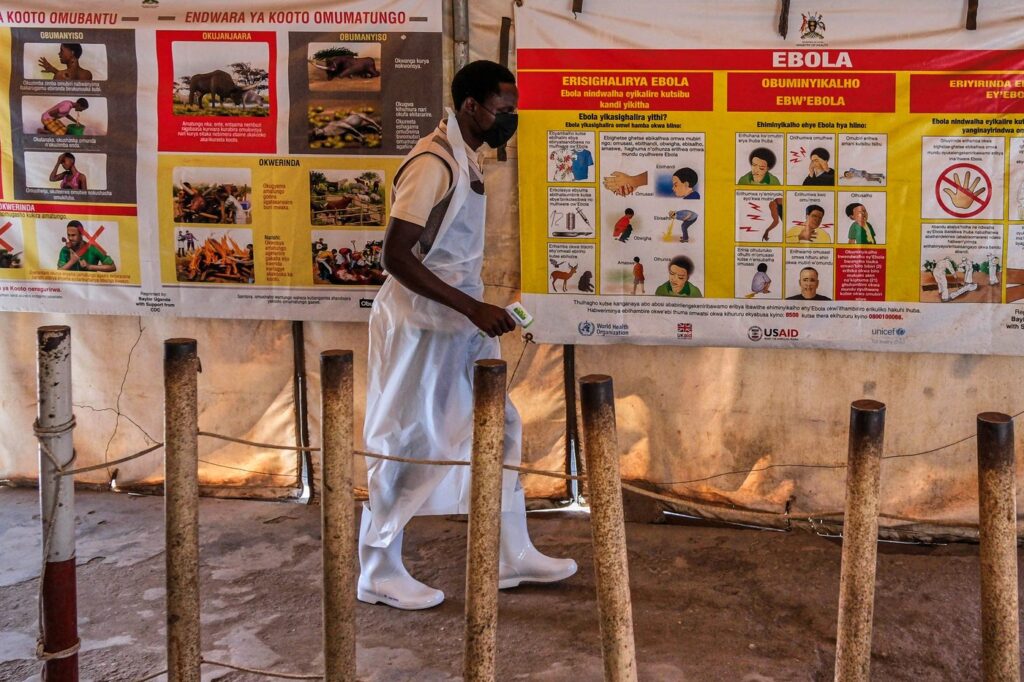
Transmission occurs once the virus infects an individual, spreading through close contact with the bodily fluids of the sick or deceased, such as blood, sweat, and vomit. Key measures in halting Ebola's spread include tracing and isolating contacts, along with equipping medical workers with proper protective equipment.
Bwambale stated that the nearest referral hospital in Kasese is equipped for isolation and possesses a lab capable of providing test results within six hours. Recent tests from 41 individuals in the area returned negative for Ebola, which presents as hemorrhagic fever.
Nonetheless, authorities appear poised to enforce more restrictions. A meeting of the local Ebola task force is anticipated to devise “a more restricted way on how both the cargo or the trucks get into the country in a systematic way,” raising concerns for traders reliant on the Mpondwe border for their business.
Masika, the plantain dealer, expressed that she would refrain from ordering more goods from Congo until the outbreak is over. However, she faces considerable losses if her current cargo does not reach destinations in and around Kampala, where fried or boiled plantains are a breakfast staple. “We are begging them to help us and open the border,” she pleaded. “We will not go back to Congo.”








