

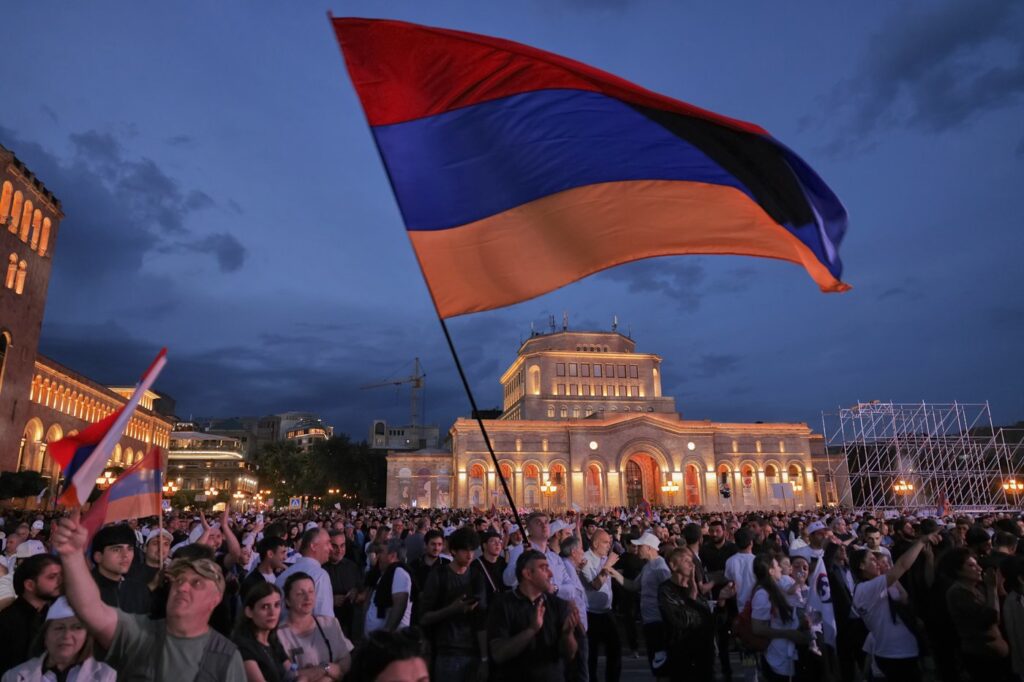
Armenia's parliamentary elections, held recently, mark a critical juncture for the nation as incumbent Prime Minister Nikol Pashinyan aims for closer ties with the European Union (EU) and the United States, contrasting sharply with the pro-Russia stance of his opponents. Analysts predict that Pashinyan's Civil Contract party will likely maintain control of the parliament, but the emergence of multiple opposition parties advocating for pro-Russia policies has intensified discussions regarding Armenia's international position.
In the lead-up to the elections, Russian President Vladimir Putin and various Russian officials warned Armenia that an alignment with the EU could severely disrupt its long-established trade connections with Russia and its allies. Mikayel Zolyan, an analyst and former member of the Armenian Parliament, noted that these elections signify the first time Armenia's geopolitical orientation has become a pivotal election issue. Historically, Armenia has operated within the sphere of Russian influence without question, but current challenges validate a reevaluation of this status.
Relations between Armenia and Russia soured significantly in 2023, particularly after Azerbaijan seized control of the entire Karabakh region, previously governed by ethnic Armenian forces with support from Armenia. Armenian authorities accused Russian peacekeepers deployed in the region of failing to protect against Azerbaijan’s advances, while Moscow dismissed these claims, citing the limitations of its troops’ mandate amid the ongoing conflict in Ukraine. Alexander Iskandaryan, director of the Caucasus Institute, explained that the perception of Russia as a reliable security guarantor for Armenia crumbled after the war over Karabakh.
In light of this lost confidence, Pashinyan has tentatively begun to mitigate Armenia's ties with Moscow, becoming a member of the International Criminal Court in 2023 and announcing Armenia's withdrawal from the Russia-led Collective Security Treaty Organization in 2024. He has also officially expressed ambitions for EU membership, going so far as to host the European Political Community summit in Yerevan in early May.
A resounding victory for Pashinyan in the parliamentary elections would empower him to continue pursuing this Western-oriented strategy and work toward stabilizing relations with Azerbaijan. Western nations have been keen to demonstrate the potential benefits of enhanced relations, such as U.S. President Donald Trump facilitating an agreement between Pashinyan and Azerbaijan’s President Ilham Aliyev aimed at ending long-standing hostilities. Additionally, President Ursula von der Leyen of the European Commission highlighted Europe's readiness to invest in Armenia's energy sector and burgeoning digital landscape.
Conversely, much of Armenia's political opposition remains deeply pro-Russian and is resistant to normalizing relations with Azerbaijan. The Strong Armenia Party, led by Armenian-Russian billionaire Samvel Karapetyan, stands as Pashinyan’s primary rival, advocating for closer economic ties with Russia and accusing Pashinyan of deliberately provoking tensions with Moscow. Other contenders include former President Robert Kocharyan, leading the Hayastan bloc, who claims Pashinyan has severely damaged Armenia’s relationship with Russia.
Russia has intensified its economic pressure on Armenia by imposing new restrictions on various Armenian exports and raising concerns about potential political and economic ramifications resulting from Yerevan's Western pivot. Putin has suggested that Armenia's shift mirrors Ukraine's trajectory leading up to its conflict with Russia. The changes in trade dynamics are evident; data from 2025 shows that 38% of Armenia's exports went to members of the Eurasian Economic Union, primarily to Russia, in contrast to just 8% toward the EU.
In light of these pressures, Von der Leyen announced that the EU would provide €50 million to support Armenia, denouncing Russia’s actions as economic coercion. Observations of Armenia's civil society indicate rising anxiety over perceived Russian disinformation campaigns aimed at the elections, while accusations of illegitimate political financing, cyberattacks, vote-buying, and journalist bribery have surfaced. This chaotic backdrop highlights the complex intersection of local politics and international relations in Armenia.








