

NEW DELHI — The Cockroach Janata Party (CJP), a social media movement that originated as a lighthearted joke, will confront its most significant challenge yet with a scheduled demonstration in New Delhi on Saturday. The founder, Abhijeet Dipke, is anticipated to lead the protest at Jantar Mantar, marking the movement's inaugural excursion into street politics after weeks of notable online presence and media coverage.
While the exact number of participants remains uncertain, this demonstration serves as an early test of the CJP's capability to convert its substantial online following into grassroots support amidst a backdrop of rising discontent among young Indians regarding their educational and job prospects as well as their economic future.
Dipke, who arrived in the Indian capital from the United States, confirmed that police granted permission for the protest, humorously stating, “Cockroaches gather at Jantar Mantar.” The CJP, having emerged only three weeks prior, has swiftly become a channel for the grievances of supporters who embrace the “cockroach” label with pride.
The movement was inspired by remarks from India's Chief Justice Surya Kant, who likened critics and some unemployed youth to cockroaches during a May hearing. Dipke, a student at Boston University and a political communications strategist, adopted this insult as the inspiration for the humorous political party. Following the launch of its website and social media channels, the CJP's Instagram account quickly garnered over 15 million followers.
The CJP has transformed the cockroach into a symbol of resilience and political expression, utilizing videos and memes to satirize issues such as unemployment, corruption, and governmental inefficiency. The movement strikes a chord with young individuals who describe themselves humorously as "unemployed," "perpetually online," and marginalized in political discussions. Amidst the humor, there exists a more serious criticism of Prime Minister Narendra Modi's administration, with supporters contending that ordinary citizens, particularly youth, have been deprived of opportunities.
With over a quarter of India's population being young individuals facing limited job prospects, soaring unemployment, and growing disillusionment towards traditional political systems, the CJP has tapped into this sentiment. Many among the youth electorate express their discontent with Modi's ruling party, the Bharatiya Janata Party (BJP), citing concerns regarding increasing religious polarization, expanding inequality, and escalating economic pressures.
Critics, particularly those aligned with Modi's BJP, dismiss the CJP as a mere social media curiosity. They express skepticism regarding whether the movement's digital success can be parlayed into tangible street action and suggest that its exponential rise may be short-lived.
The trajectory of the CJP mirrors a wider trend in South Asia, where youth movements, often rooted in social media, have played pivotal roles in anti-government protests, as evidenced in nations such as Sri Lanka, Bangladesh, and Nepal.
In the lead-up to Saturday's march, CJP organizers harnessed social media to mobilize supporters, aiming to demand the resignation of Education Minister Dharmendra Pradhan. This demand emerged from a controversy regarding exam irregularities in May, which escalated into broader frustration over India's educational landscape and limited job openings.
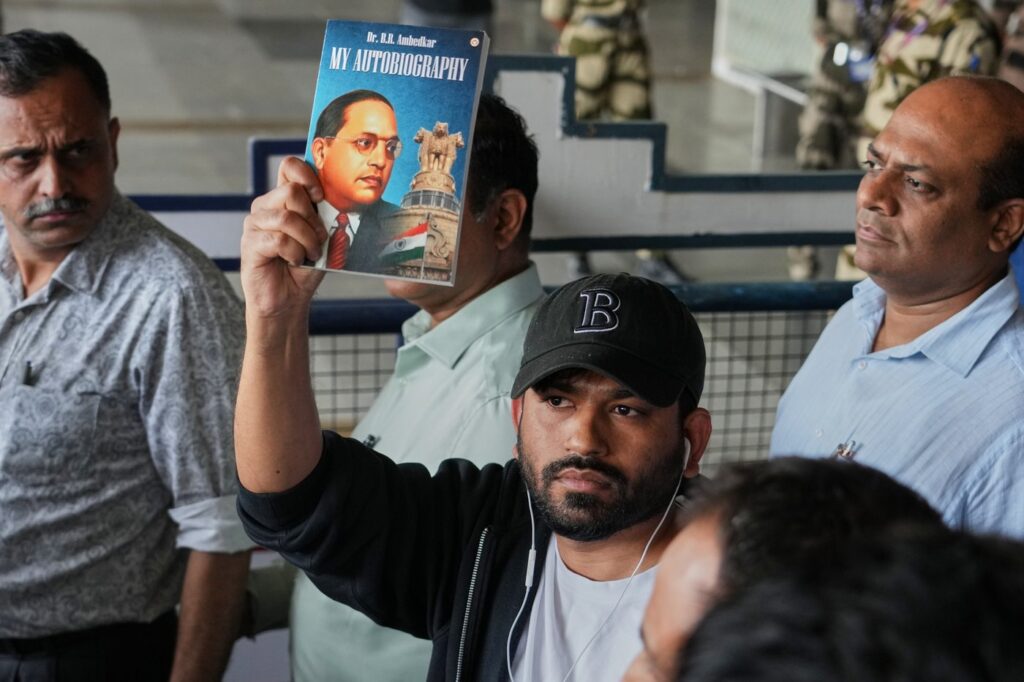
Demonstrators were encouraged to bring India's national flag and a book, symbolizing the right to education and equal opportunity for all. Organizers emphasized the importance of maintaining a peaceful demeanor and avoiding conflicts with law enforcement.
Despite its rapid ascent, the CJP faces substantial challenges ahead. Over the past decade, Modi's administration has implemented measures to suppress dissent, including crackdowns on protests related to controversial citizenship laws and lengthy farmer demonstrations.
Moreover, several past protest movements have encountered legal actions against their organizers and arrests of activists, leading critics to argue that these developments reflect a broader strategy by Modi's government to stifle dissenters.








