

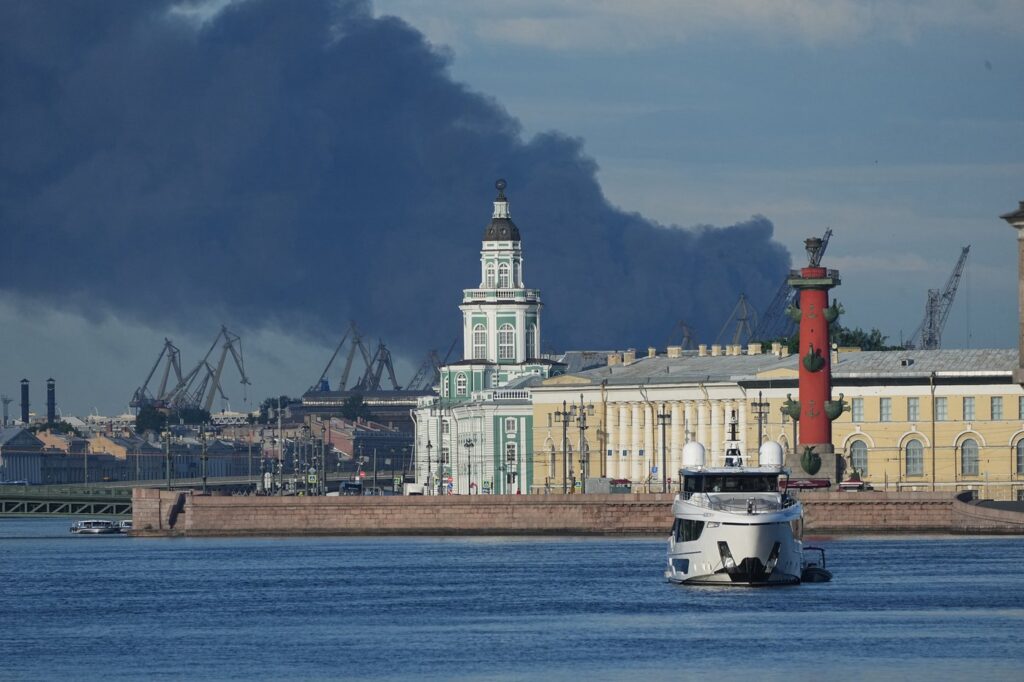
On Saturday morning, residents of St. Petersburg, Russia’s second-largest city, were advised to stay indoors following a "large-scale" Ukrainian drone attack that highlighted Ukraine’s increasing capacity to strike deep within Russian territory. This incident occurred just a day after Russian President Vladimir Putin declined an invitation for a meeting with his Ukrainian counterpart, President Volodymyr Zelenskyy.
St. Petersburg Governor Alexander Beglov urged locals to remain at home due to safety concerns and potential disruptions to mobile internet services. Concurrently, Regional Governor Alexander Drozdenko reported that air defenses in the surrounding Leningrad region successfully intercepted 141 drones. According to the Russian Defense Ministry, a total of 376 Ukrainian drones were shot down during the attack.
Ukrainian President Volodymyr Zelenskyy disclosed on social media that Ukrainian drones had traveled around 1,000 kilometers to reach targets in the St. Petersburg region, aiming at the enemy navy's arsenals and a naval base in Kronstadt. Although there were no immediate reports of casualties, this renewed strike was another significant setback for President Putin, undermining his efforts to portray the ongoing conflict as a distant issue that does not directly affect Russian citizens.
Earlier in the week, a separate drone strike in St. Petersburg had set fire to an oil terminal and impacted a nearby naval base, just hours before the St. Petersburg International Economic Forum—an annual event that showcases investment opportunities—was set to begin. During the forum, Putin asserted that Russia would bolster its air defenses in response to the increasing frequency and depth of Ukrainian drone strikes, which have overshadowed the event held in his hometown.
On Friday, Putin rebuffed Zelenskyy's recent proposal for a direct face-to-face meeting regarding the four-year conflict, stating that he saw "no point" in engaging. Zelenskyy’s message, which marked the first public correspondence directly to Putin since the Russian invasion of Ukraine in 2022, included a comprehensive critique of Putin’s nearly three-decade rule, as well as jabs concerning his age.
As both Russian and Ukrainian forces are engaged in a standoff along the front lines, persistent drone and artillery attacks have hindered any significant territorial advancements. Meanwhile, in Ukraine, one individual was killed, and three others were injured in the Dnipropetrovsk region due to multiple strikes from Russian forces, which targeted three districts with over 30 attacks using drones and artillery, as reported by regional head Oleksandr Hanzha. In Zaporizhzhia, seven people required medical attention following a Russian drone strike that ignited fires in a parking area.
Ukrainian air forces reported that Russia launched 272 strike drones against Ukraine overnight, successfully intercepting 249 of them. This ongoing cycle of attacks reflects the escalating hostilities as both nations vie for strategic advantages amid the prolonged conflict.








