

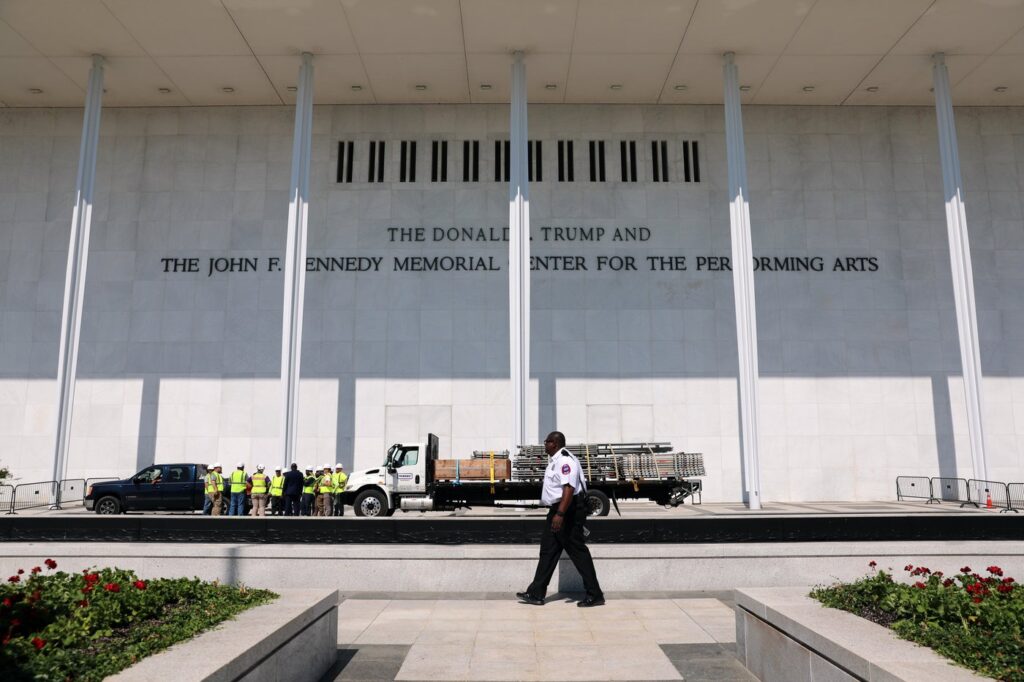
Workers commenced the removal of President Donald Trump's name from the facade of the John F. Kennedy Center for the Performing Arts in Washington, D.C., just hours after a court-mandated deadline on Friday, June 12, 2026. This significant action marks a pivotal moment in a series of events surrounding the contentious naming of the prestigious cultural institution.
In the hours leading up to the removal, the scene outside the Kennedy Center was bustling with activity. Workers were seen erecting scaffolding in front of the building to facilitate the removal process. Photographs captured by Rahmat Gul and Cliff Owen depict workers constructing scaffolding at various angles, emphasizing the preparations required for this undertaking. The scaffolding obscured President Trump’s name, symbolizing the shift that was occurring at this iconic venue.
On the same day, a notable figure, drag queen Tara Hoot, was present to celebrate the momentous occasion. Known for her activism against Trump's association with the Kennedy Center, Tara Hoot's presence underscored the cultural and political tensions surrounding the name change. Her celebration added an air of festivity amidst the operational undertakings of the workers, showing the division among the public regarding Trump's legacy.
As the workers continued to prepare for the name removal, obstacles such as inclement weather posed challenges. Reports indicated that rain caused delays, forcing workers to pause their operations temporarily until the weather improved. Despite these setbacks, the urgency of the project reflected the symbolic importance of removing Trump's name from such a prestigious venue.
The following day, Saturday, June 13, 2026, marked the commencement of the actual removal process. In images taken on this day, a worker was photographed carefully extracting a letter from Trump's name, an act that many viewed as a reclamation of the Kennedy Center's legacy. By this point, the facade had been enveloped in tarps, covering the area where the name had once proudly proclaimed its association with the former president.
The series of events surrounding the name removal has catalyzed discussions on the intersection of politics and culture in America. The Kennedy Center, a revered institution established in honor of President John F. Kennedy, has served as a space for artistic expression and cultural events. However, Trump's controversial presidency had cast a long shadow over its legacy, leading to calls for his name's removal from the center's facade.
Public sentiment regarding Trump's legacy remains divided, but the actions taken at the Kennedy Center represent a significant moment in the ongoing discourse about monuments and the names we choose to honor. As the workers completed the removal and finalized the covering of the once-visible name, it became clear that this act transcended the mere logistics of construction; it was a cultural statement reflecting a changing perspective on leadership and legacy in America.
In conclusion, the removal of President Donald Trump's name from the Kennedy Center encapsulates a broader cultural movement, signifying a desire to redefine public spaces and the narratives they convey. As the scaffolding and tarps become a part of the Kennedy Center’s history, they serve as a reminder of the dynamic interplay between art, politics, and public perception in contemporary society.








