

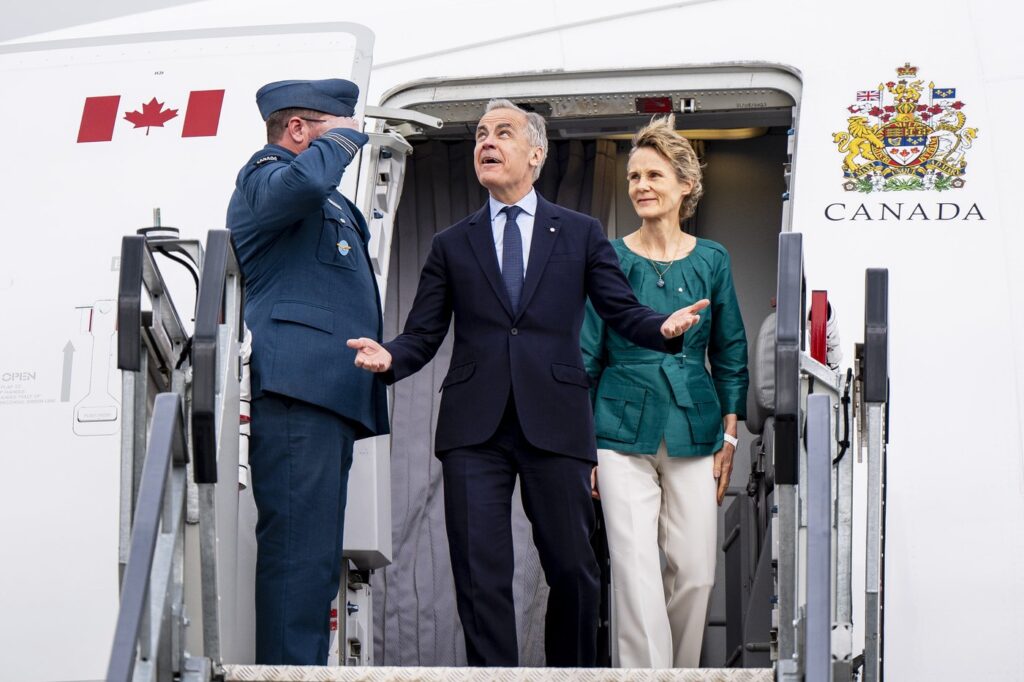
DUBLIN – Prime Minister Mark Carney is currently on an official visit to Ireland, aiming to foster business and investment opportunities with European partners while also connecting with his ancestral roots on the Emerald Isle. Carney arrived in Dublin on Saturday morning, where he is scheduled to meet with Micheál Martin, the head of government in Ireland, before participating in a welcoming ceremony at Dublin Castle.
The visit includes a joint media availability in the afternoon where both leaders are expected to discuss various topics, including a dialogue focused on strengthening transatlantic ties between Canada and Europe. In the evening, Carney will deliver remarks at an official dinner hosted by Martin.
This visit comes after Martin's planned trade mission to Canada was cancelled in April due to significant protests in Ireland over rising fuel prices. Notably, last September, Martin commissioned a report from the Conference Board of Canada to reinforce Ireland's role as “Canada's gateway to the European Union.” The report highlighted how Canada could enhance its exports to Ireland, particularly in financial services, air transportation, management, and consulting, while also pointing out that Ireland has opportunities to expand its sales in computer services, as well as insurance and pension sectors.
The report raised concerns regarding the complex regulatory environment in Canada, particularly interprovincial trade barriers, which pose challenges for businesses looking to establish and operate in the country. Meanwhile, Ireland has emerged as a significant hub for foreign investment and international technology companies, and it is preparing to assume the presidency of the Council of the European Union in July, with plans to unveil new digital policies. Both countries have recently introduced artificial intelligence strategies, with Ireland publishing its plan in the winter and Canada releasing its own plan earlier in the month.
Deirdre Giblin, head of the Ireland Canada Business Association, emphasized the growing relationship between the two nations, noting that Irish exports to Canada have nearly quadrupled in value since 2018, largely due to the Canada-EU trade agreement, CETA. However, the deal has not yet been fully ratified by Ireland due to ongoing concerns about trade tribunals and issues of national sovereignty. Martin previously met with Carney in Ottawa last September, where they expressed mutual interest in Ireland's full ratification of CETA by 2026. Giblin anticipates that Ireland will finalize its ratification shortly after Carney's visit as the government concludes its reforms on arbitration law.
Carleton University scholar Fen Osler Hampson pointed out that Carney's visit to Ireland is strategic for Canada, especially as Ireland takes a leading role in the EU. He noted that strengthened ties could assist Canada in enhancing its relationships with Europe across multiple sectors including defense, security, energy, artificial intelligence, and critical minerals. With CETA still pending ratification, Hampson suggested that Carney might encourage Ireland to persuade other nations to support the agreement's full implementation.
Giblin observed that Carney's discussions around diversifying trade relationships while adapting to shifts in the American economy resonate with Ireland, which has faced economic instability following Brexit. She described the current state of affairs as “values-based realism,” acknowledging that maintaining a stable relationship with the UK remains challenging.
However, Hampson warned that Ireland is likely to avoid critiquing the U.S. during Carney's visit due to its significant reliance on American direct investment, particularly in pharmaceuticals and technology sectors, which have benefited from Ireland's favorable tax regulations. Giblin raised concerns about over-reliance on these sectors, noting that more than half of Ireland's corporate tax revenue in 2023 originated from just ten American companies.
Compounding the complexity of the situation, controversy has arisen in Ireland regarding the Aughinish Alumina refinery, formerly owned by Canada’s Alcan, which now supplies Russian smelters with alumina used in aluminum production that is allegedly related to military supply chains. Canadian officials were cautious regarding whether Carney would address this matter during his visit but acknowledged ongoing dialogues between EU and Irish officials regarding the issue.
Further highlighting Ireland's unique position, although it maintains a neutral stance, it has shown support for Ukraine and has welcomed numerous Ukrainian refugees, alongside advocating for Palestinian rights in recent years. Giblin expressed that the alumina plant poses a challenge for Ireland’s international image, as discussions are underway about its operational implications amidst its employment of around a thousand individuals.
On Sunday, Carney plans to visit his family's ancestral home in County Mayo and meet with Irish President Catherine Connolly. His grandfather, Robert Carney, and grandmother, Nora Moran, hailed from Aughagower, County Mayo, before immigrating to Canada in the early 1920s.








