

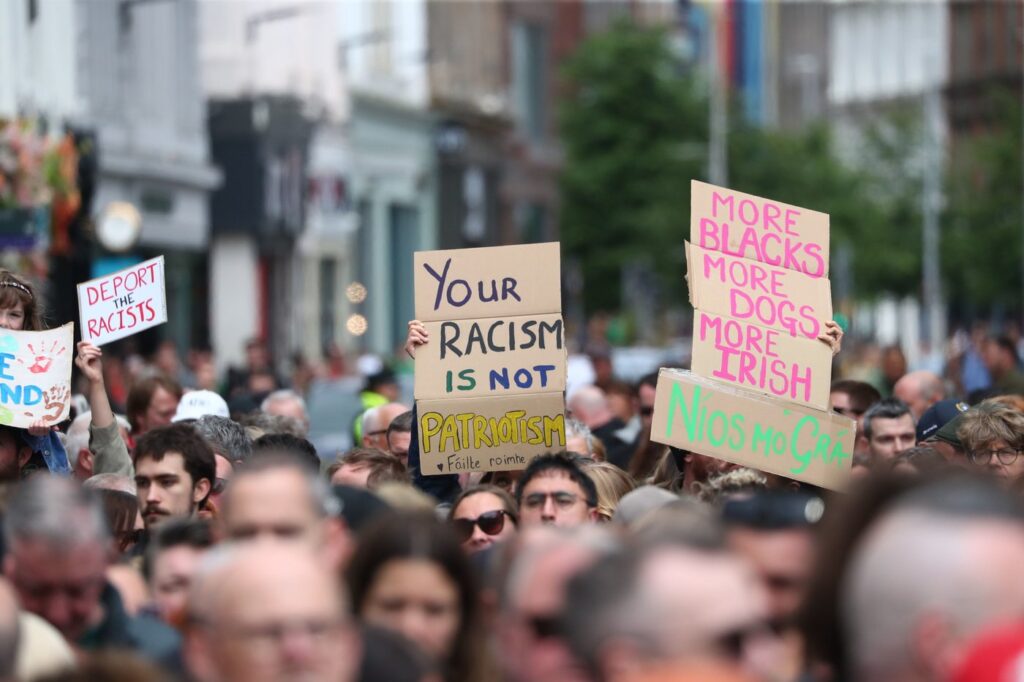
Thousands of demonstrators gathered in Belfast on Saturday to oppose anti-immigrant rioters who had set fire to homes and vehicles earlier that week, following a violent stabbing incident linked to an asylum seeker. This anti-racism rally was organized in response to the events that had unfolded after a 30-year-old Sudanese man was arrested and charged with attempted murder for a stabbing that left a victim partially blind.
The situation escalated as violent protests erupted, particularly in Northern Ireland. Groups of masked individuals took to the streets, targeting homes they believed housed immigrants, igniting a bus, and engaging in confrontations with law enforcement. Over two dozen people were left homeless due to the violence, and twelve police officers sustained injuries, with officials labeling the unrest as "thuggery."
Elaine Crory, a speaker at the rally, articulated the underlying issue of racism in her remarks, highlighting how the actions of a single person who is non-white and local can result in a resurgence of racist sentiments. The peaceful nature of the demonstrators stood in stark contrast to the earlier violence, as they carried signs proclaiming messages such as "The problem is evil & violence not race," "Your racism is not patriotism," and "Protect people not prejudice."
Amidst this turmoil, newlyweds Cara Bell and Matthew Richardson expressed their desire to contribute positively to their community. Just moments after their wedding ceremony at City Hall, they joined the peaceful protest to affirm that the sentiments of hate displayed during the violent protests do not represent the majority of Belfast residents. Bell remarked on the stark contrast between "the worst of humanity and the best of humanity" witnessed in Belfast that week.
Despite calls for calm from local officials and the family of the stabbing victim, far-right and anti-immigration factions were blamed for inciting protests in various locations throughout the U.K. earlier in the week. The unrest wasn't limited to Belfast; similar disturbances took place in Glasgow, Scotland, where minority communities were targeted. During one incident, worshippers at a local mosque were sent into lockdown due to heightened fears stemming from the protests.
On the same day as the Belfast rally, an anti-racism group in Glasgow mobilized thousands to reclaim the streets and challenge the far-right presence. However, they were met by a smaller group of counter-protesters, primarily men performing Nazi salutes and chanting anti-Muslim slogans. In response, the anti-racism demonstrators chanted back slogans such as "Nazi scum off our streets," indicating strong resistance to the hate-driven rhetoric.
The ongoing tensions and the need for solidarity against racism and violence remain a critical issue in the wake of these incidents. The protests underscore the urgent need for dialogues addressing the roots of hatred and the promotion of inclusivity within communities.








