

BEAVERTON, Ore. (AP) — Nike has prioritized heat, moisture, and national pride in designing uniform kits for the 2026 World Cup. This includes kits for football powerhouses such as France and Brazil, as well as the host nations, the U.S. and Canada. As the tournament faces challenges like storm delays and soaring temperatures of around 90 degrees Fahrenheit (32 degrees Celsius) in various locations, the company's main focus was on optimizing players' performance and comfort.
Phil McCartney, the Chief Innovation, Design and Product Officer at Nike, revealed that the company collaborated with athletes, coaches, and football federations to gain insights into the impact of uniforms on gameplay. "We also talk to fans — what does it mean to wear a Uruguay jersey, represent France, or play for Canada?" McCartney explained. This input is blended with scientific innovation to create aesthetically pleasing and functional designs.
Competing brands have also joined the mix, with Adidas creating jerseys for defending champions Argentina, host nation Mexico, and Colombia. Puma has taken responsibility for designing kits for Portugal, Morocco, and Senegal, the latter two being finalists in the recent African Cup of Nations.
Nike's sports research lab, located just outside Portland, Oregon, has played a significant role in the development of these kits. The facility features a 200-meter track, a small football pitch, and a basketball court, all equipped with hundreds of motion-capture cameras. Thermal chambers are utilized to replicate the effects of heat and humidity on clothing worn by human athletes or robot mannequins.
"We take motion capture to see how they’re moving in the kit, how the kits are responding," McCartney said. The thermal chambers test the kits' breathability and moisture management. For the World Cup, Nike has engineered a new fabric that promises increased breathability and is made entirely from recycled materials, featuring mesh stitching in areas to enhance airflow and thermal regulation, addressing feedback from players.
Despite extensive testing, some issues arose during earlier matches in 2026, with bulging appearing in the shoulder seams of jerseys for teams such as France and Uruguay. Nike assured that they identified the problem before the World Cup commenced and collaborated with federations "to ensure kits show up as intended."
In addition to the physical aspects of the kits, their design is equally meaningful for fans who wish to proudly display their team's colors. McCartney highlighted that inspiration for the designs comes from various sources, including history, art, music, and culture, all aiming to connect with the nation being represented.
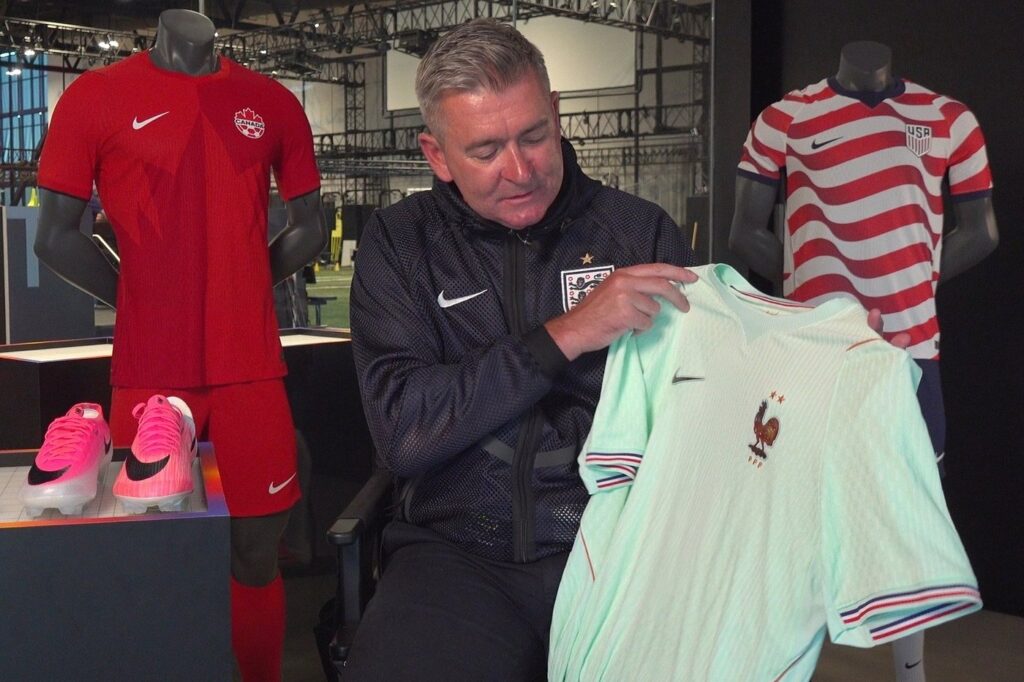
France's away kit is a light green that resembles the Statue of Liberty, a gift from France to the United States in the late 19th century. The interior tag features the word “Liberté” alongside a silhouette of the monument’s crown, while the front showcases a rooster—an emblem of both the national team and the country—alongside two stars symbolizing France's previous World Cup victories.
Both France's and Uruguay's home kits feature collars, a design choice influenced by the respective federations. France’s decision reflects its reputation as a fashion capital, while Uruguay aims to evoke a classic football aesthetic reminiscent of older uniforms that often included collars.
For the U.S. and Canada, national symbols informed kit designs. The U.S. home kit boasts horizontal red and white stripes reminiscent of the American flag, while Canada’s prominently features a maple leaf. McCartney noted, "Especially in an event like the World Cup, we really play into national pride."








