

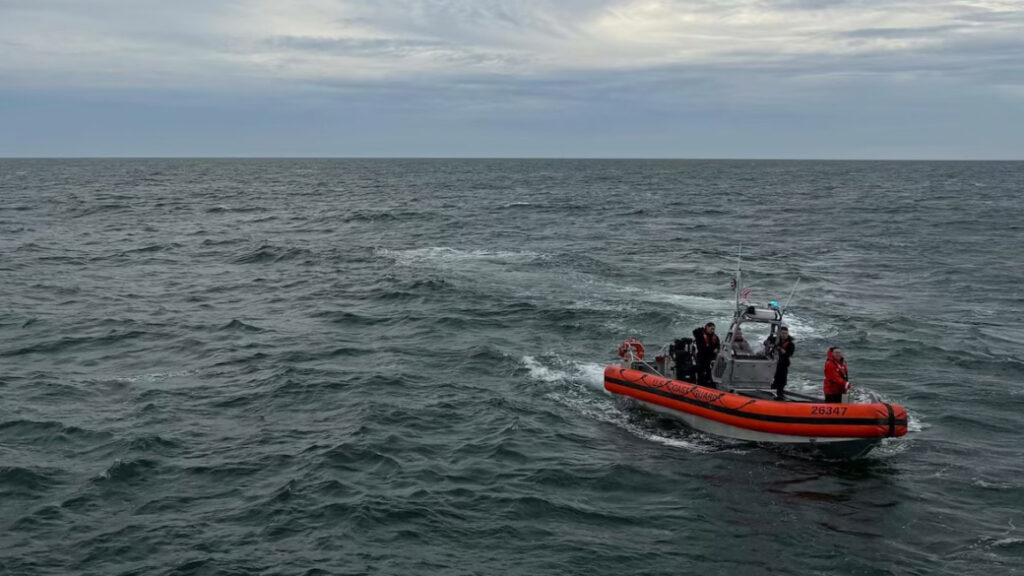
The United States Coast Guard continues its search for survivors of an Ontario air ambulance that crashed off the eastern U.S. coast early Saturday morning. As of Sunday morning, officials have focused their efforts on a debris field located approximately 20 miles off Nantucket, although they have refrained from confirming whether the operation has transitioned from a rescue mission to recovery.
U.S. Coast Guard Rear Admiral Matt Lake emphasized, “Our priority is to locate the six personnel on that aircraft.” Coast Guard teams, alongside the New York National Guard’s Air Rescue Wing and local Massachusetts authorities, are conducting extensive search operations over an area of 2,840 square miles (7,356 square kilometers). Their search involves various assets, including fixed-wing aircraft, helicopters, boats, and cutters.
Lake describes the search area as “large and demanding.” The water depth surrounding the debris field is reported to be between 80 and 90 feet (approximately 24 to 27 meters). The Coast Guard has initiated the deployment of sonar technology to explore the seabed in their quest for the missing aircraft.
Captain John McTamney, the search and rescue coordinator, stated, “We’ll continue to search and saturate the area until we’re confident that if there were any survivors remaining on the surface of the water, we would have found them.”
The aircraft, owned by Latitude Air Ambulance, a medical evacuation company based in Hamilton, Ontario, was transporting a patient and a family member from Bermuda to Boston when it disappeared around 1:30 a.m. The flight had six people on board, comprising four Canadians and two Bermudian nationals.
Newly released air traffic audio suggests that just prior to the aircraft’s disappearance, the pilot experienced electrical problems and declared an emergency while approaching the U.S. coast amidst an impending storm. A controller is heard confirming with the pilot, “Roger, you said you’re coming in blind. Is that what you said?”
Mary Schiavo, a former Inspector General of the Transportation Department, believes the airplane could have lost its navigational instruments just as the storm approached, noting that the plane sharply descended from its cruising altitude of approximately 24,000 feet to as low as 10,000 feet. This alarming drop in altitude was corroborated by preliminary data from FlightRadar24.
Schiavo commented, “Something bad happened with this big drop, and they flew into this big storm. It’s a terrible place to have a loss of your instruments and be flying blind. It’s very easy to get disoriented and not know if you’re turning, climbing, descending, etc.”








