

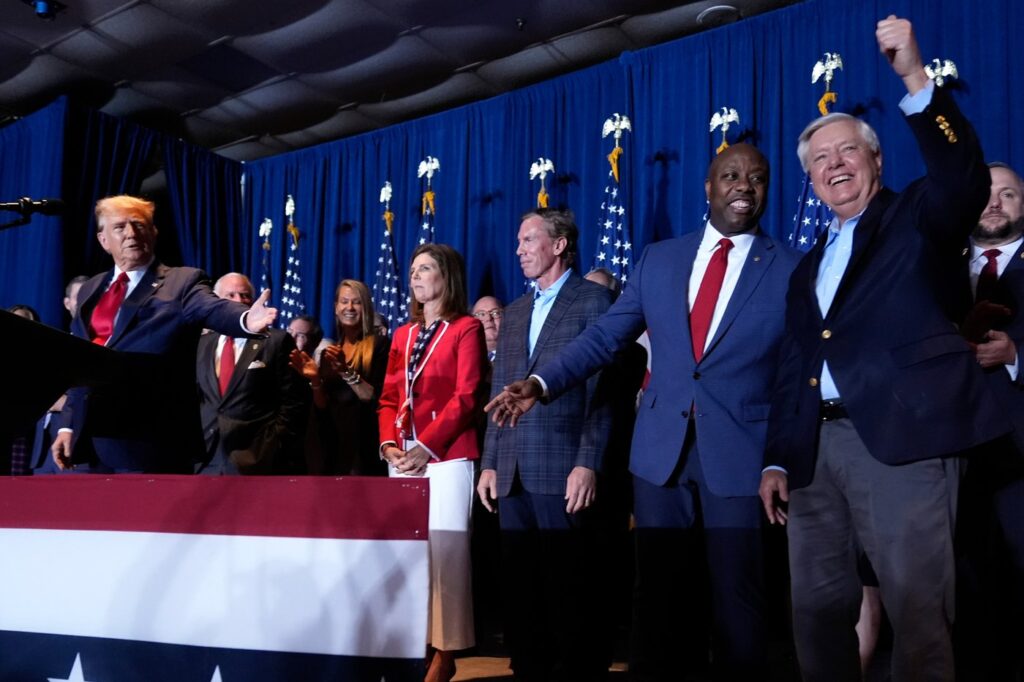
CHARLESTON, S.C. (AP) – The recent death of Senator Lindsey Graham, who was campaigning for a fifth term, has initiated a significant shift in South Carolina's political landscape during an already tumultuous year. Graham, a prominent figure and influential ally of former President Donald Trump, was widely expected to secure reelection before his sudden passing.
In the wake of Graham’s death, South Carolina Governor Henry McMaster is tasked with appointing a temporary replacement to serve until January. This appointment is crucial as the state gears up for a special primary election in which voters will select a new Republican nominee for the upcoming general election. The opening of a Senate seat has sparked intense interest among the state’s ambitious conservative politicians, many of whom are eager to ascend in their political careers.
The recent Republican primary battle for McMaster's successor saw State Attorney General Alan Wilson emerge as the nominee, defeating several notable contenders, including Lt. Gov. Pamela Evette, Rep. Nancy Mace, and Ralph Norman. All of them are now potential candidates eyeing Graham's Senate seat.
According to South Carolina law, the filing period for the special primary election will commence on the second Tuesday following Graham's death, which is set for July 21. The election will then take place on the second Tuesday following the closing of the filing period, designated for August 11. If a runoff is necessary, it would occur two weeks later on August 25. This timeline poses complications regarding compliance with federal law, which mandates that ballots for military and overseas voters must be distributed 45 days before a federal election. This timing aligns with the general election primary that would have started on June 27.
The circumstances surrounding Graham's death, attributed to an aortic dissection, have left many in South Carolina's Republican circles speculating about potential appointees to fulfill the remainder of Graham’s term. The individual chosen by McMaster is likely to be a significant contender in the special primary, although it’s possible that the appointee may only serve as a caretaker until the election concludes. Evette, who has worked closely with McMaster over the past eight years, is considered a viable candidate. Despite her recent loss in the gubernatorial primary runoff to Wilson, she reportedly feels encouraged and believes she could perform well in the upcoming special primary.
It's important to note that House members are unlikely to be appointed to finish Graham's term due to the narrow Republican majority in the chamber. However, several representatives, including Joe Wilson, Mace, and Russell Fry, have expressed interest in running for the forthcoming full term. Mace, in particular, is not seeking reelection for her House seat and is contemplating a run for Graham’s vacated position.
In the context of the general election, no Democrat has secured a Senate seat in South Carolina for decades, with Republicans often achieving substantial victories in statewide races. Graham's previous electoral success in 2020 against Democratic challenger Jaime Harrison, where he won by a 10 percentage point margin, reflected this trend. Charleston pediatrician Annie Andrews has secured the Democratic nomination and is actively fundraising for the race, demonstrating a significant financial commitment that could pose a challenge for Republicans moving forward.
Graham’s passing leaves a substantial void in the Senate, where his seniority played a crucial role in influencing committee leadership and legislative agendas. With more than 20 years of service, Graham was a well-established figure, and his absence will be felt keenly by his colleagues, especially by South Carolina's junior senator, Tim Scott, who referred to Graham as "irreplaceable" and expressed deep personal loss.
Overall, Graham's death marks a pivotal moment in South Carolina politics, with repercussions that will influence both state and national dynamics as the potential candidates for his Senate seat prepare for what promises to be a competitive election cycle.








