

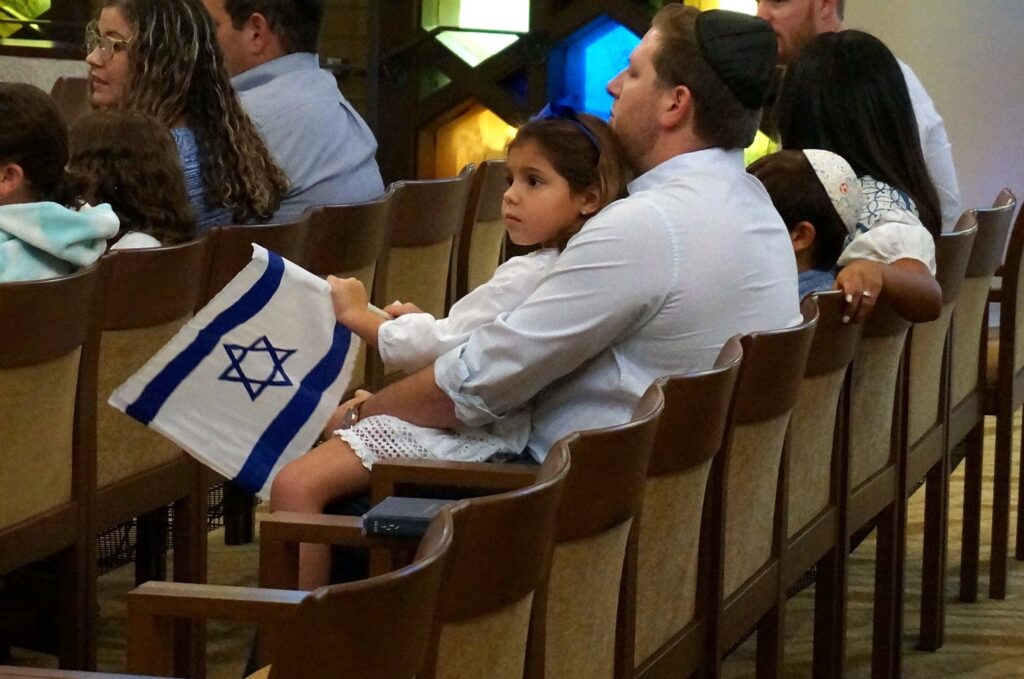
A recent AP-NORC poll highlights a significant generational divide among Jewish adults in the United States regarding their support for Israel. While many Jewish adults aged 45 and older strongly associate their religious identity with support for Israel, younger Jewish adults tend to prioritize other aspects of their cultural and religious connection, such as celebrating Jewish holidays.
The survey, which involved 1,022 Jewish adults, indicates that this generational gap extends beyond political views to the very foundations of religious identity. Younger Jewish adults, particularly those who identify as religiously Jewish, place a stronger emphasis on cultural practices and traditions rather than on the state of Israel itself. For instance, approximately 6 in 10 religious Jewish adults of all ages regard their Jewish identity as “extremely” or “very” important in their lives. However, support for Israel is deemed less critical among younger individuals.
Cameron Bernstein, a 27-year-old medical student from New Orleans, shared her perspective, stating, “I pray for people in the land of Israel. I don’t need to pray for the state,” indicating a more personal connection to Israel rather than allegiance to its government. This sentiment reflects a larger trend among younger Jewish adults, where about 4 in 10 express that supporting Israel is “extremely” or “very” important to their Jewish identity, compared to nearly 50% of older adults who share this view.
The poll reveals that among Jewish adults who identify as religiously unaffiliated, the emotional connection to Israel is generally weaker. Susan Boyer, a 72-year-old retiree from Southern California, draws a link between supporting Israel and protecting Jewish people and their homeland. Boyer’s views are rooted in historical concerns about antisemitism and Jewish safety, especially in light of rising antisemitism in recent years.
Conversely, some younger Jewish adults like Ari Pollack, a 30-year-old arts fundraiser from Wisconsin, express strong opposition to Israel's military actions, arguing they contribute to antisemitism and make Jews less safe globally. Pollack highlighted a struggle with the Jewish establishment’s historically pro-Israel stance that he found difficult to reconcile with his evolving views. His perspective aligns with the sentiment of about 3 in 10 religious Jewish adults under 45, who characterize Israel's actions during the recent Gaza conflict as genocidal.
Additionally, values such as social justice and community engagement hold great importance for younger Jewish adults. Phoebe Wapnitsky, a 32-year-old from Connecticut, articulated her commitment to standing against oppression as a core Jewish principle, further distancing her identification with the Israeli government's recent actions.
Brian Ebarb, a 47-year-old attorney from Louisiana, acknowledged the importance of supporting Israel while also emphasizing that rightful criticism of the government should not translate into hostility towards Jewish people worldwide. Ebarb's caution reflects a complex understanding of Jewish identity that extends beyond political support.
Overall, the findings from the AP-NORC poll underscore a complex landscape of Jewish identity in the U.S., where younger generations are increasingly redefining their connections to Judaism, Israel, and their understanding of cultural practices. The perceptions of what it means to be Jewish and the role of Israel in that identity are evolving, indicating a significant shift in the cultural and religious priorities of younger Jewish adults.








