

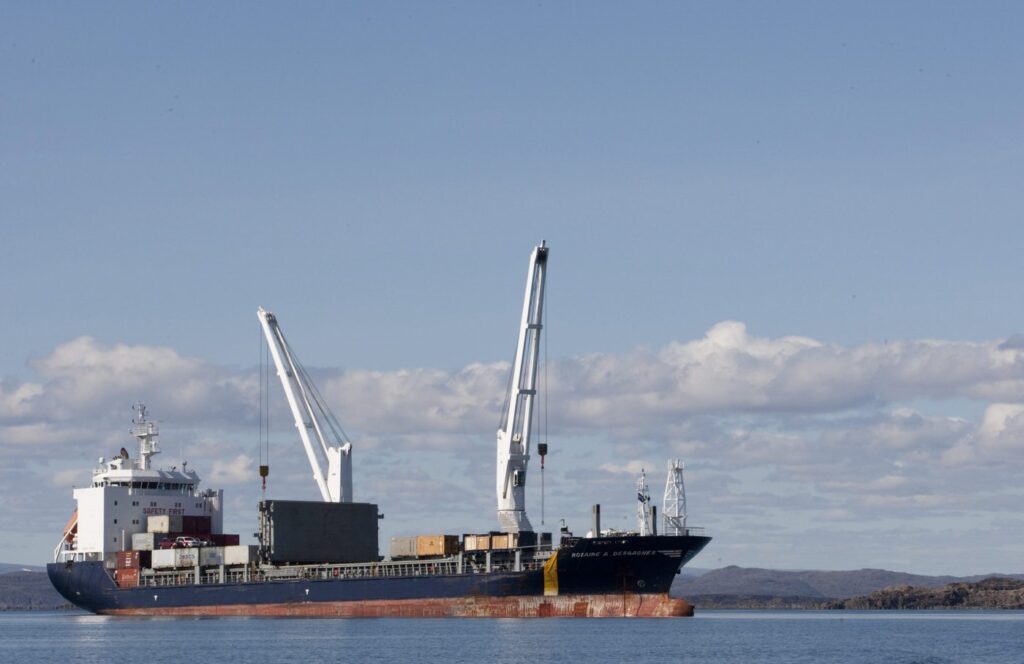
MONTREAL – A Canadian shipping firm, Desgagnés, has faced significant challenges in its attempts to exit the Strait of Hormuz after nearly five months of being trapped in the Persian Gulf amid ongoing conflict in the Middle East. The Quebec-based company operates two freighter ships, which are reported to be the only Canadian commercial vessels caught in the Gulf during escalations that began when the U.S. and Israel launched attacks on Iran in late February 2026.
Pascal Larose, vice-president of Desgagnés, detailed that officials from the U.S. Navy in Bahrain have provided a potential route for the ships to navigate safely through a hazardous area filled with mines. However, he noted that the "danger zone" is approximately a 12-hour sail, and the exact timing of their departure remains uncertain. “It’s a moving target,” Larose stated in a phone interview, emphasizing that the exit's feasibility depends entirely on American military guidance.
Initially, Desgagnés aimed to have at least one of its freighters leave the conflict zone within seven days. Unfortunately, these plans have not materialized, and as tensions in the Middle East escalated with fresh fighting between the U.S. and Iran, any plans for departure have now been postponed indefinitely.
In the past week alone, U.S. forces have reportedly targeted over 300 sites in Iran, including military speedboats located near the Strait of Hormuz. In retaliation, Iran's military announced that it had initiated a new wave of strikes targeting U.S. military installations in Bahrain and Kuwait, as well as various locations in Oman and Jordan. In light of these developments, President Donald Trump announced the reintroduction of a naval blockade on Iranian ports and a 20% tariff on all cargo passing through the Strait, a historically critical passageway managing about a fifth of the world's oil and liquefied natural gas shipments.
Despite this, the statements made by the administration reflect earlier threats that did not come to fruition and stand in stark contradiction to prior assertions regarding international maritime law, which affirms that no state should impose fees for passage through open seas.
Larose shared the financial strain Desgagnés has endured due to this prolonged stoppage. The company was forced to lease alternative freighters to maintain its operations and fill the void left by the stranded vessels. "When you charter a ship like that, your margin is very minimal, if not negative," he said.
The two stranded ships, identified as the Miena Desgagnés and the Rosaire A. Desgagnés, had been on a mission to deliver general cargo to ports in Iraq, Saudi Arabia, and the United Arab Emirates at the time tensions escalated in late February. From March through May, both vessels remained immobilized in the Persian Gulf, anchored off the coast near Jubail, Saudi Arabia.
The situation has been described as “stressful” for the 34 crew members aboard – 17 on each ship, alongside three trainees from a maritime institute in Quebec who were evacuated in March. Notably, the remaining crew members are not Canadian nationals. Larose assured that they had not faced immediate threats, such as drone or missile attacks, and took care in selecting secure anchoring locations.
In May, the ships made a brief stop in Dubai to resupply on food, water, and fuel, which provided them with self-sufficiency for an additional two months. Initially, the crew had expected to remain on board until mid-June; however, by early July, they were feeling fatigued from the extended confinement. Most of the original crew members had since returned to their homes in the Philippines and Ukraine, leaving new crews who are eager to depart the area.
In June, after remaining idle for more than three months, the freighters found temporary work within the Gulf, transporting metallic powder used in steel production. Nevertheless, Larose indicated that once they do finally leave the region, there is a strong possibility they will choose not to return. “There’s a good chance we’ll say no. We’ll go elsewhere,” he remarked, acknowledging the substantial financial "hurt" the company has experienced.








