

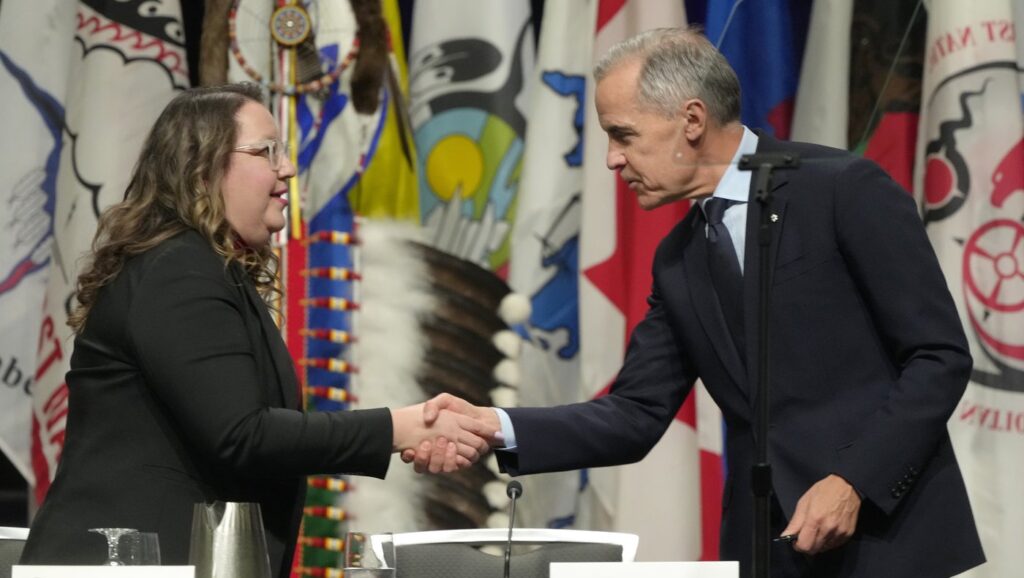
Hundreds of First Nations chiefs are convening in Ottawa today for the annual Assembly of First Nations (AFN) meeting. This three-day event will see delegates debate 53 distinct resolutions that touch on critical issues such as the federal government's projects agenda, First Nations child welfare, Indian Act status, and requests for the Vatican to retract several papal decrees.
During the assembly, chiefs will also gain insights from presentations focused on the recently tabled First Nations Clean Water Act, consultations regarding major project developments, child welfare reforms, and an upcoming First Nations meeting with Canadian premiers and Prime Minister Mark Carney.
National Chief Cindy Woodhouse Nepinak expressed her appreciation for the heightened interest in the assembly from federal ministers, private corporations, and environmental groups. She emphasized the leadership role of First Nations across various sectors in Canada, stating, “We have to make a stronger Canada from all of us by working together more closely.”
The Assembly of First Nations serves as a national advocacy body representing around 630 First Nations chiefs. While it does not hold rights itself, the assembly reflects the interests and rights of its chiefs. Several federal ministers are expected to be in attendance, including Indigenous Services Minister Mandy Gull-Masty, Crown-Indigenous Relations Minister Rebecca Alty, Natural Resources Minister Tim Hodgson, Artificial Intelligence Minister Evan Solomon, and Public Safety Minister Gary Anandasangaree.
Minister Gull-Masty recently reintroduced legislation designed to guarantee First Nations access to clean drinking water in their communities. This new bill aligns closely with a previous one that was unsuccessful under Prime Minister Justin Trudeau's government but lacks language acknowledging an immediate right to clean water. Instead, it states the government will work toward the “progressive realization” of that right. Chief Roderick Gould Jr. of Abegweit First Nation is urging his fellow chiefs to push for the explicit inclusion of the right to clean water in the new legislation.
A first ministers meeting that Prime Minister Carney promised to the chiefs is now scheduled for the fall. Over the years, Woodhouse Nepinak and her predecessors have consistently called for First Nations representation at such meetings. These pleas gained urgency last year when discussions among federal and provincial governments focused on expediting major infrastructure projects without the involvement of First Nations representatives. Woodhouse Nepinak has deemed the exclusion of First Nations from these discussions as “very disrespectful.”
She remarked on the necessity for economic progress that simultaneously respects First Nations rights and the government's legal obligations. The upcoming meeting with Carney and the premiers is seen as a significant opportunity to gauge Canada's capability to reconcile economic development with First Nations' rights. “Are the conversations going to be easy? Absolutely not,” Woodhouse Nepinak noted. “We’re not going to solve Canada’s issues in one day.”
Among the resolutions to be debated is one demanding that Pope Leo rescind papal bulls—official papal decrees—which First Nations leaders argue have historically facilitated the enslavement and conquest of Indigenous Peoples. In 2023, the Vatican formally disavowed the controversial Doctrine of Discovery, which has been used to justify European territorial claims in the Americas. Chief Dan Manuel of the Upper Nicola Indian Band advocates for the Vatican to take further action by nullifying additional papal decrees considered the “blueprint” for colonization. He calls for the creation of a global memorial to document and honor the adverse effects these decrees have had on Indigenous populations.
As the assembly progresses, the AFN is also preparing for an election for national chief in the upcoming year, coinciding with the conclusion of Woodhouse Nepinak’s three-year term. She announced her intent to seek re-election, although no other candidates have publicly declared their intentions as of yet.








