

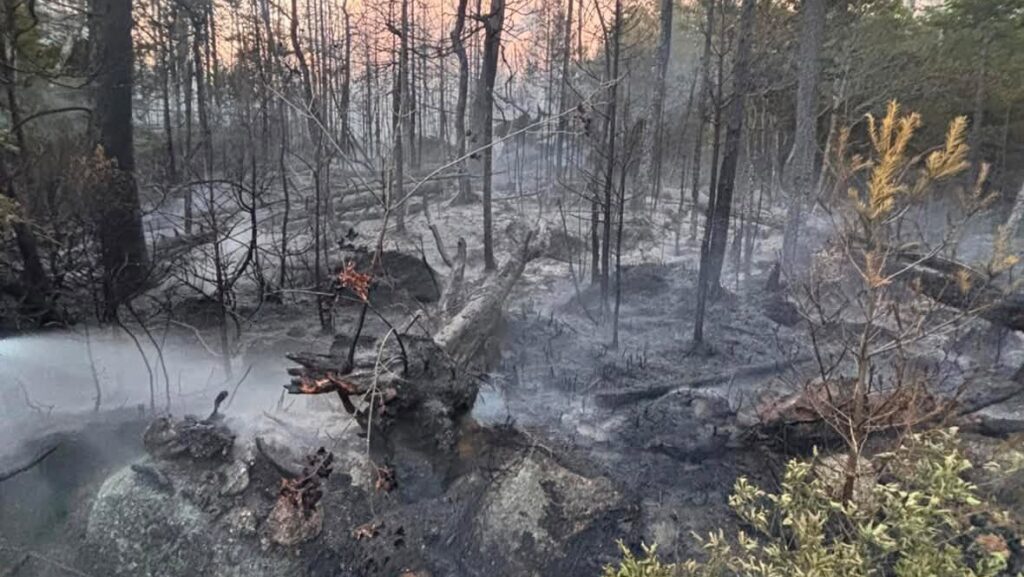
Crews from Halifax Regional Fire and Emergency Services, in collaboration with volunteers and personnel from the Department of Natural Resources (DNR), are actively engaged in combating an uncontrolled fire in Jacket Lake as of Thursday morning.
Emergency officials received the initial reports regarding “heavy smoke” in the vicinity of Mooseland Road on Wednesday evening around 7:00 p.m. Upon arrival, firefighters discovered a blaze occurring in what they described as a “remote and difficult-to-access area." The Halifax Professional Fire Fighters union noted that aerial firefighting support from the DNR was unavailable due to the time constraints of dusk.
A DNR spokesperson clarified that while helicopters are equipped to conduct operations safely during daylight hours, they are grounded at nightfall. Fortunately, the firefighting teams made initial contact with sections of the fire before darkness fell.
The morning after the initial report, fire crews resumed operations, joined by DNR officials, to reassess the situation. Additional off-duty members from the Halifax fire services were summoned to bolster the firefighting efforts. As reported by the DNR, 24 provincial personnel, 31 volunteer firefighters, and members of Halifax Regional Fire and Emergency Services are actively engaged in firefighting operations. In total, two helicopters and four fixed-wing water bombers have been deployed to combat the flames from the air.
Patricia Jreige from the Department of Emergency Management acknowledged the unpredictability of the fire situation, stating, “It’s difficult to say definitively at this point when we will get this under control, as the weather this afternoon may pose challenges.” She pointed out that Nova Scotia has encountered over 100 wildfires this year, which is double the number of incidents when compared to the same period last year.
In an online message, the provincial DNR estimated the fire's size at approximately seven hectares, indicating that it remains out of control. The current situation thus poses considerable challenges for the firefighting teams on the ground and in the air.
The province of Nova Scotia recently enhanced its wildfire response capabilities with the introduction of a new fleet of helicopters. These H125 helicopters are noted for their versatility and are intended to assist in firefighting, search and rescue operations, as well as scientific research and transportation of personnel and equipment. Additionally, the province has contracted four water bombers specifically for the ongoing wildfire season which runs until the end of September.
Jreige emphasized that “Nova Scotia's investments in modern wildfire response are already making a real difference.” The integration of new helicopters, along with contracted fixed-wing water bombers and well-trained firefighting crews, is expected to significantly improve the province's capacity to respond to wildfires and protect its citizens and their communities.








