

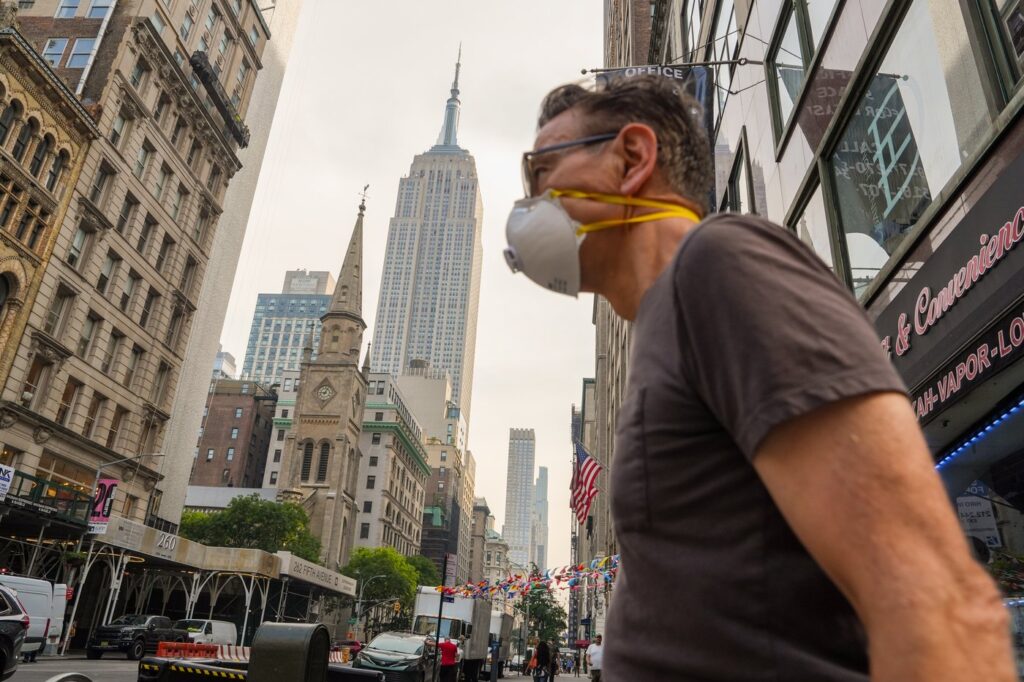
Smoke from Canadian wildfires recently observed in northern New Jersey may not postpone Sunday’s World Cup final, though deteriorating air quality could still lead to a delay, as articulated by Dr. Myles Druckman, senior vice-president and global medical director at International SOS. Dr. Druckman expressed that conditions will be closely monitored throughout the day and if the smoke intensifies at the New York-New Jersey Stadium in East Rutherford, a kickoff delay might be considered.
According to Dr. Druckman, the hopes are for a combination of factors to alleviate the situation, including the weather potentially clearing some of the smoke, a change in wind direction, the diminishing of the fires, and cooler temperatures. He noted, “The combination of heat and smoke is never good.”
Dr. Druckman further mentioned that the New Jersey region has previously experienced “yellow-outs,” which indicate a serious level of air pollution where visibility decreases significantly, necessitating the need for vehicles to operate with headlights on. He surmised that if conditions worsened to this extent, it would likely result in a delay of the match. He expressed, “We’re all hoping that that’s not going to be the case.”
Despite hazy skies shrouding the New York-New Jersey area for several days, the current impact of smoke on the World Cup final remains uncertain. The World Health Organization’s forecast predicts an improvement in air quality to a “moderate” level in East Rutherford, suggesting an overall positive trend.
Air quality was reportedly more favorable on Friday; however, uncertainty persists due to expected rainfall of up to 3.17 centimeters on Saturday. The smoke from the wildfires has already caused several sporting events in Canada and the United States to be canceled this week. For instance, a Major League Soccer match between the Vancouver Whitecaps and a Chicago team was postponed, while a Canadian Premier League game involving Forge FC and Pacific FC in Hamilton was rescheduled due to the adverse air quality stemming from wildfires in northern Ontario.
In a separate instance, the New York Mets and the Philadelphia Phillies adjusted their game schedule on Thursday night by moving the start time up by one hour due to air quality concerns. Dr. Druckman commented on the deteriorating conditions he observed while watching parts of the game, noting, “You could see the haze roll over the stadium. It’s definitely something that they’re going to have to watch very carefully.”
Further emphasizing the health concerns related to air quality, Phillies star Bryce Harper remarked to ESPN that it might not be wise to play in such weather conditions. Dr. Druckman pointed out the necessity for organizers to consider the welfare of the thousands of spectators attending the match, given that many would be vocally participating while breathing in potentially harmful air.
Despite New Jersey's distance from the fires, Dr. Druckman explained that smoke can still have a significant impact on the respiratory system, leading to symptoms like respiratory irritation and itchy eyes. While more dangerous small-particle chemicals dissipate quickly, the larger particles posed in wildfire smoke can still cause health issues.
It is notable that while some sports organizations, such as the Canadian Football League (CFL), have set clear air-quality protocols, FIFA has yet to publicly disclose the air quality thresholds that would trigger a postponement of matches. Dr. Druckman indicated that the increase in frequency of wildfire smoke events necessitates the establishment of clearer guidelines among sports organizations to ensure the safety of participants and spectators alike.
He noted, “These types of events push it into the forefront for all organizations. It is going to push sports organizations to develop some standards so at least everyone is on the same playing field, as they say, when it comes to this.” Dr. Druckman concluded with an acknowledgment of the emerging reality of more frequent air quality crises, emphasizing the need for proactive preparation and planning in the face of such unfortunate events.








