

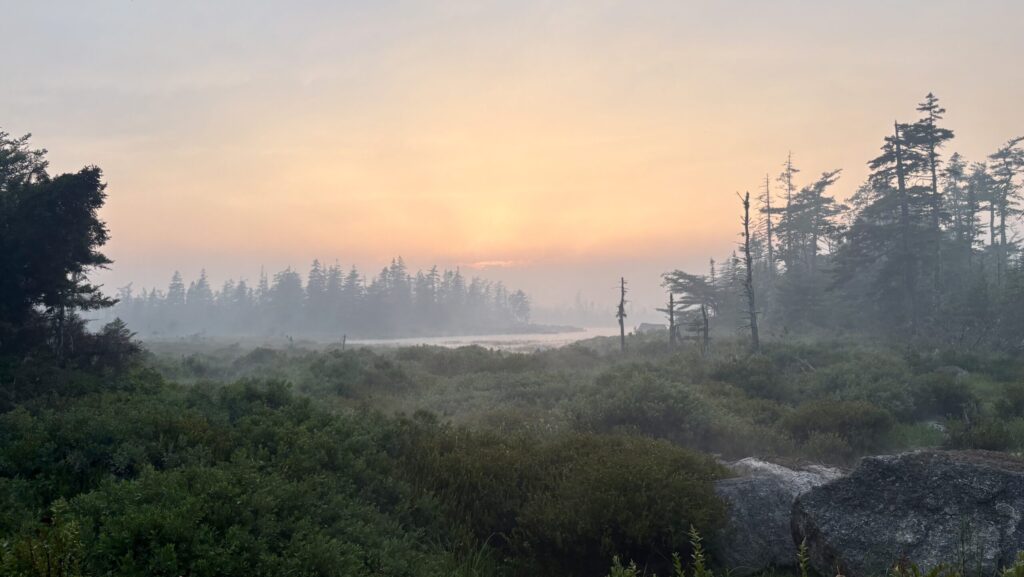
A significant wildfire continues to rage out of control near Mooseland Road by Sixth Lake in Halifax County, as confirmed by an update at 10:30 a.m. on Saturday, July 18. The fire has been officially mapped at an estimated 1,386 hectares, a reduction from the previously estimated 1,700 acres due to improved measurement techniques. Authorities are continuing to recommend that people avoid the area, and Mooseland Road remains closed to traffic starting from the intersection with Highway 7.
Fire and emergency services personnel are actively responding to the situation, utilizing two Department of Natural Resources (DNR) helicopters and four fixed-wing water bombers to combat the flames. Additionally, two more water bombers from Newfoundland are assisting with the effort. The firefighting workforce on the ground includes 25 DNR personnel and 45 firefighters from Halifax Regional Fire & Emergency services. The Halifax Professional Firefighters union has indicated that this will be the last update unless there are significant changes in conditions.
Fire Discovered Thursday, Residents Told to Evacuate
The Jacket Lake wildfire was initially discovered on Thursday, July 16, and began at a mere four hectares in size. However, it rapidly expanded to approximately 1,700 hectares by July 17. Around 9:00 p.m. on Thursday, residents living along Mooseland Road, from 4315 Mooseland Road to Highway 7, were issued evacuation orders.
Fire crews have been engaged in a challenging battle against the flames, which originated in a "hard-to-access" region of Halifax County. According to Halifax Professional Firefighters, the blaze spread south and east on Thursday afternoon, crossing Mooseland Road and complicating firefighting efforts.
Evacuees are able to register at designated evacuation centers located at Musquodoboit Rural High School, situated at 11980 Hwy. #224, and Marine Drive Academy at 479 Church Point Road.
While there is no rain predicted for Saturday, officials are hopeful for precipitation to arrive by Sunday. Robichaud, a spokesperson for the firefighting teams, expressed optimism that a weather system expected to move in could deliver significant rainfall, with forecasts ranging from 15 to 30 mm for the affected area.
In terms of manpower, the DNR has mobilized 25 personnel alongside 31 volunteer firefighters, all cooperating with Halifax Regional Fire and Emergency Services to address the crisis. Notably, this year has already witnessed over 100 wildfires in Nova Scotia, doubling the number of incidents recorded at the same time last year. Comparatively, the previous year's fire season was marked by severe drought conditions and ignitions caused by lightning that persisted well into the fall.
Though Rudderham noted that Nova Scotia's current drought levels do not surpass those from last year, indications suggest a worrying trend towards similar conditions. As the situation unfolds, all focus remains on firefighting efforts and mitigation strategies, with the hope that upcoming weather changes will aid in controlling the blaze.








