

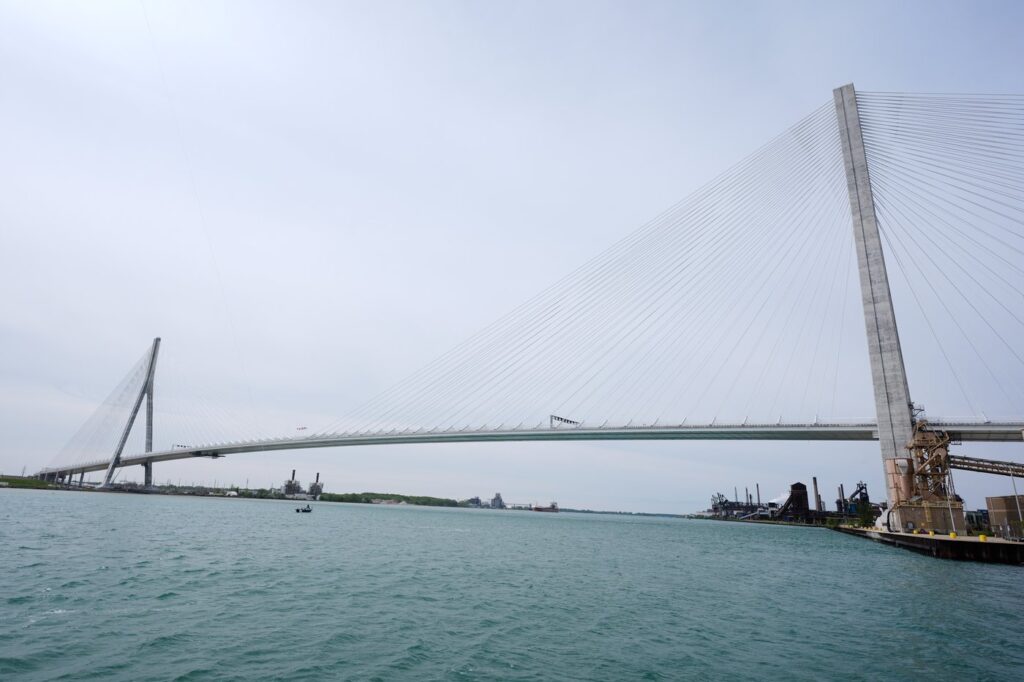
OTTAWA — The Canadian federal government announced on Tuesday that it will not hold a celebratory event in conjunction with the opening of the Gordie Howe International Bridge due to the recent tariff threats made by U.S. President Donald Trump. Jenna Ghassabeh, a spokesperson for Infrastructure Minister Gregor Robertson, stated in an emailed message, “It would be inappropriate to proceed with a celebratory event between the two countries.”
Despite the lack of a Canada-U.S. celebration, a Canada-only event is scheduled for Friday, with the bridge expected to officially open on the following Monday. Sources familiar with the arrangements, who requested to remain anonymous, indicated that invitations for the Friday event had already been distributed and that the decision to limit the celebration to Canada was made earlier in the day, with attendees notified in the afternoon.
On Monday, Trump threatened to impose tariffs of up to 50 percent on various Canadian products within the next 30 days. American officials characterized these new tariffs as a reaction to Canada’s provincial bans on U.S. alcohol, its supply-managed dairy system, and quotas that affect American automobile imports. On the same day, Prime Minister Mark Carney had a telephone conversation with Trump, where they agreed to intensify trade negotiations.
As of now, neither Michigan Governor Gretchen Whitmer nor the Windsor-Detroit Bridge Authority has responded to requests for comments regarding the upcoming event or Trump's tariff announcement. The Gordie Howe International Bridge, which connects Ontario and Michigan, was established as a representation of the close ties and interdependence between the two regions. It is named after Gordie Howe, a legendary Canadian hockey player known for his achievements with the Detroit Red Wings, including four Stanley Cup victories.
The Howe Foundation released a statement on social media expressing pride and gratitude over the bridge being named after Gordie Howe, emphasizing that the late hockey star “always believed in bringing people and communities together.” However, the bridge's opening has now become emblematic of the strained relationship between Canada and the United States during Trump’s presidency.
The bridge's inauguration was initially postponed when the Trump administration sought to renegotiate the agreement due to opposition from the Moroun family, which owns the Ambassador Bridge and has significant ties to the Republican Party. A ribbon-cutting ceremony was originally planned for June 12 to officially open the $6.4 billion bridge. However, according to a source from the White House, U.S. Commerce Secretary Howard Lutnick intervened, prompting negotiations on new terms.
Reports indicate that Lutnick met with members of the Moroun family shortly before Trump threatened to block the bridge’s opening unless the U.S. was compensated. On July 10, a deal to proceed with the bridge was finally announced, yet confusion surrounding its financial arrangements persists. Carney indicated that Canada and the U.S. will share net revenues—post operational costs—for the first 15 years of the bridge’s operation. The U.S. share will contribute to a regional economic development program in Michigan, while Canada intends to use its share to cover construction debt.
However, the Bloomberg news agency has stated that the recent deal does not include provisions for covering debt servicing costs. It is important to highlight that the 15-year agreement to operate the bridge is separate from the original arrangement signed in 2012, under which Canada undertook the construction costs. The initial terms, established with former Republican Michigan Governor Rick Snyder, remain active, stating that after 15 years, all toll revenues will go to Canada until the full construction cost is repaid, after which revenues will be shared with Michigan.
The ownership of the Gordie Howe International Bridge is held jointly between the Government of Canada and the State of Michigan, marking a significant infrastructure project symbolizing cross-border cooperation amidst current tensions.








