

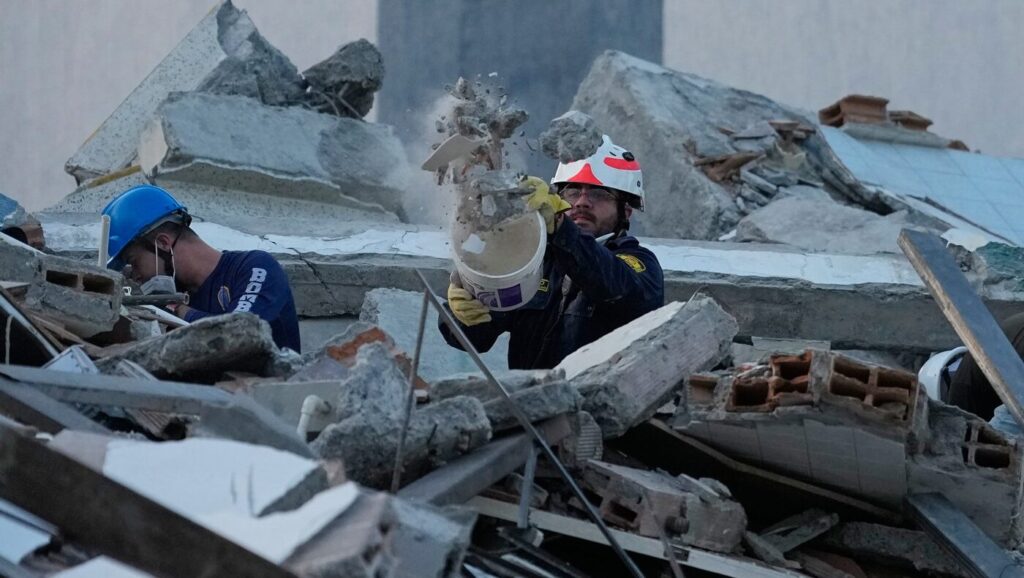
Search and rescue operations resumed on Tuesday in numerous cities and towns across western Colombia following a powerful earthquake measuring 7.4 on the Richter scale that struck on Monday. The disaster has left over 3,000 people unaccounted for, with many feared trapped beneath the rubble.
Mayors and governors from key locations including Cali, Pereira, Choco, and Manizales reported on Tuesday that at least 179 fatalities have been confirmed across these areas. In contrast, the federal government had provided an earlier death toll of at least 111 as of Monday. The scale of the devastation has been significant, with approximately 1,600 buildings reported as damaged or completely collapsed.
Emergency personnel, soldiers, and families have been coordinating rescue efforts, sifting through debris and passing large concrete chunks by hand in an organized chain of volunteers. The Choco region, where the earthquake's epicenter is located, is one of the poorest and most neglected areas in Colombia, often plagued by conflict among armed groups. Due to the challenging geography, much of Choco is accessible only via boat, through dense jungle, or by air, leaving substantial uncertainty regarding the extent of damage there.
Colombia's newly inaugurated President, Abelardo De la Espriella, visited Choco's capital, Quibdo, on Monday night. He announced the mobilization of "the entire military and police apparatus" to aid in the emergency response, including the deployment of engineers, rescue workers, and search dogs. De la Espriella emphasized his commitment to ensuring that "Choco will never again be the 'land of the forgotten.'"
This earthquake marks a pivotal challenge for President De la Espriella, who took office just days before the disaster on Friday. His controversial stance has included a rigorous crackdown on criminal organizations that have long affected the Andean nation. Families are actively seeking missing relatives, utilizing citizen-run websites to share information. Dana Carolina Zamora, for example, has been searching for her missing 60-year-old uncle, Miguel Ángel Zamora, a farmer from El Cairo, whose traditional house made of sticks and mud lies close to the quake's epicenter in San Jose Del Palmar.
Local authorities have reported that around 80 percent of El Cairo, which has a population of about 7,000, has been damaged. Zamora expressed her concerns, stating, "We are afraid. We hope that is not the case, that he is all right and that it is only a communication failure. But we haven’t heard anything from him." The quake has left many in the region uneasy, especially after several intense quakes devastated neighboring Venezuela in late June, resulting in over 6,300 casualties and extensive property damage.
Among those affected is Mónica Sánchez, who runs a small company that manufactures work uniforms in Pereira, one of the cities hit hardest by the earthquake. A wall inside her factory collapsed, yet she and her 12 workers managed to escape just in time. "It was shocking — the city fell down around us," she recounted. Pereira's municipal government reported at least 58 buildings had collapsed, while in Cali, Mayor Alejandro Eder confirmed that at least 40 buildings were also downed.
To maintain order and prevent looting, both cities implemented curfews on Monday night. In Pereira, the government has also prohibited privately owned vehicles from circulating to facilitate the movement of ambulances, police, and rescue workers. The U.S. State Department announced it would provide $15.5 million for emergency shelter, food, and additional aid, with support also coming from various governments across Latin America.
Mayor Mauricio Salazar of Pereira described the situation as a tragedy for the entire city and thousands of families, adding, "But here we are, and we will continue forward with the hand of God."








