

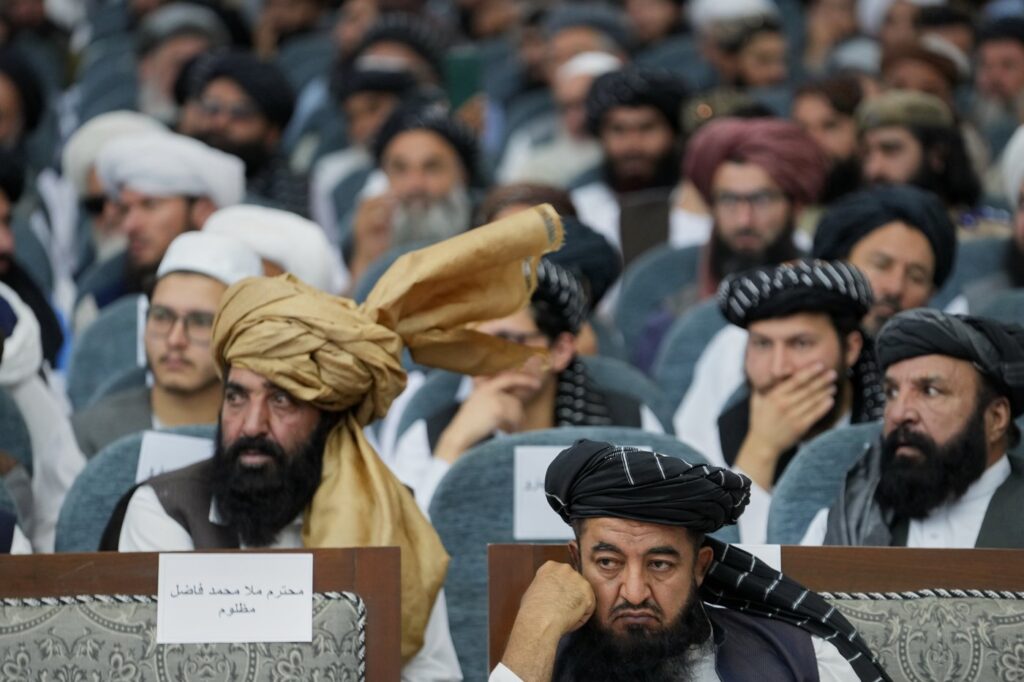
KABUL, Afghanistan (AP) – On Saturday, Taliban rulers and various officials convened at Afghanistan's traditional Loya Jirga assembly hall to commemorate the fifth anniversary of their return to power, asserting that they have brought stability and an end to decades of conflict. However, a senior United Nations official has issued a stark warning about a severe human rights crisis affecting the nation, particularly the denial of education for girls over the age of 12.
The Taliban seized control on August 15, 2021 as U.S. and NATO troops withdrew after a protracted two-decade war, triggering chaos at Kabul airport as many sought to escape the country. Immediately following their takeover, the Taliban enforced bans on girls' education beyond the sixth grade and subsequently imposed restrictions on higher education for women, despite earlier promises to facilitate education, employment, and public participation for women.
In addition to educational restrictions, women have been barred from public spaces, including gyms and parks, prohibited from participating in sports, and required to have a male guardian for travel outside their communities.
During the Loya Jirga gathering, high-ranking officials joined foreign representatives and thousands of citizens for speeches celebrating what they described as Afghanistan’s liberation from U.S. forces. "We pray to Almighty God to forever protect our homeland from occupation, aggression, wars, and insecurity, and to enable our people to enjoy peace, tranquility, and prosperity under the auspices of the Sharia-based government," said Hamdullah Fitrat, the Taliban government's deputy spokesman. Notably, there were no women present at the event.
Five years into their rule, the Taliban government remains isolated on the international stage, with Russia being the sole country to formally recognize its authority. Foreign Minister Amir Khan Muttaqi urged other nations to reconsider engagement with the Taliban, asserting that those which did have benefitted from their interactions. "Those that engaged and interacted with the Islamic Emirate of Afghanistan benefited," he stated, calling for a shift in policy towards engagement and mutual interaction.
Security was heavily fortified in Kabul during the celebrations, with men taking to the streets carrying Taliban flags and chanting slogans in support of the governance. Convoys of vehicles contributed to traffic congestion, while tight security measures included numerous checkpoints leading to the Loya Jirga hall. Celebratory activities also extended to various provinces, where Taliban flags and supportive posters lined roads and marketplaces.
Richard Bennett, the U.N. special rapporteur on the human rights situation in Afghanistan, highlighted the deepening human rights crisis in a video message, indicating worsening conditions particularly for women and girls. He remarked, "While the era of war has ended, it’s questionable whether there’s real peace, and the human rights situation has steadily deteriorated." Bennett classified the systematic oppression of women as a crime against humanity, detailing a range of human rights violations occurring in the country, including arbitrary arrests, torture, extrajudicial killings, and discrimination against various minority groups.
In an interview, Molvi Hayatullah Mahajar Farahi, the Taliban's deputy minister for broadcasting, acknowledged past challenges yet claimed the administration had succeeded in improving security, infrastructure, and job creation over the five years. However, he did not comment on the education restrictions affecting girls and women. According to UNESCO, approximately 2.4 million girls have been excluded from secondary education, with child malnutrition reported at critical levels across one-third of Afghanistan’s provinces, as outlined by the U.N. World Food Program.
The U.N. agency for women's rights, U.N. Women, indicated that women and girls are facing some of the most severe restrictions globally, warning that these policies jeopardize Afghanistan's future by undermining essential services such as teaching and healthcare.








