

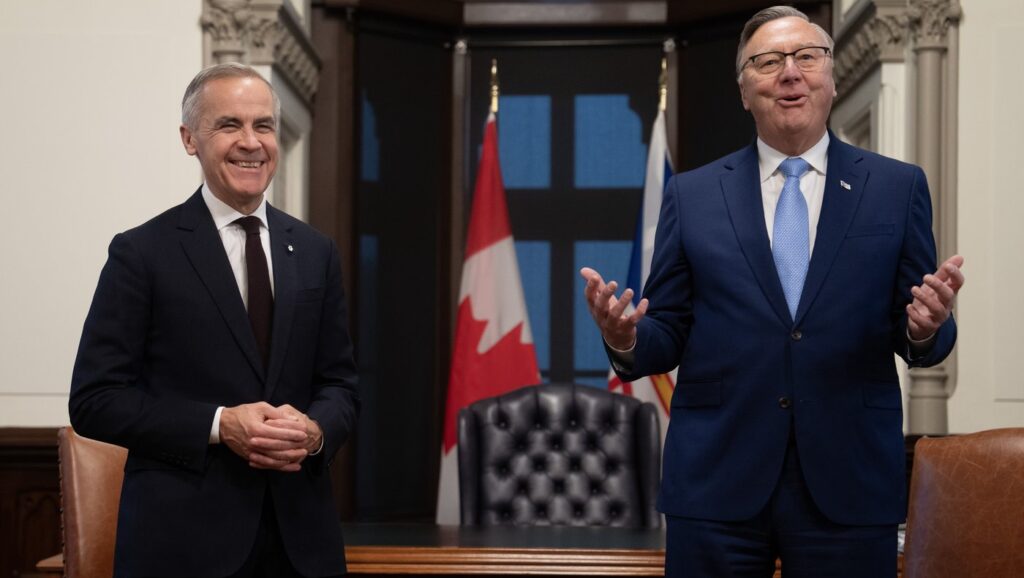
ST. JOHN'S Hydro utilities in Quebec and Newfoundland and Labrador have reached a non-binding agreement for energy sharing from Labrador, with assistance from the federal government. This announcement was made during a joint press conference held in St. John’s, attended by Prime Minister Mark Carney and the premiers of both provinces.
The tentative agreement outlines a framework for Hydro-Québec and Newfoundland and Labrador Hydro to split power from the Churchill Falls generating station. Additionally, it proposes the development of new hydro, wind, and transmission projects that are expected to exceed $50 billion in value.
If finalized, this agreement represents a significant milestone for Newfoundland and Labrador, enabling the transmission of up to 985 megawatts of power from Labrador through Quebec to markets in the United States. Negotiators are hopeful to finalize the deal by year’s end; however, the timeline may be impacted by the Quebec provincial election, which Quebec Premier Christine Fréchette must call by October 5. The effects of this electoral campaign and the potential formation of a new government remain uncertain, casting a shadow over these negotiations.
Newfoundland and Labrador Premier Tony Wakeham expressed confidence in the draft agreement, labeling it a "win-win-win situation," despite the challenges ahead. The region's utilities are exploring approximately 14,000 megawatts of potential hydroelectric developments along the Churchill River and in Labrador. Newfoundland and Labrador seeks to capitalize on the hydroelectric potential of the river for economic gain, while Quebec aims to ensure a stable power supply for the foreseeable future.
The negotiation process has been ongoing for years. A framework agreement was reached in 2024, but Wakeham, following his election victory last year, sought further negotiations to secure more power, greater value, and better transmission rights through Quebec. During his election campaign, he had pledged to hold a public referendum regarding any finalized deals but recently retracted that promise. He acknowledged that while some in his province might be disappointed, the opportunity to strike a deal could not be passed up.
The agreement introduced on Monday includes plans for a new 2,700-megawatt generation facility at Gull Island on the Churchill River, as well as upgrades to the existing 5,428-megawatt power station at Churchill Falls. Furthermore, it encompasses proposals for new transmission lines and a feasibility study for constructing a second powerhouse at Churchill Falls.
The federal government is set to invest $10 billion into several proposed projects, including those related to transmission lines and the Gull Island development. Starting from 2027, Hydro-Québec will begin paying an increased rate for power from the Churchill Falls facility, initially set at 1.8 cents per kilowatt-hour and projected to rise until reaching an average effective price of 7.4 cents per kilowatt-hour over the next 50 years. This is a significant increase compared to the 0.2 cents per kilowatt-hour currently paid under a contract established in 1969, which will expire in 2041. The historical arrangement has been perceived by many in Newfoundland and Labrador as inequitable and unjust.
The tentative agreement aims to ultimately terminate the 1969 deal, potentially resolving longstanding tensions between Quebec and Newfoundland and Labrador. The agreement, if finalized, would strengthen interprovincial relations and enhance energy collaboration, signalling a new chapter for both provinces.








