

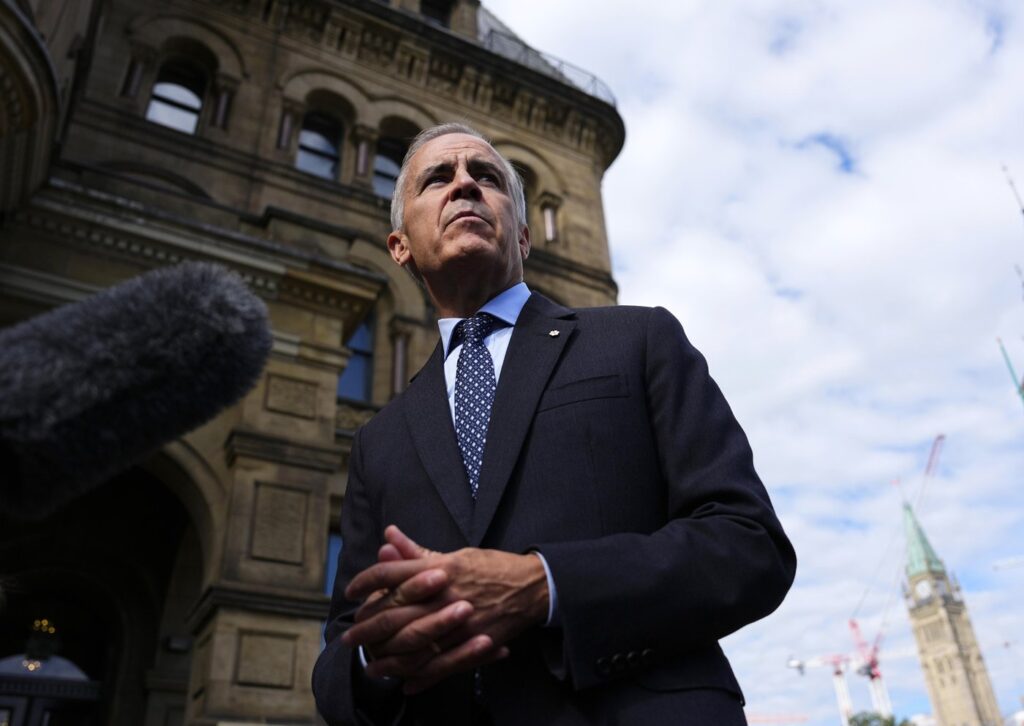
OTTAWA – Prime Minister Mark Carney has cautioned Canadians that the nation’s shift away from reliance on the United States will come with challenges, but he insists that the repercussions of inaction would be far more detrimental. In a nationally released video address on Tuesday, which coincided with the introduction of Canada’s retaliatory tariffs, Carney emphasized the government’s strategy to forge new trade agreements with other countries in response to the ongoing U.S. trade war.
During the video, Carney stated, “We have everything we need to pivot and prosper.” He acknowledged that while the transition to a broader trade network would incur expenses, “there’s always a cost to action,” he added, “But it doesn’t come close to the cost of standing still.” This video is part of a communications effort started last spring to keep Canadians informed about government actions and the responses to U.S. trade measures.
Carney’s objective, he stated, is to strengthen Canada’s economic resilience, thereby ensuring that “no country can ever hold us hostage, and that we can live how we want to live.” His remarks come in the wake of trade discussions with the U.S. that fell through last month, as both parties were unable to finalize a deal before U.S. President Donald Trump’s deadline, which included the imposition of 50 percent tariffs on approximately $28 billion worth of Canadian goods.
In the latest address, Carney reiterated earlier assertions that the U.S. has attempted to implement restrictions impacting Canada’s ability to trade with other nations and to safeguard and promote French language and culture within the country. These concerns have stirred debate, prompting federal Conservative leaders to demand the full disclosure of the deal Canada walked away from. They have also called for the government to reconvene parliament earlier than the scheduled return date of September 21.
Conservative Party leader Pierre Poilievre addressed the media in Regina, stating, “We’re asking for the Prime Minister to be straight up. We know it’s not easy to negotiate with the U.S. President. But the best way to keep everyone united and rowing in the same direction is to be up front about the costs, the decisions and the plan going forward.” He criticized the government for not sharing the deal’s details with the Canadian public, declaring that citizens deserve to know what the country is advocating for and what it is opposed to.
Carney also detailed how Trump’s tariffs have been strategically designed to disproportionately impact certain Canadian industries, particularly steel, aluminum, auto, and lumber, predominantly affecting workers in Ontario, Quebec, and British Columbia. Conversely, provinces such as Alberta and Saskatchewan have seen less impact. He remarked, “In the spring of last year, I warned that America is trying to break us so they can own us. And I promised that that will never, ever happen.”
For nearly two years, Trump has aired thoughts about integrating Canada as the 51st U.S. state, labeling Carney and former Prime Minister Justin Trudeau as “governor.” He has also been vocal about feeling that Canada desires to be treated like a U.S. state. In January 2025, prior to his inauguration for a second term, Trump indicated that while he would not utilize military action to annex Canada, he would contemplate applying “economic force” to achieve that aim.
The introductory tariffs by Canada took effect on Tuesday, serving as a direct response to Trump’s latest tariff measures. These Canadian tariffs, which range from 15 to 50 percent, target only those products listed by the U.S., matching the value of exports at $27.8 billion. Carney clarified, “I don’t believe in escalating the conflict; that’s not constructive. But our tariffs are necessary to protect our workers, protect our companies, and our communities. We can’t let American goods into Canada tariff-free while they charge our companies to export them.”








