

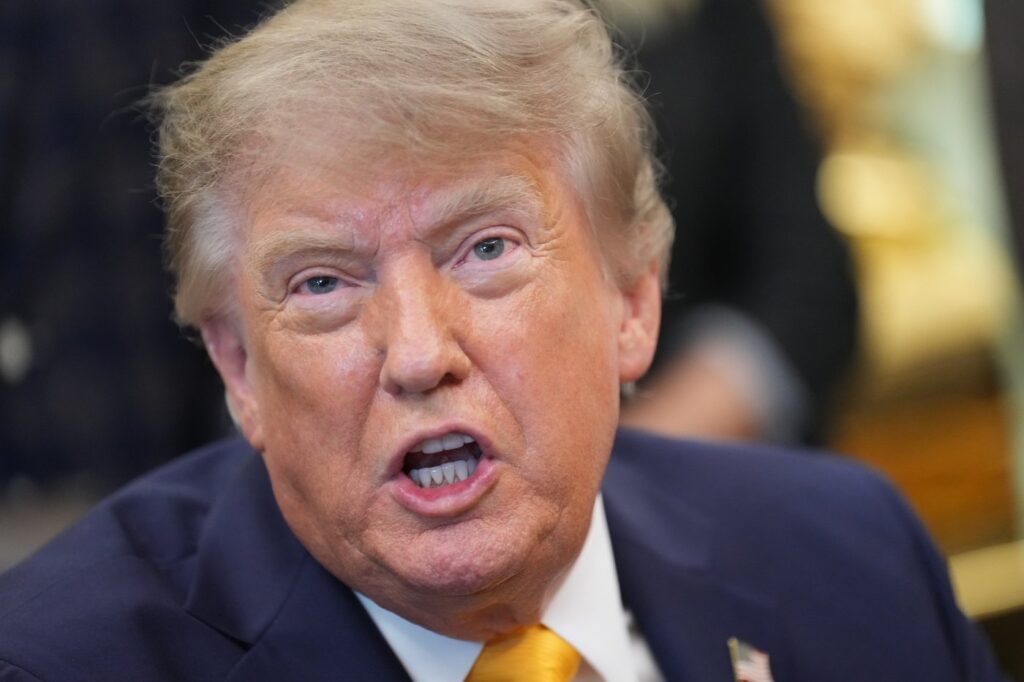
On Tuesday evening, President Donald Trump announced a significant shift in trade policy by issuing a series of executive orders that will bar the import of specific Canadian goods into the United States. Among the goods affected are motorcycles and alcoholic beverages. This latest action comes in the wake of retaliatory tariffs imposed by Canada, which took effect at midnight the same day.
The imposition of these new restrictions indicates a renewed tension between the two neighboring countries regarding trade practices and policies. Earlier in the day, Trump further escalated his rhetoric by threatening to eliminate Canadian products from government contracts as part of his broader strategy to combat what he perceives as unfair trade practices from Canada.
In a social media post, Trump indicated that he would instruct trade representatives along with the federal agency responsible for government procurement to “take all necessary steps” to eliminate Canadian-origin products unless Canada agrees to restore “full and fair reciprocity” for American farmers and businesses. This refers to his insistence that the United States should have equitable access to Canadian markets, similar to what Canada offers to American companies.
Trump's statements included a claim that the Canadian government, along with its provinces, has effectively barred American small businesses from participating in Canadian government procurement markets. He characterized this situation as not meeting the standard of reciprocity but rather as a “Canadian Trade Scam,” emphasizing his belief that Canada has been engaging in unfair trade practices against U.S. companies.
In his earlier comments and ongoing critique, Trump pointed to the “Buy Canadian Policy” implemented by the Canadian government as a retaliatory measure following his administration’s imposition of tariffs and other trade threats against Canada. He has claimed that this policy significantly undermines American businesses and contributes to an unbalanced trade relationship.
In juxtaposition, the United States has its own version of a “Buy America” policy, which prioritizes domestic purchasing in vital sectors of the economy. This practice reflects a broader trend among countries to protect their domestic industries by encouraging the purchase of homegrown products, but it also raises questions about the implications for international trade relations and the potential for escalating trade conflicts.
The developments pertaining to U.S.-Canada trade relations highlight ongoing challenges in negotiations and trade agreements between the two nations. The latest round of executive orders signifies a hardline stance from the Trump administration, aiming to leverage trade policy as a means to negotiate more favorable terms for American businesses.
With these actions set to take effect later in the month, stakeholders in both the U.S. and Canadian markets are left to navigate the ramifications of this trade order, which poses potential economic consequences for various sectors reliant on cross-border trade. As tensions simmer, the future of U.S.-Canada trade relations appears to be at a critical juncture.








