

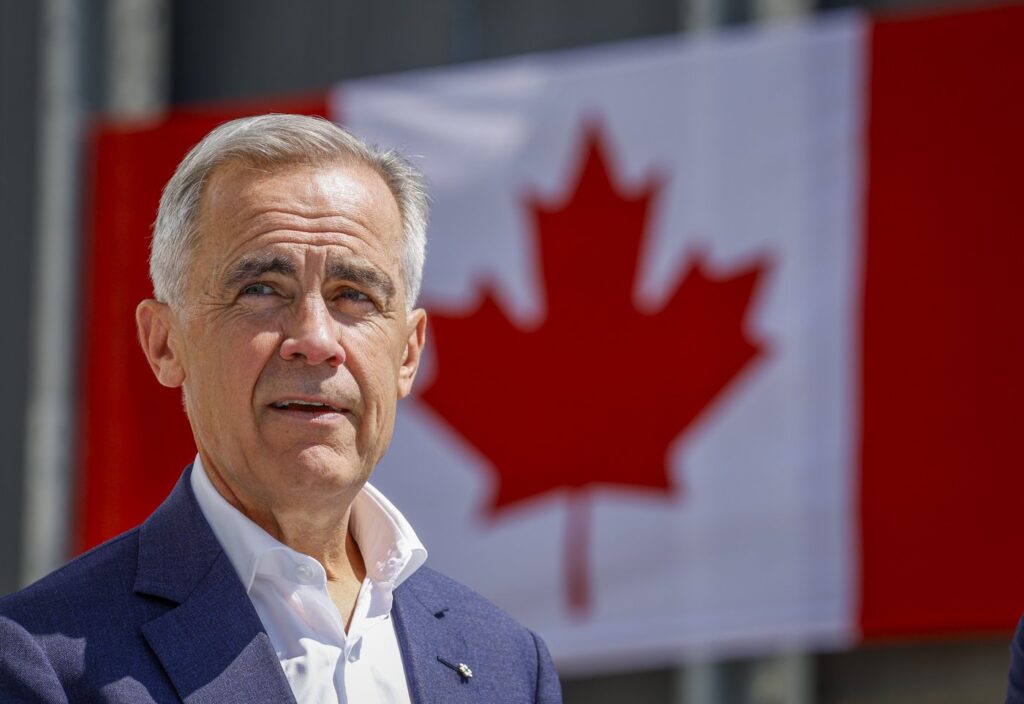
A recent poll indicates that the Liberal Party, under the leadership of Mark Carney, has secured its most substantial lead over the Conservative Party since his taking office. The survey reveals that a majority of Canadians would cast their vote for the Liberals if an election were to be conducted today.
The Abacus Data survey shows that the Liberals currently hold a 14-point lead over the Conservatives, an increase of four points from the previous poll conducted at the end of August. This marks the largest lead for the Liberals recorded by the polling firm since May 2017.
If an election were held today, the poll indicates that 47 percent of committed voters would opt for the Liberals. In comparison, 33 percent would choose the Conservatives, while the New Democratic Party (NDP) would garner eight percent, the Bloc Québécois seven percent, and the Green Party three percent.
Geographically, the Liberals maintain over 50 percent support in British Columbia, Ontario, and Atlantic Canada, while 48 percent of voters in Quebec are leaning towards them. The Conservative Party finds its strongest support in Alberta, Saskatchewan, and Manitoba.
This survey was conducted during a pivotal moment in the Canada-U.S. trade dispute, coinciding with the implementation of counter-tariffs on nearly $25 billion worth of U.S. imports that took effect on September 8. Additionally, since the last survey, the Liberals achieved significant victories in three federal byelections held on August 31 across Ontario, British Columbia, and Quebec.
David Coletto, CEO of Abacus Data, commented on the poll's implications, stating that the political landscape has shifted considerably in favor of Mark Carney and the Liberals following the collapse of trade negotiations with the United States. Coletto noted that Canadians have largely rallied behind the Prime Minister's decision to abandon the offered agreement from the U.S., showing strong support for a firm stance. There is a general distrust of the current U.S. administration, contributing to the Liberal government's positioning around themes of sovereignty, independence, and resilience.
Donald Trump: A Primary Concern
Furthermore, Donald Trump is recognized as a leading concern for Canadians, with 46 percent identifying his administration as their primary worry. The rising cost of living ranks as the only issue of greater concern, followed by the economy, healthcare, and housing affordability and accessibility.
The survey reveals that 68 percent of respondents believe the Liberals are the most capable party to handle relations with the Trump administration. This public sentiment aligns with the overall negative perception of Trump, as only 10 percent of Canadians hold a positive view of him, while 82 percent view him unfavorably.
As the ongoing tariff conflict with the United States persists, 45 percent of respondents believe Canada is moving in the right direction, while 41 percent disagree. This sentiment shows a slight improvement from a similar survey conducted two weeks prior, where opinions were more evenly split at 43 percent each.
Approval ratings for Mark Carney's government have shown a positive trend, with 59 percent of Canadians expressing approval of his administration's performance, a three-point increase from the last survey. Additionally, 57 percent approve of how Carney's government is managing the relationship with the United States.
In terms of personal approval, Mark Carney's rating continues to rise, with 54 percent of Canadians holding a favorable impression of him, resulting in a net impression of +27. Conversely, Conservative leader Pierre Poilievre holds a negative net impression of -13.
The survey was conducted with 1,479 Canadian adults between September 4 and September 9, 2026, and features a margin of error of +/- 2.54 percentage points, applicable 19 times out of 20.








