

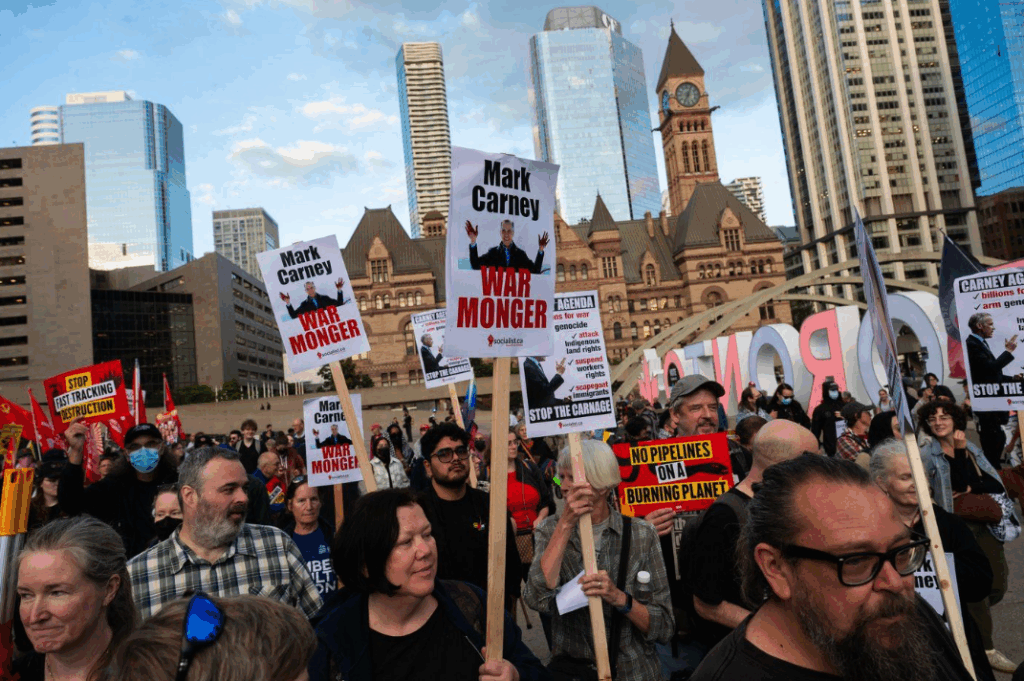
Prime Minister Mark Carney's high-stakes pitch for foreign investment attracted a diverse crowd of protesters in Toronto on September 14, 2026. Among the demonstrators were Indigenous leaders, environmental groups, and labor union representatives, all unified in opposition to Carney’s agenda aiming to attract $1 trillion in new investment over the next five years.
The event marked Canada's first-ever national investment summit, drawing hundreds of executives and global asset managers to the city. As the evening progressed, a rally organized by various advocacy groups developed into a larger protest movement against the summit's opening gala at the Art Gallery of Ontario (AGO), where attendees were met by a police barrier.
Protesters expressed their discontent with the idea of allowing CEOs to dictate Canada’s economic future, raising concerns about public services, environmental degradation, and the impact on Indigenous lands. Hailey Asquin, a representative from the group Common Horizon, articulated the aspirations of young workers looking for meaningful employment and desirable living conditions, emphasizing their opposition to investments in artificial intelligence, military projects, and fossil fuels.
Asquin asserted, “We want to be part of building a Canada that we can be proud of, one that is a superpower in things like renewable energy and health care.”
Tom Deadman, an Ottawa teacher, voiced concerns regarding Carney’s invitation to U.S. executives amidst a trade war with the United States, suggesting that it may compromise Canadian public services for American corporate interests. Kakeka ThunderSky from Poplar River First Nation also participated in the protest, highlighting worries about accelerated environmental assessments and government actions affecting First Nations' territories. ThunderSky stated, “I came here to let them know that our lands and our resources are not on the chopping block for their profit and their benefit.”
Wet'suwet'en Hereditary Chief Na'Moks remarked that Carney was leveraging U.S. trade tensions to gain support for major infrastructure projects, challenging the narrative that such developments were necessary for Canada’s economic defense against American policies.
The summit was poised to host influential figures in finance, including BlackRock CEO Larry Fink and Blackstone president Jon Gray. Kai Nagata, spokesperson for the environmental organization Dogwood, warned that allowing foreign billionaires to invest heavily in Canada could lead towards American economic dominance. “We need investments in this country,” he stated, “but that doesn't mean running back into the arms of the same American billionaires who are bankrolling the MAGA movement.”
Nik Barry-Shaw from the Council of Canadians criticized the summit as a front for privatization, suggesting it would not benefit ordinary Canadians or Indigenous communities affected by corporate activities. He lamented that Canadians were not being considered stakeholders in the investments being encouraged by Carney's administration.
During a reception with Canadian business leaders preceding the summit, Carney assured attendees that his government was collaborating with Indigenous groups to ensure that projects were constructed responsibly. His administration faced significant backlash from Indigenous leaders previously for pushing legislation that expedited major project development. There has been a shift in tone, with several Indigenous business leaders granted invitations to the reception.
Despite invitations extended to indigenous organization leaders, attendance was sparse; only Métis National Council President Victoria Pruden appeared. National Chief Cindy Woodhouse Nepinak from the Assembly of First Nations expressed through social media that it is vital for investors to engage directly with First Nations leaders to avoid future legal challenges associated with major projects. She emphasized that Indigenous communities should play a crucial role in the ownership and execution of projects affecting their lands.
Overall, the first national investment summit initiated by Prime Minister Carney was framed by significant activism from various community groups, reflecting deep-seated concerns within Canada regarding foreign investment strategies, Indigenous rights, and environmental preservation.








