

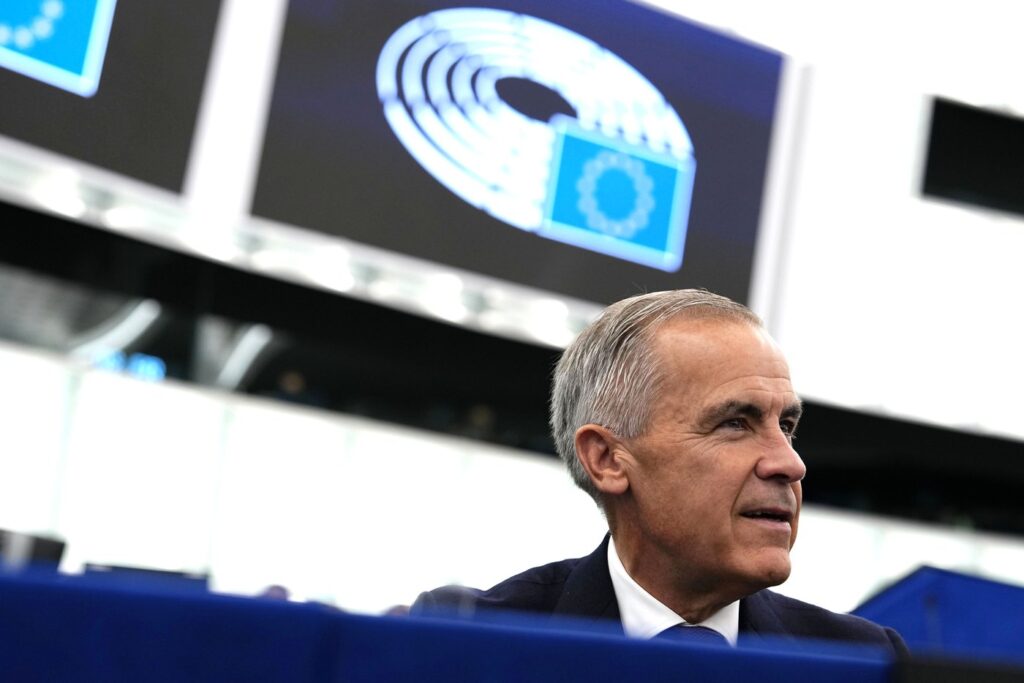
Prime Minister Mark Carney has announced that a proposal for an enhanced partnership between Canada and the European Union (EU) will soon be debated and subjected to a final vote in Parliament. This comes in light of a vision where Canada could become the EU’s first associate member, a concept that is still in its formative stages regarding specific implications and definitions.
During his address to the European Parliament, Carney referenced a recent speech by EU President Ursula von der Leyen, who emphasized the potential for deepening the relationship with Canada beyond mere trade partnerships. Carney expressed Canada's enthusiasm for this ambition, citing public opinion data that indicates strong support among Canadians for closer ties with Europe.
Carney's statements reflect a shift in tone from previous comments by Canadian officials who previously downplayed the significance of an "associate member" designation. While naming and defining this enhanced partnership are still pending, Carney underscored the necessity for collaboration between Canada and Europe in crucial areas such as critical minerals, defense, artificial intelligence, and energy security.
He advocated for initiatives that would enable youth to live, work, and study on both sides of the Atlantic, as well as the creation of an integrated market for financial services. Although he did not explicitly name U.S. President Donald Trump, Carney’s remarks implicitly addressed the frayed relations with the American administration. He reaffirmed Canada’s position as a steadfast ally, emphasizing shared values including rule of law, human dignity, individual freedom, and democracy.
Trump has openly criticized the prospect of Canada becoming an associate EU member, characterizing it as a hostile act and threatening “serious” tariffs against the EU should such a partnership advance. In response, Carney clarified the intent of the partnership, stating it is not aimed at establishing a rival bloc but rather at enhancing resilience so that no external power can infringe on Canada’s sovereignty or democratic freedoms.
Jonathan Wilkinson, Canada’s incoming ambassador to the EU, has indicated that both the name and details of the partnership are still being finalized, with an official announcement expected at the upcoming EU-Canada Summit in Montreal in October. He noted that any new labor mobility programs linked to this partnership would be limited and require discussions with provincial governments.
Before departing back to Ottawa, the Prime Minister will engage with reporters. Conservative Members of Parliament (MPs) have voiced concerns over the possible implications of associate membership, warning that it could threaten Canadian sovereignty. They have raised alarms about potential issues such as chaotic open borders, significant tax revenues being redirected to the EU, and job displacement for Canadians, although it remains unclear what specific changes would actually stem from such a membership.
Additionally, it is noteworthy that ten out of the 27 EU member states have yet to ratify a trade agreement with Canada that has already been provisionally in place for nine years. Meanwhile, Canadian businesses have not fully utilized the market access opportunities provided by this trade deal compared to the extent that European industries have accessed the Canadian market.








