

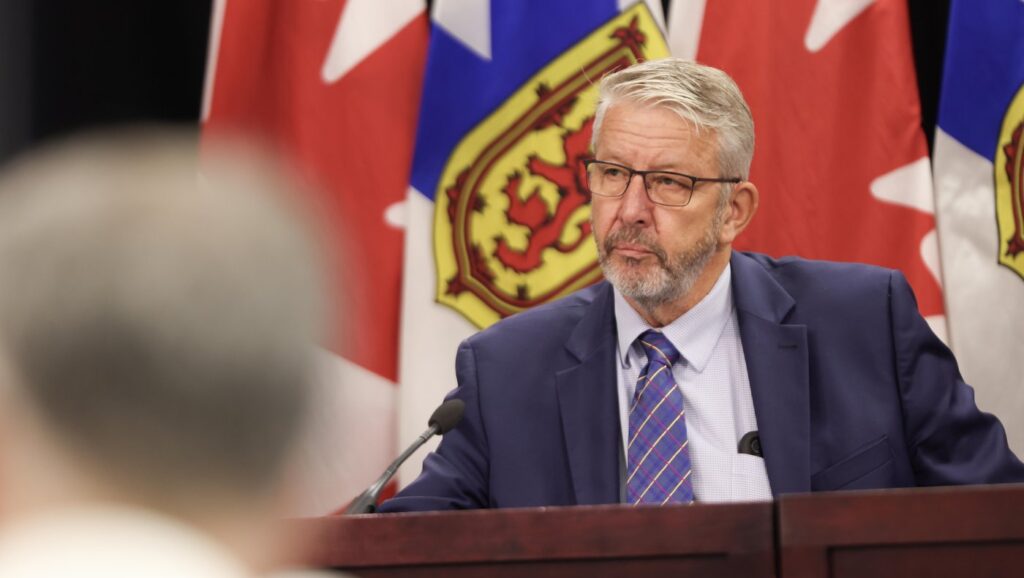
HALIFAX — The Nova Scotia government announced that it has exceeded the approved budget for the 2025-26 fiscal year by a record $1.9 billion. Finance Minister John Lohr attributed this excessive spending to various factors while highlighting the importance of flexibility in governance during a press conference held on Thursday.
Additional appropriations are defined as spending beyond the budget that is sanctioned by the cabinet without requiring legislative approval. Lohr emphasized that much of this additional funding was earmarked for health care services and senior citizen support. Among the notable expenditures, $40.4 million was allocated for public works projects, and another $13.8 million was set aside for emergency management in anticipation of the 2025 wildfire season.
Furthermore, the Department of Finance reported that around $420 million of the increased spending was designated for expected commitments that have not been finalized, thus limiting the government’s ability to publicly disclose specifics. Lohr refrained from linking this situation to a controversial wage restriction bill, known as Bill 148, which was enacted by former Liberal Premier Stephen McNeil in 2015 and later deemed unconstitutional by a Supreme Court judge in February.
Lohr indicated that a settlement regarding Bill 148 must be reached by February of the coming year but did not provide details on potential costs, citing ongoing legal proceedings. The fiscal year 2025-26 concluded with a notable deficit of $1.4 billion, as expenditures totaled $19.4 billion, eclipsing revenues that were slightly below $18 billion. This led to a net debt reaching $24.1 billion, with the government projecting a $1.44 billion deficit for the 2026-27 fiscal year.
The government’s financial strategies drew sharp criticism from opposition parties, who condemned the Progressive Conservative administration for its increasing deficit and reliance on off-budget expenditures. Interim Liberal leader Iain Rankin expressed that the recent budget update further exposed the government’s failure to manage spending effectively. He remarked that multiple departments consistently overspent without seeking legislative approval, describing this practice as unprecedented and reflecting a lack of accountability.
Lisa Lachance, the NDP finance critic, echoed similar concerns, asserting that the government’s approach has created a “generational hole” for Nova Scotians in terms of deficit spending and escalating debt. She pointed out that, despite significant financial investments, citizens are not receiving adequate services, particularly in sectors like health care and affordable housing, which remain in crisis.
In response to these challenges, Lohr acknowledged that affordability, housing, health, and senior care are pressing issues for Nova Scotians. He reiterated the government’s commitment to addressing these concerns while emphasizing the need for economic growth. Lohr expressed confidence in the province’s fundamentals for growth in various sectors, including defense, clean energy, housing, and natural resources.
This development was reported by The Canadian Press on September 24, 2026, with contributions from Lyndsay Armstrong.








