

U.S. President Donald Trump has intensified the trade war with Canada by implementing outright bans on imports of specific Canadian goods. These bans, which took effect at 12:01 a.m. ET on Tuesday, target various products, including alcoholic beverages, dairy byproducts, and motorcycles.
Dominic LeBlanc, Canada’s Trade Minister, emphasized that the government’s primary objective is to "protect and support Canadian workers, farmers, families, and businesses from these unjustified actions." This move marks another escalation in the ongoing trade conflict as the Trump administration pressures Canada for concessions in trade discussions.
Although the trade restrictions could significantly harm the affected industries, experts believe they are unlikely to greatly impact Canada's overall economic growth in the short term. Jacob Jensen, the director of trade policy at the American Action Forum think tank, estimated that the import bans would encompass approximately US$967 million worth of Canadian imports by 2025. Of this total, 87 percent consists of alcoholic beverages, which the U.S. targeted following some Canadian provinces' decision to retaliate by banning U.S. liquor from retail shelves.
The bans also extend to motorcycles, particularly affecting BRP Inc. in Quebec. The company confirmed that its three-wheel Can-Am Spyder and Canyon motorcycles are no longer eligible for importation into the U.S. However, BRP indicated that the impact of these restrictions is expected to be minimal until next year, as the company has already completed most of its production and shipments for the current season.
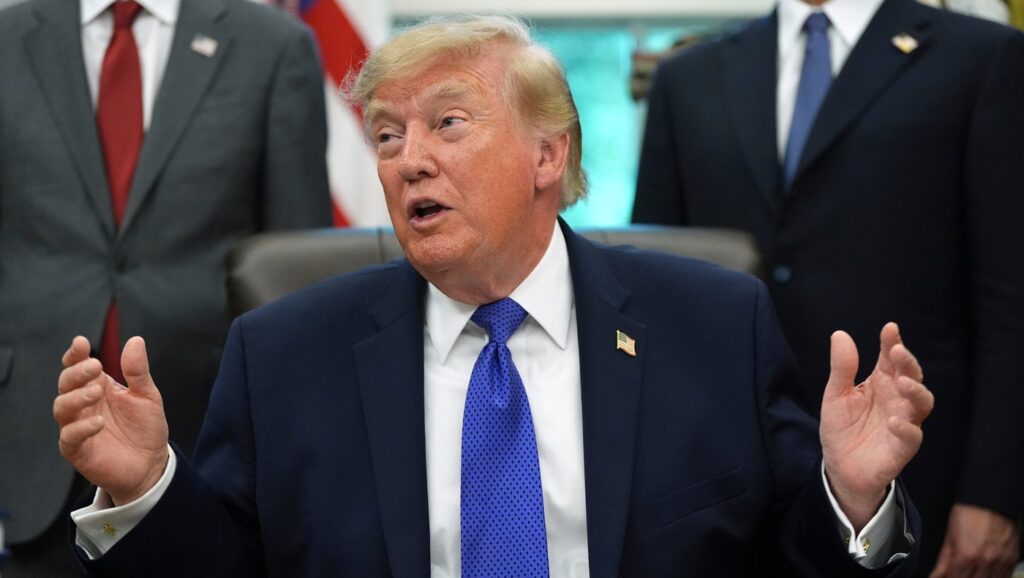
Recent negotiations between the two countries broke down last month, with both sides accusing one another of making eleventh-hour modifications to the terms. Trump expressed his expectation on Monday that Canada would return to negotiations soon, suggesting they would come with an apology. "I think what’s going to happen is over the next three or four weeks, they’re going to come to us and they’re gonna say, ‘We’re gonna get rid of all the tariffs,’" Trump stated during a press briefing at the Oval Office. He confidently asserted, "We’re going to win everything."
Following the collapse of talks in August, the United States imposed a series of 50 percent tariffs on a range of Canadian goods. In retaliation, Ottawa enacted its own tariffs a few weeks later. In response to the escalating tensions, Trump signed directives to have federal agencies exclude Canadian goods from procurement lists and to enforce the import bans that began recently.
Additionally, Trump has issued an executive order concerning the renaming of Lake Ontario to Lake America, further illustrating the contentious nature of the U.S.-Canada trade relationships. Canada is also facing 10 percent tariffs related to claims of forced labor within supply chains, although these tariffs do not apply to products that comply with the Canada-U.S.-Mexico Agreement (CUSMA).
Moreover, Canadian industries such as steel, aluminum, automobiles, and cabinetry are grappling with additional sector-specific tariffs levied by the Trump administration. These measures are indicative of the heightened animosity and the challenges within the trade dynamics between the neighboring countries.








