

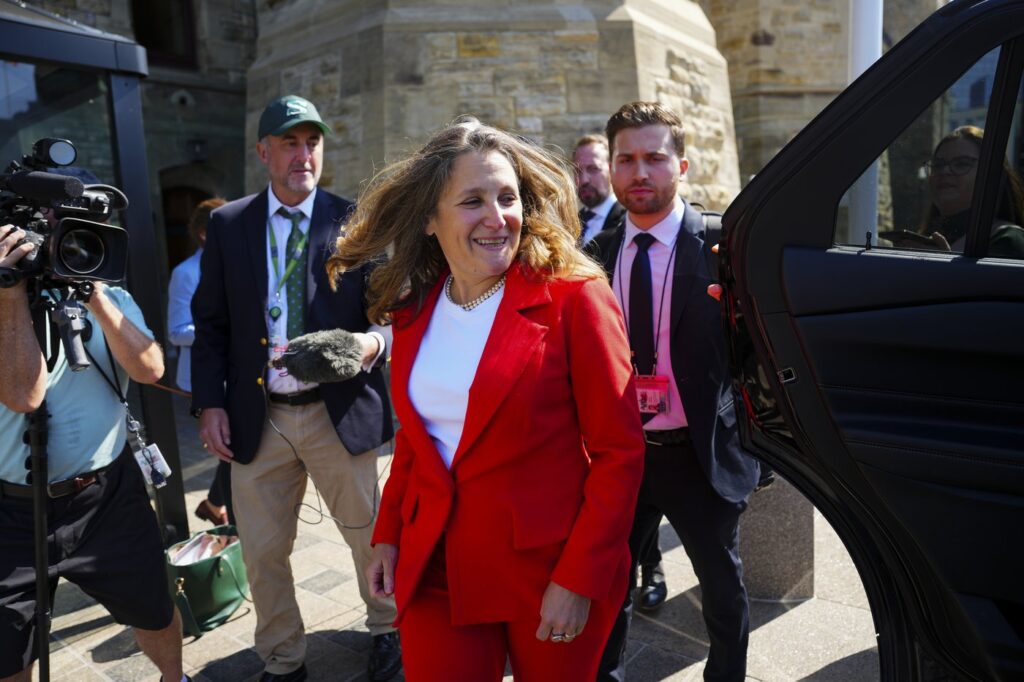
Former Deputy Prime Minister Chrystia Freeland emphasized the critical need for Canada to diversify its trade relationships, particularly away from the United States, citing national security concerns. During her address at the Council on Foreign Relations in New York on Thursday, Freeland articulated the risks associated with maintaining a close economic partnership with a nation that openly expresses intentions of dominance.
Freeland's remarks come in light of U.S. President Donald Trump's past comments regarding the possibility of Canada becoming the 51st state. While Trump has dismissed the notion of using military might to annex Canada, he has not ruled out the use of "economic force" to achieve his aims. This creates a precarious situation for Canada, as Freeland pointed out that even with a U.S. leader who champions free trade, relying heavily on a single partner is fraught with risk.
In her recently released book titled Unreliable Boyfriend, Freeland combines elements of international analysis regarding the shifting role of the United States with her own political memoir. The title of her book is drawn from a comment she made on an American talk show in February, where she characterized the U.S. as "not a very reliable boyfriend right now." This statement underscores her viewpoint that Canada's economic future should not be tethered to a partner that does not consistently prioritize mutual interests.
Freeland's assertions raise important questions about the sustainability of Canada-U.S. relations and the implications of economic reliance on a nation that has, at times, exhibited erratic political behavior. Her call for diversification is not merely a response to current political rhetoric but reflects a broader strategic outlook that advocates for a more resilient and independent Canadian economy.
As global markets increasingly shift and evolve, Freeland’s emphasis on diversifying trade avenues speaks to a fundamental restructuring of Canada’s economic strategies. The necessity of forging new partnerships and exploring alternative markets outside the U.S. is becoming ever more apparent, especially as geopolitical tensions rise. Freeland suggests that Canada must actively seek to mitigate risks by establishing a broader network of trade relationships, ensuring that the economy is insulated from the potential fallout of any singular partnership.
This dialogue about Canada’s economic independence is particularly poignant given the historical context of Canada-U.S. relations. The long-standing trade ties have been a cornerstone of Canada’s economic stability; however, this dependency may now be viewed through a lens of caution and strategy. Freeland's insights illuminate a growing recognition within Canadian leadership that robust economic policies must prioritize national security alongside economic prosperity.
In conclusion, Freeland's statements offer a compelling perspective on the future of Canadian trade and foreign policy. Her advocacy for a diversified approach appears not just as a reaction to current U.S. political climate but as a proactive strategy aimed at ensuring Canada's sovereignty in an increasingly complex global landscape.








