

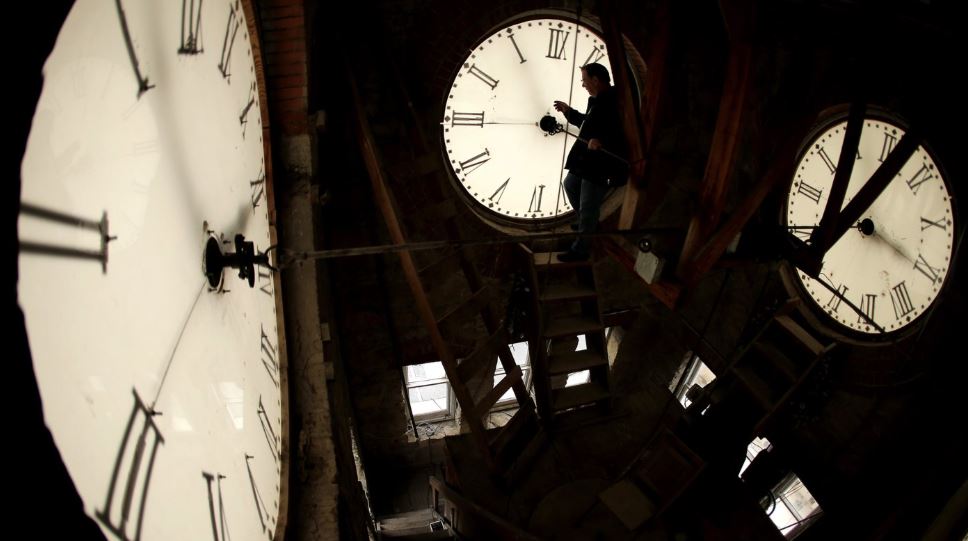
As Canadians prepare to wake up on Sunday, the seemingly straightforward question of “what time is it?” may not have a simple answer. Clocks will be set back one hour at 2 a.m. on November 1, marking the end of Daylight Saving Time (DST) and providing an extra hour of sleep for many. However, for some residents, this could be the last time they adjust their clocks.
Despite increasing calls to abolish the biannual time shift, most of Ontario will continue the tradition this weekend. In 2020, the province passed legislation aimed at permanently remaining on Daylight Saving Time, but this decision was contingent on both Quebec and New York State making the same switch simultaneously.
While the U.S. Senate has yet to address a House-passed bill that proposes to make DST permanent, Quebec's new government has indicated that it plans to eliminate the time change after this weekend. Should Quebec proceed, it would follow in the footsteps of British Columbia, Alberta, and Manitoba, which opted to forgo the time change earlier this year. The Northwest Territories also chose to maintain daylight time year-round.
Certain regions in northwestern Ontario will similarly continue with permanent daylight time to align with Manitoba’s decision. Saskatchewan has not faced time change confusion since it eliminated the practice in 1966, while the Yukon discontinued clock shifts in 2020.
The potential confusion regarding time zones is already a concern. “This coming winter is going to be very confusing for everybody,” said Dr. Patricia Lakin-Thomas, a professor of biology at York University. “I’ve got a map on my computer I have to keep checking like, ‘What time zone are you in?’”
Experts warn of potential “buyer’s remorse” in the spring when people experience the sun rising as late as 9 o’clock or later, leading to dissatisfaction with the new time arrangements. Daylight Saving Time was initially introduced in Canada during World War I to conserve energy by maximizing daylight hours, with the intention of reducing reliance on artificial lighting and heating.
Although the rationale for energy conservation is less pertinent today, many argue that the disruption to sleep schedules and the abrupt shift in daylight patterns now outweigh any benefits. Dr. Lakin-Thomas explains, “It’s very hard to get up in the dark in winter mornings... it’s like being jet-lagged all the time.” She emphasizes the need for morning sunlight for our biological clocks to reset effectively.
Research published in the Canadian Medical Association Journal suggests that health evidence favors moving to permanent standard time, as it better aligns with the body’s natural rhythm. “When we’re on Standard Time, we’re going to be getting up closer to sunrise, which would be the natural time to get up, and our body can adjust,” Lakin-Thomas noted.
Even if the extra hour of sleep is welcomed, experts warn that even a one-hour shift can disrupt circadian rhythms, potentially contributing to chronic diseases such as diabetes, cardiovascular issues, and even certain types of cancer. Lakin-Thomas argued that politicians presenting Daylight Saving Time as a positive measure overlook the fact that extending daylight into the afternoon means losing morning light.
This confusion has historical precedent; during the 1974 energy crisis, the United States attempted year-round Daylight Saving Time but repealed the measure after just one year due to widespread dissatisfaction. Dr. David Prerau, an authority on the topic, explained how initial support often wanes once people experience the realities of getting up in the dark. In retrospect, some regions allowed cities to choose their time, resulting in chaotic situations where neighboring areas had different clock settings.
Experts studying biological clocks and sleep are now advocating for a national strategy that aligns time zones more closely with natural time to create a more coherent system for the entire country.








