

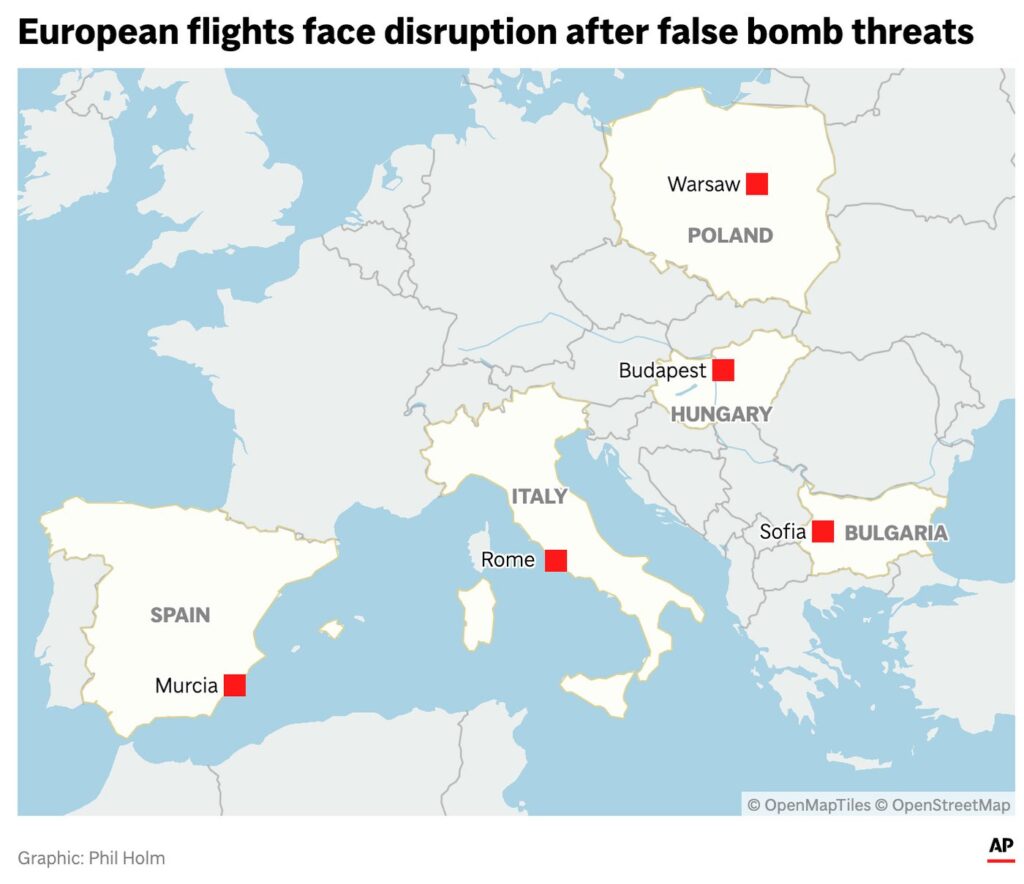
On Thursday, multiple flights across Europe faced bomb threats, resulting in emergency landings, security searches, and military escorts in France, Italy, and Bulgaria. British officials characterized these incidents as “malicious hoaxes” and highlighted a disturbing pattern of similar threats earlier in the week.
More than a dozen flights originating from cities such as Copenhagen, Dublin, Helsinki, Madrid, Milan, and Warsaw were disrupted by bomb threats. While most flights were diverted to alternative airports for safety, some managed to land at their intended destinations. So far, subsequent inspections of the aircraft have revealed no dangerous or suspicious materials.
Heidi Alexander, the British Transport Secretary, confirmed that these threats were widespread across Europe. Apostolos Tzitzikostas, the European Union’s Transport Commissioner, condemned any threat against civilians as “unacceptable” and noted that the EU’s executive branch was in close contact with the affected member states. He further stated, “It is too early to draw conclusions on whether the reported incidents are linked,” emphasizing that national investigations were still in progress.
In response to the threats, an EU-level information-sharing mechanism concerning aviation security has been activated. Tzitzikostas indicated that there is currently no evidence to suggest these incidents are the result of a cyberattack. The increase in such threats is particularly alarming given the current geopolitical tensions and disruptions, including attacks on supermarket refrigeration systems, drone incursions in Europe, and mysterious alerts on safety applications. Authorities have warned of the prevalence of hybrid threats.
Military Response to Bomb Threats
A flight from Dublin to Rome was diverted to a military airbase in Evreux, Normandy, due to a bomb threat. The French Prime Minister’s office reported that all 151 passengers and six crew members were safe, with military bomb disposal teams conducting an examination of the aircraft. Passengers were questioned in groups of ten while officials ensured the plane's security. The Aer Lingus flight, escorted by a French warplane, was facilitated through its emergency landing by Italian authorities who had alerted France of the threat.
Additionally, Italian air force jets were deployed to escort a Finnair flight from Helsinki to Rome after receiving a similar email threat. Landing without incident at Rome’s Leonardo da Vinci airport around 9:30 a.m., police bomb disposal experts performed an inspection and found no explosives onboard. Finnair classified its flights as experiencing “unfounded hoax bomb scares,” confirming safe operations following the inspections.
Hoaxes Impacting Various Airlines
Greece's Aegean Airlines reported receiving bomb threats involving two of its flights—one from Thessaloniki to Milan and another from Athens to Vienna. After confirming the threats were baseless, both flights were cleared to depart. Czech authorities mentioned that searches of four planes landing in Prague after bomb threats turned up no credible threats, although security measures were taken as a precaution.
A LOT Polish Airlines flight traveling from Warsaw to Brussels successfully completed its journey without incident, while a Wizz Air flight from Milan to Bucharest also landed safely following a bomb threat. A flight intended for Warsaw was redirected to Vienna due to a vague email threat but ultimately continued on to its original destination. In a similar vein, a LOT flight from Warsaw faced security checks after a reported threat at Chopin Airport, resulting in temporary runway closures while security protocols were enacted.
Furthermore, three Ryanair flights bound for Sofia, Bulgaria, were forced to make emergency landings because of bomb threats. Two of these flights, originating from Copenhagen and Madrid, landed safely at Vasil Levski Airport. The third, coming from London Stansted, was diverted and safely landed at Plovdiv, Bulgaria's second-largest city. Military jets escorted these planes through Bulgarian airspace, as confirmed by the Ministry of Defense.
Pattern of Hoaxes Continues
These recent bomb threats are not isolated incidents. Earlier in the week, multiple flights, including those of LOT, Scandinavian Airlines, Wizz Air, and Ryanair, also received hoax bomb threats that resulted in similar emergency protocols being activated. Notably, a plane en route to Bulgaria was diverted to Hungary after receiving a bomb threat during flight, although no injuries were reported in any of these incidents.








