
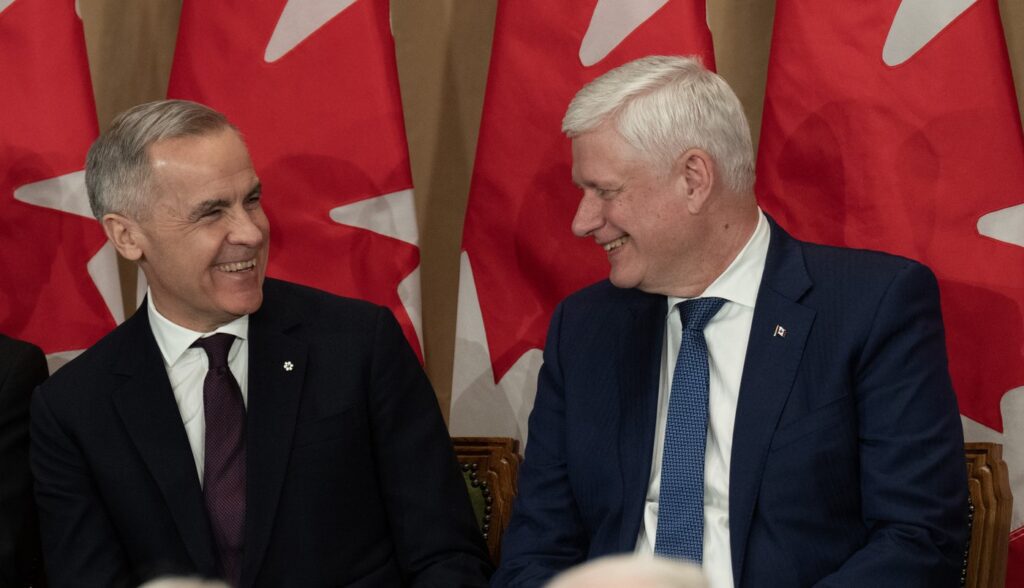
OTTAWA – Former Prime Minister Stephen Harper reveals in his new memoir, “Here for Canada: Memoirs of the 22nd Prime Minister,” that he had approached Mark Carney, the then-governor of the Bank of Canada, in 2012 with an offer to join his Conservative government, although not immediately as finance minister. Harper clarifies that while the finance minister position was occupied at the time, he indicated that Carney would be a primary candidate for the role should it become available.
Harper wrote, “Obviously, I did not offer him the post of minister of finance, as it was then not available. However, I indicated that, if he chose to join the government, he would be the leading candidate should the post come open.” Carney recounted during a CBC interview that Harper had indeed asked him to consider the finance minister role but felt it would not be appropriate to transition directly from the governorship of the Bank of Canada to partisan politics.
In his memoir, Harper reflects on Carney’s effectiveness as bank governor but notes that then-finance minister Jim Flaherty expressed growing concerns that Carney was considering political ambitions, specifically a potential bid for leadership of the Liberal Party, which was rumored at that time. Harper described this worry as a “serious concern” for his government.
To address these concerns, Harper consulted his chief of staff, Nigel Wright, who proposed that offering Carney a position in the government could either secure his expertise or eliminate any speculation regarding Carney’s ambitions for a Liberal leadership role. Ultimately, Harper reveals that Carney took time to consider the offer but chose to remain out of partisan politics, subsequently moving on to become governor of the Bank of England.
The mention of Carney is just one small facet of Harper’s nearly 650-page memoir, which chronicles his political journey from the unification of the right to ten years in government. The memoir also delves into Harper's final election campaign in 2015, detailing his reflections on significant decisions he faced during his leadership.
Harper details his internal struggles about potentially stepping down from leadership in the summer of 2014 to rejuvenate the party, ultimately deciding to lead through what he anticipated would be a challenging election until after the 150th anniversary of Canadian Confederation on July 1, 2017. He indicated that he planned to call for a leadership race shortly thereafter.
Moreover, the memoir provides insight into some controversial moments from the 2015 election. Harper recounted his reaction to the introduction of a “barbaric cultural practices hotline,” a policy he only learned about during preparations for a French leaders' debate in Montreal. Harper expressed his frustration, stating he had not been consulted on the policy yet was expected to defend it on the campaign trail.
Spanning decades of Canadian political history, Harper's book captures multiple pivotal moments, including his face-to-face confrontations with Russian President Vladimir Putin at G8 meetings, his response during the 2008 parliamentary crisis, and his personal experience during the 2014 shooting on Parliament Hill, which occurred when he was without his usual protective detail.
In addition to recalling his time in office, Harper shares his present views, particularly regarding the World Economic Forum (WEF). He mentions having attended the WEF twice during his tenure but now stands against Canada's participation, labeling it as a venue that has shifted to promote “narrow interests” of “globalist, elitist” attendees.