

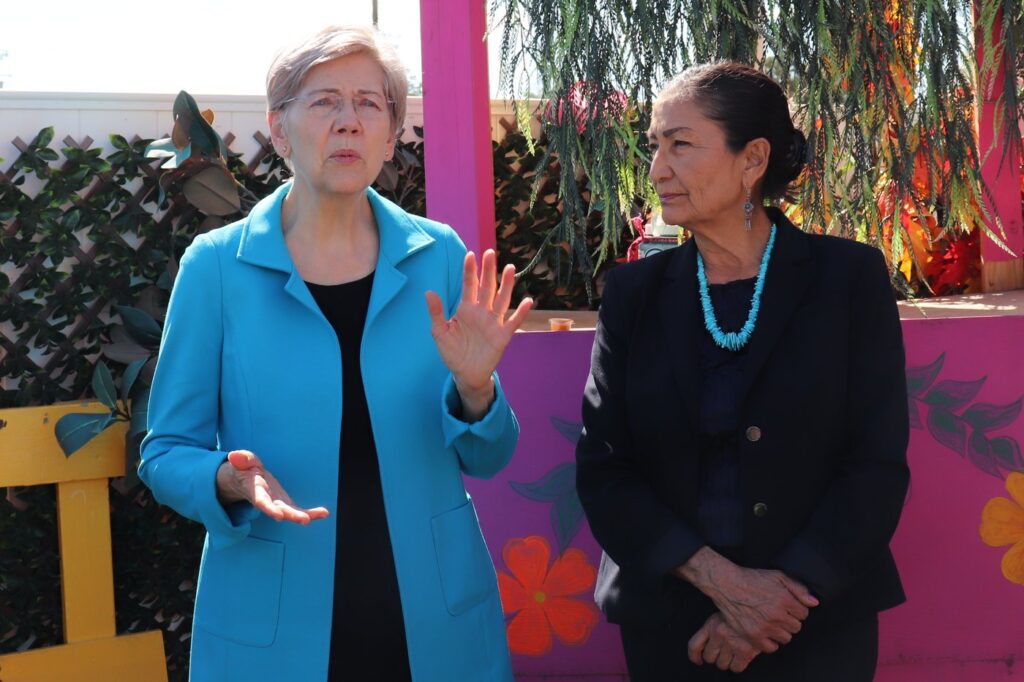
The midterm elections are notable for featuring one of the most diverse groups of candidates in recent history for both the Democratic and Republican parties, paving the way for a potential wave of landmark leadership firsts across the United States. Voters on Tuesday may elevate several historic candidates to office, including the first Native American female governor, the first Native American women senators, the first Black female governor, the first openly gay U.S. senator, and the first Muslim U.S. senator, among other significant milestones. While many of these groundbreaking candidates are Democrats, the Republican Party also has opportunities to make history.
Some of these candidates have chosen to focus less on the historic implications of their race, gender, religion, or sexual orientation, yet advocates for voting rights are celebrating the expansion of the electorate. Alexis Anderson-Reed, president and CEO of State Voices, pointed out via email that “These firsts show how our country is changing.” She emphasized that years of hard work by people of color and LGBTQ+ communities are leading to these potential victories.
First Native American Female Governor
Deb Haaland, a Democrat and citizen of the Laguna Pueblo, made history in 2018 by becoming one of the first two Native American women elected to Congress and later served as the first Native American cabinet secretary under President Joe Biden. In the upcoming elections, Haaland is poised to become the first Native American female governor if she defeats Republican Gregg Hull in New Mexico. It’s noteworthy that Oklahoma is the only state to have had a tribal citizen as governor, with Democrat Johnston Murray serving in the 1950s.
First Native Woman Senators
Mary Peltola, a Yup’ik Democrat, previously made headlines as the first Alaska Native in the U.S. House of Representatives. She is now attempting to make history again by running for Senate against Republican incumbent Dan Sullivan. Additionally, Minnesota's Lt. Gov. Peggy Flanagan, a progressive Democrat and citizen of the White Earth Band of Ojibwe, is contesting against Michele Tafoya. Should Tafoya win, she would make history as the first Republican of Latina heritage elected to the U.S. Senate.
First Black Female Governor
In an unprecedented move, Democrat Keisha Lance Bottoms and Republican Lisa Demuth could end over 250 years without a Black woman serving as a state governor. Bottoms, the former mayor of Atlanta, is running against billionaire businessman Rick Jackson in Georgia. If successful, she would also be the state’s first governor of color. In Minnesota, Demuth is challenging incumbent U.S. Senator Amy Klobuchar, ensuring that regardless of the outcome, the state will have its first female governor.
First Muslim U.S. Senator
Abdul El-Sayed, a progressive Democrat from Michigan, is positioned to become the first Muslim American to serve in the U.S. Senate. He faces a challenging race against Republican Mike Rogers. Throughout his campaign, El-Sayed has faced Islamophobic attacks, with some national figures suggesting he is un-American or supports terrorism, which he and his supporters vehemently denounce.
First Openly Gay U.S. Senator
If elected, Democratic Rep. Chris Pappas could make history as the country’s first openly gay senator while competing in New Hampshire against former Republican Senator John E. Sununu. Pappas previously made history as the first openly gay member of Congress in 2018 and has noted that his sexual orientation has not been a significant conversation point in the campaign.
Potential Surge of Black Governors
The U.S. could significantly increase its count of elected Black governors from three to as many as ten after this election cycle. Maryland’s Wes Moore, currently the only Black governor, is expected to be re-elected. Other states witnessing historical contests include Georgia, Florida, Wisconsin, Nevada, South Carolina, and Michigan, potentially welcoming new Black governors into their ranks.
Record Year for Women Candidates
This midterm election has seen a record number of women running for state and federal offices. The Democrats have increased their candidate count to 19 women vying for governor, while the Republicans are fielding seven. Notable races include Jerri Green in Tennessee attempting to become the state's first female governor, and potential firsts for Asian-American women governors in Vermont and Oklahoma.
Additionally, nearly 300 women, including incumbents, are running for the U.S. Senate and House, as reported by the Center for American Women and Politics. If Democrat Juliana Stratton wins her Senate race in Illinois, she and fellow Democrat Tammy Duckworth would make Illinois the first state with two female senators of color.








