

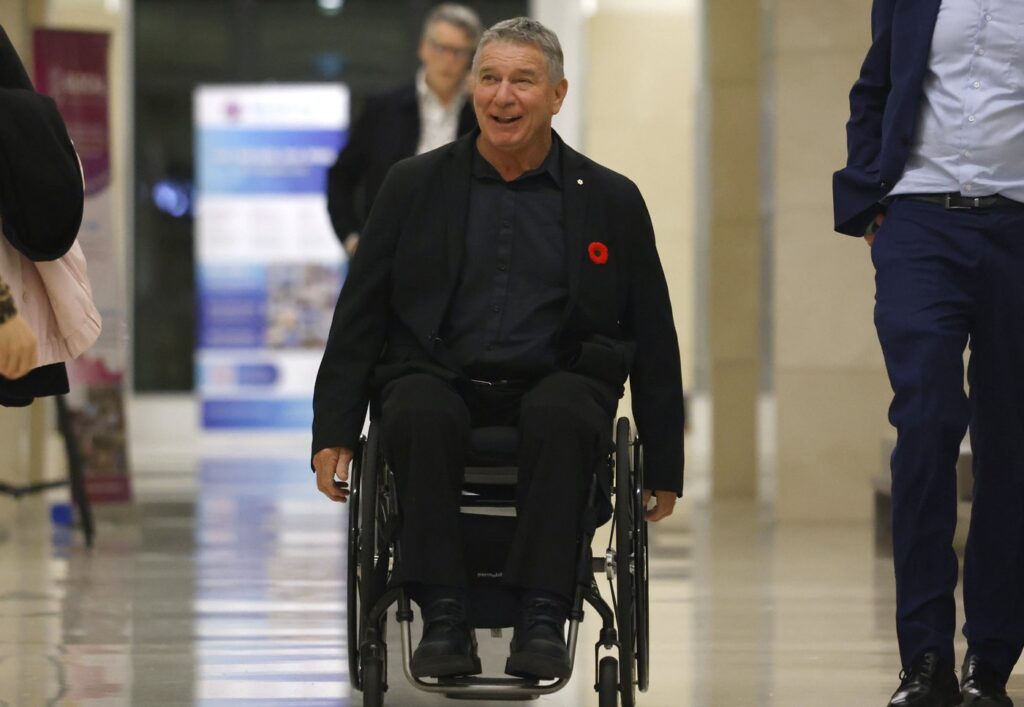
OTTAWA – In 1985, Canadian athlete and activist Rick Hansen embarked on a significant world tour, wheeling over 40,000 kilometers across 34 countries. His mission was to promote inclusion and address the barriers faced by individuals with disabilities. Hansen's journey has been a pivotal moment in the fight for accessibility and inclusion in Canada.
More than four decades later, Hansen acknowledges that while substantial progress has been made, considerable work remains to be done. A screening of the documentary film "Man In Motion: The Rick Hansen Story," which premiered at the Toronto International Film Festival in September, was held on Parliament Hill in Ottawa on Wednesday. This event commemorated the moment over 40 years ago when Hansen crossed the bridge from Hull, Quebec, into Ottawa, where he was met by thousands who celebrated his revolutionary journey.
At that time, then-Prime Minister Brian Mulroney contributed $1 million on behalf of Canadians to support Hansen's tour, which ultimately raised $26 million. Reflecting on his experiences, Hansen remarked at the Ottawa event, "The moment here in Ottawa was a highlight I’ll never forget. While we’ve come a long way in the dream of an accessible and inclusive Canada, we have a long way to go, and we have to accelerate our progress."
After suffering paralysis from the waist down due to a truck accident, Hansen became a prominent figure in the disability rights movement. He highlighted that although awareness surrounding disabilities has grown, multiple barriers persist. "The built environment is one of the most urgent priorities," he stated. Hansen, who has won 19 wheelchair marathons and earned three gold medals at the Paralympic Games, emphasized the need for a shift in how we approach building and designing spaces. "We’re building things for the future of our country, and unless we change the way we approach building, we are building in barriers that are not sustainable," he cautioned.
According to the 2022 Canadian Survey on Disability, 8 million Canadians, or more than 27 percent of the population, live with a disability. Hansen pointed out that the number of individuals who either know or live with someone with a disability is significantly higher. He remarked, "It’s the only club that eventually everyone is going to join and be part of, so this is a big deal, and we have to wake up to the importance of this and start to reflect what Canadians really want." He further asserted that "incremental progress isn’t acceptable anymore. We have to accelerate."
Hansen advocated for sustained programs supporting accessibility, urging governments to ensure that "every dollar is spent wisely to ensure that everything becomes more meaningfully accessible and inclusive." He firmly believes, "If we do that, it’s a marginal cost, and it’s of massive financial and social benefit."
In 2019, the Canadian government adopted the Accessible Canada Act, which pledges to make Canada barrier-free by 2040. Hansen underlined that achieving accessibility is a continuous process, stating, "Accessibility and inclusion isn’t just about the things we build; it’s about the people and how we engage and connect and ensure that no one gets left behind."
This message serves as a reminder of the ongoing efforts required to foster a more inclusive society for all Canadians, particularly those with disabilities.








