

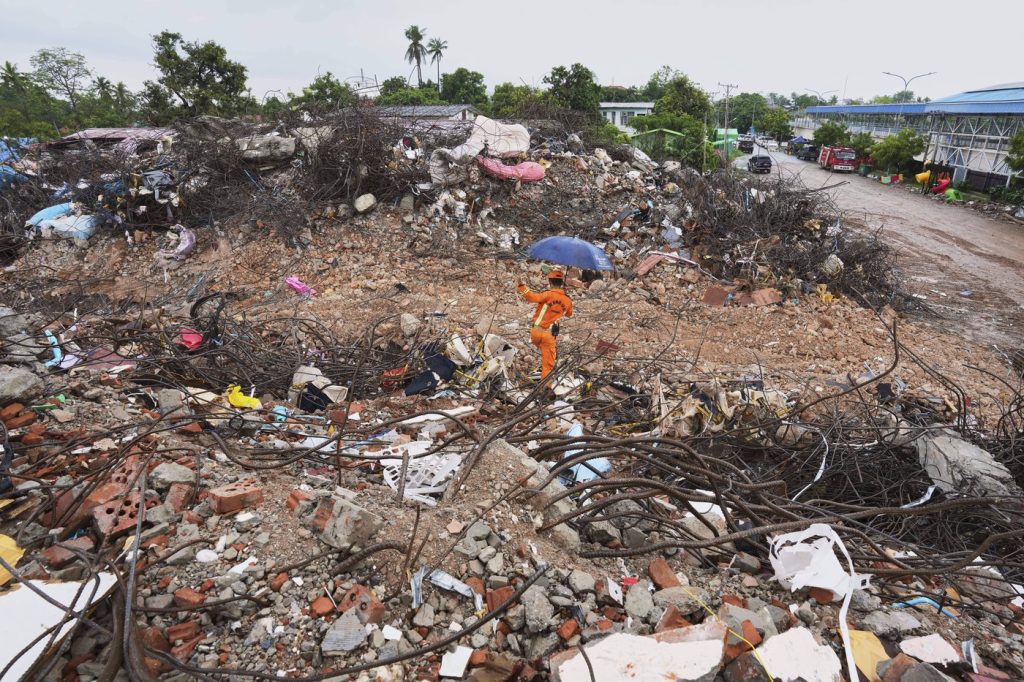
In Mandalay, Myanmar, Thae Mama Swe has been observing the ongoing recovery efforts following a devastating 7.7-magnitude earthquake that struck on March 28. This disaster caused the collapse of a 10-story condominium and office building, resulting in nearly 200 confirmed fatalities, including her son, whose body has yet to be recovered. For five months, she has stood atop the rubble, expressing her grief and desperation in the face of unyielding rain.
The earthquake's aftermath has left more than 3,800 people dead and exacerbated the nation's already dire humanitarian crisis, as Myanmar is entrenched in a civil war. This ongoing conflict involves armed militias and pro-democracy forces fighting against the military government that overthrew the democratically elected government of Aung San Suu Kyi in 2021. The United Nations has indicated that, even before the earthquake, over 3.5 million people were displaced and approximately 20 million in need of assistance.
While a ceasefire was initially declared following the earthquake, military airstrikes and artillery attacks have persisted, often targeting civilian areas affected by the disaster. Tom Andrews, the U.N.-appointed human rights expert for Myanmar, highlighted that these attacks have severely hindered humanitarian aid delivery. Meanwhile, insurgent groups have continued to launch strikes against military targets, complicating the situation further.
The military, known as the Tatmadaw, claims that airstrikes are conducted in self-defense against attacks by militia groups, denying any obstruction of aid. However, the U.N. Office of the High Commissioner for Human Rights reported that the military continues to restrict assistance in areas beyond its control. Humanitarian organizations working in Myanmar, dependent on regime permission, have been tight-lipped about the ongoing situation.
Infrastructure destruction has impeded recovery efforts, particularly the rebuilding of roads and bridges essential for delivering aid to the hardest-hit areas. With around 29,000 homes, 5,000 pagodas, and 43 bridges reported as either completely or partially destroyed, the challenge of recovery has only intensified. The military has attempted to construct temporary structures to facilitate transportation, but violence from pro-democracy forces remains a threat along major routes.
Despite Myanmar's ongoing trade with countries like China and Russia, Western sanctions have further strained its economy, limiting resources available for reconstruction. Cuts to foreign aid under previous U.S. administrations have exacerbated the situation, depriving humanitarian organizations of necessary logistical support crucial for effective aid distribution.
In Naypyitaw, the parliament complex is seeing urgent repairs, with nearly 500 workers striving to fix five key buildings damaged by the quake, ahead of elections scheduled for the end of December. However, many critics view these elections as an attempt by the military to legitimize its power after the ousting of the National League for Democracy party following the 2021 coup.
As reconstruction efforts continue, officials emphasize the need for international assistance in building earthquake-resistant structures. Aye Min Thu, chief of the disaster management agency in Mandalay, expressed hope for constructing a resilient society to safeguard future generations against similar devastation.
At the site of the collapsed hospital in Mandalay, engineer Thin Thin Swe recalls losing two colleagues in the disaster and hopes for a decision on whether the facility will be rebuilt. Among the wreckage, Thae Mama Swe clings to hope for the recovery of her son's body, viewing it as crucial for completing the necessary Buddhist rites for his soul's peace. As rescue teams navigate the slow recovery process, the emotional toll on families like Thae Mama Swe's remains profound, characterized by grief, guilt, and an enduring hope for closure.








