

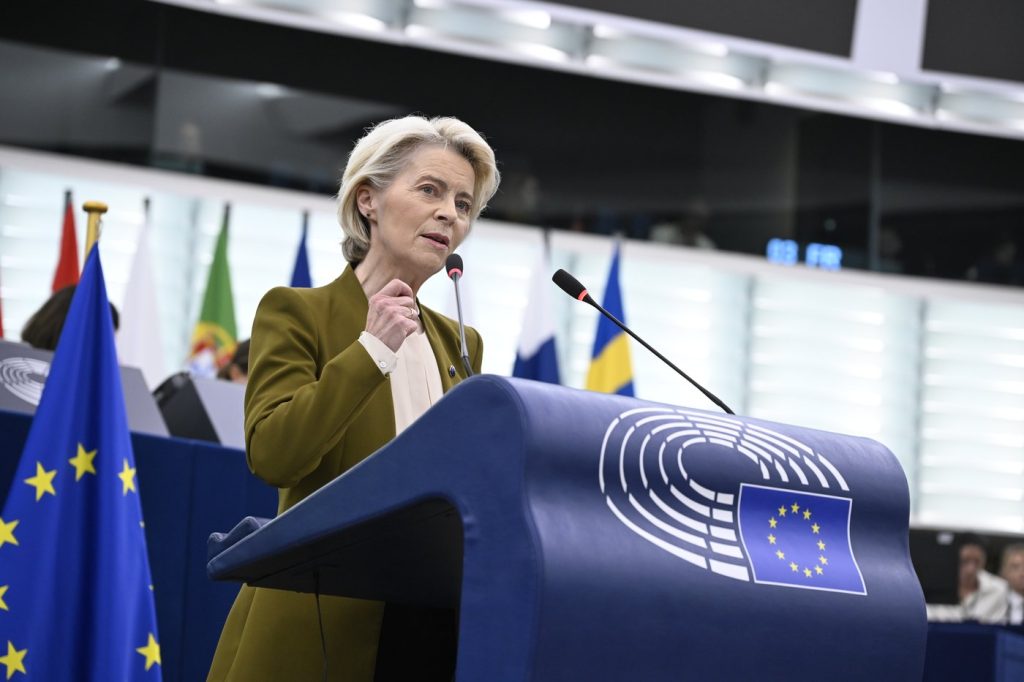
European Commission President Ursula von der Leyen announced her intention to pursue sanctions and a partial trade suspension against Israel due to the ongoing war in Gaza. This plan emerges amidst significant divisions within the 27-nation European Union regarding its stance on Israel and the Palestinians, making it uncertain whether a majority will support these proposed measures.
In related developments, emergency personnel in Qatar were engaged in recovery efforts following an Israeli airstrike targeting Hamas' political leaders who were convened in the country to discuss a U.S. proposal for a ceasefire in Gaza. The strike, which occurred on Tuesday, received condemnation from numerous countries across the Middle East and beyond. While Hamas reported that all its senior leaders survived the attack, five lower-ranked members were killed. Additionally, Qatar confirmed that a member of its Internal Security Force lost their life in the incident, with others sustaining injuries.
Von der Leyen's statement emphasized her plan to freeze the European Union's bilateral support to Israel, a decision that would not necessitate approval from the 27 member states. The exact amount of financial assistance provided by the European Commission to Israel is unclear, as is the intended use of those funds. Von der Leyen assured that this suspension of support would not hinder cooperation with Israeli civil society organizations or Yad Vashem, the Holocaust memorial.
Experts have warned that the Israeli attack on Hamas in Qatar could jeopardize potential negotiations for a ceasefire and Israel's ongoing diplomatic efforts with Gulf Arab states. According to a report from The Soufan Center, the strike carries significant strategic consequences: by targeting a member of the Gulf Cooperation Council, Israel risks damaging the normalization efforts established by the Abraham Accords, which facilitated diplomatic recognition between Israel and the United Arab Emirates in 2020. The center raised concerns regarding the implications for future mediation efforts if states like Qatar are penalized for their role in such incidents.
Von der Leyen also expressed her concern over the humanitarian situation in Gaza, highlighting the suffering of children and families. She strongly condemned the use of famine as a weapon of war, calling for an immediate cessation of violence. Her remarks were met with applause during a session of the European Parliament in Strasbourg, France. Moreover, she revealed plans for the commission to initiate a Palestine donor group aimed at addressing the future reconstruction of Gaza.
In a separate reaction, Qatar's local media remained aligned with governmental narratives following the Israeli attack, which resulted in the deaths of at least six people within a diplomatic and educational neighborhood of Doha. The emir of Qatar, Sheikh Tamim bin Hamad Al Thani, was reported to have had conversations with various world leaders, including U.S. President Donald Trump, where he condemned the attack and highlighted Israel's policy of aggression.
Sheikh Mohammed bin Abdulrahman Al Thani, Qatar's prime minister and foreign minister, indicated that Israeli weaponry used in the strike evaded radar detection, implying that the missiles were launched from a distance, likely over the Persian Gulf. U.S. officials stated they had warned Qatar prior to the strike; however, this claim was challenged by Qatari officials who stated that notification was received too late to be effective.
In international reactions, Japan's Chief Cabinet Secretary Yoshimasa Hayashi strongly condemned Israel's actions, viewing them as detrimental to the ongoing diplomatic efforts aimed at achieving ceasefire and hostage release around Gaza. He urged all parties to avoid actions that could further destabilize the region.








